
Orthopedic surgeon Dalip Pelinkovic, M.D., with Great River Medical Center in West Burlington, Iowa, performed the first-in-man implant of CTL Amedica’s Minimally Invasive Flex Tower during a lumbar back surgery.
First-in-Man for Minimally Invasive Flex Tower
2 min read Premium comments
Secondary#ctlamedica#dalippelinkovic#minimallyinvasiveflextower
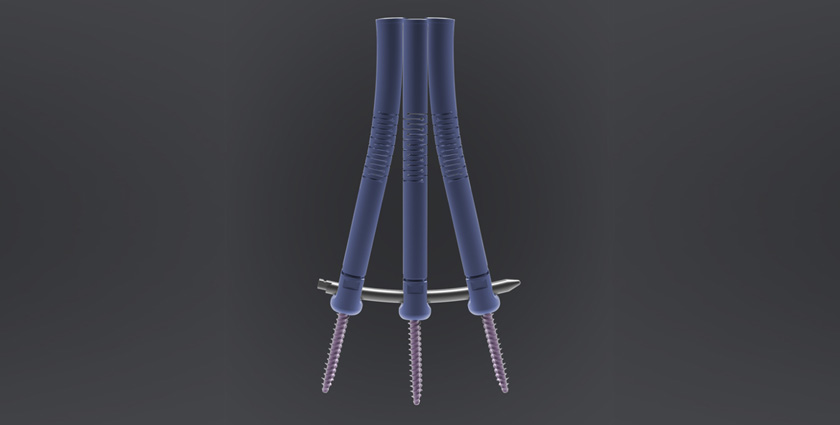
The detachable, Minimally Invasive Flex Tower, which is currently in beta launch, is “designed with a proprietary, mid-tower, accordion hinge that allows the tower to bend and contour in crowded surgical sites, mitigating tab interference while still maintaining construct integrity throughout the procedure. This flexibility enables the surgeon to navigate MIS [minimally invasive spine] lumbar procedures more freely.”
“For this case, I utilized the flex tower at the lower lumbar levels because it provided greater flexibility. Uniquely, it accommodates the trajectory of pedicle screws in challenging anatomy without interference. It’s compatible with the easy-to-load screw bodies, has better functionality with MIS retractors, and gives surgeons the option to attach tabs pre-op or in situ,” noted Dr. Pelinkovic.
OTW asked for details on the development of the Minimally Invasive Flex Tower and Daniel Chon, CTL Amedica president and CEO, explained. “During multiple surgeon visits to our home base in Addison, Texas, we continued to hear stories about tower interference during minimally invasive surgery, from minimally invasive screw systems across the industry. We thought, ‘Although this might not seem like a huge issue in all minimally invasive surgeries, sometimes solving the small frustrations can make such a big difference for our surgeons.’”
“And so our team got to work on a comprehensive solution. Our PICASSO II Minimally Invasive Pedicle Fixation Platform functioned as the starting point for this new design, and we were able to incorporate the proprietary hinge design into the screw tower, while still holding on to the many benefits the original tower design offered. In this way, we were able to offer the best of both worlds, while solving a frustration many surgeons experience on a daily basis during their minimally invasive cases.”
Listening to Surgeons
Daniel Chon: “The flex towers were specifically engineered to solve the problem of tower interference. Through surgeon feedback, we found that this was a common issue during MIS surgery, particularly on lower lumbar levels. We also came across instances in which tower interference had the potential to prevent a set screw to fully seat to the rod, which would give a sense of ‘false locking.’ Our R&D department was able to develop a solution to this problem through the proprietary mid-tower accordion hinge design, which allows the tower to maneuver in situ, inevitably solving the interference issue during MIS cases.
Revamping the Surgical Experience
“Problem solving is our business,” said Chon to OTW. “It’s at the core of what we do as an organization. We continually strive to provide efficient solutions for surgeons, and ultimately their patients. The flex towers were designed to mitigate several issues consistent with lumbar MIS surgery, reducing surgeon frustration and allowing for a more streamlined experience in the operating room. At the end of the day, it’s about creating an improved surgical experience for both surgeon and patient, and we are thrilled to add the flex towers to our portfolio.”
Author
React:
Discussion
This is a fascinating development. In my practice we've seen similar outcomes with the revised protocol. The key differentiator seems to be patient selection criteria. Has anyone else noticed the correlation with BMI thresholds?
Great point. I'd push back slightly on the conclusion, the sample size in the cited study is too small to draw population-level inferences. That said, the directional signal is compelling and worth a larger RCT.
We implemented a similar approach last year. Early results are promising but we're still gathering 12-month follow-up data. Happy to share our protocol if anyone is interested.
Join the conversation
Orthopedic professionals are discussing this. Sign in and upgrade to read every comment and add your voice.