
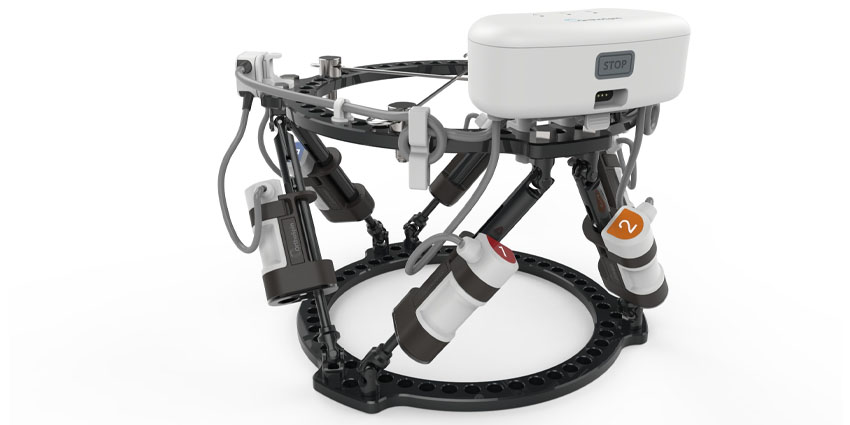
The FDA has cleared OrthoSpin Ltd.’s AutoStrut G2 System, a second generation robotic digitally enabled external fixation device. OrthoSpin’s first robotic system was cleared in August 2019.
FDA Clears 2nd Generation Robotic Fixation System
2 min read Premium comments
Secondary#robotics#fdaclearance#fracturefixation
Robotic Fixation
“External fixation devices are a common treatment for bone lengthening, setting complex fractures, and correcting deformities. Patient compliance and a lack of real-time feedback for physician follow-up are substantial challenges,” according to a company press release. In the old pre-robotic days, external fixation devices had to be turned manually by the patient. In fact, up to 2,100 manual turns for an average patient with weekly visits to the doctor’s office.
But that changed when robotic fixation came along.
The OrthoSpin external ring fixation system makes pre-programmed adjustments automatically without the need for patient involvement. Integrated software lets the physician track and chart patient progress and immediately adjust treatment programs. “The second-generation system,” according to the company, “is more user friendly, covers all strut range sizes and is lighter by 20%” than the original.
Indications
According to FDA clearance documents, the system is indicated for the following treatments in adults, and in both children (3-12) and adolescents (12-21) in which growth plates have fused and will not be crossed with hardware:
- fracture fixation (open and closed)
- pseudoarthrosis of long bones
- limb lengthening (epiphyseal or metaphyseal distraction)
- joint arthrodesis
- infected fractures or nonunions
- correction of bony or soft tissue deformities
- correction of segmental defects.
AutoStrut G2 System
The AutoStrut G2 consists of a control system, software, and six length-adjustable struts powered by a motor and used in conjunction with the DePuy Synthes MAXFRAME multi-axial correction system, including all its parts and software, except that the MAXFRAME struts are substituted with the AutoStrut G2 motorized struts.
The struts are provided in three (3) sizes, large, medium and small corresponding to the MAXFRAME and should be steam sterilized by the user prior to use.
The MAXFRAME, cleared in 2016, comes with software that generates a treatment plan for the patient, detailing how much each strut should be extended after a given amount of time. The output of this software, state FDA documents, is downloaded to the AutoStrut G2 control box which will then automatically extend the motorized struts the predetermined amount at the prespecified times. As one of the predicates, the MAXFRAME used the Synthes manual distraction oseogenesis system, which had been cleared in May 2010.
OrthoSpin Chairman Assaf Dekel said, “We believe that robotic automation will revolutionize the hexapod bone deformity market and we are proud to play a part in this transformation.”
The company believes future applications for the system include the ability to follow and modify treatment plans via smart phones and cloud-based AI algorithms treatment plans based on computerized historical data.
OrthoSpin
The Yokneam, Israeli-based OrthoSpin Ltd. was founded in December 2014 to offer a robotic, digitally enabled external fixation system for orthopedic treatments. Johnson & Johnson led an investment round of $3 million for OrthoSpin’s system in 2018.
A video showing the system in action is available on YouTube.
Author
React:
Discussion
This is a fascinating development. In my practice we've seen similar outcomes with the revised protocol. The key differentiator seems to be patient selection criteria. Has anyone else noticed the correlation with BMI thresholds?
Great point. I'd push back slightly on the conclusion, the sample size in the cited study is too small to draw population-level inferences. That said, the directional signal is compelling and worth a larger RCT.
We implemented a similar approach last year. Early results are promising but we're still gathering 12-month follow-up data. Happy to share our protocol if anyone is interested.
Join the conversation
Orthopedic professionals are discussing this. Sign in and upgrade to read every comment and add your voice.