
OnlineDoctor recently published a report exploring the rise of telehealth in the wake of the coronavirus pandemic.
What Is the Future of Telehealth? New Report Has Data
2 min read Premium comments
Secondary#telehealth#googletrends#onlinedoctor
OnlineDoctor focuses on the care that patients receive through online medical care. The company’s mission is to cover this emerging industry of online health services and technology and “provide the most up-to-date information about the services and companies available so that consumers can make informed decisions about their health.”
In the report, OnlineDoctor utilized data from Google Trends to track the rise in telehealth. For those unfamiliar with Google Trends, OnlineDoctor explained how the tool works. Notably, “Google normalizes and measures search interest on a scale from 0 to 100, with 100 being the maximum search interest in a given topic for the time and location selected.” The search interest is important because it allows an individual to measure percent increases (or decreases) in search interest of a topic over a period of time.
Utilizing this tool, OnlineDoctor hoped to understand further how the coronavirus pandemic has changed the health care delivery. To do so, it looked at the change in Google search interest for “telehealth” and “doctor near me” over a span of two years.
COVID was officially declared a national emergency on March 13, 2020. Immediately, according to OnlineDoctor Google search interest for “telehealth” rose by 317%. Simultaneously, Google searches for the term “doctor near me” dropped by 28% in the U.S.
What does this mean? According to OnlineDoctor, “Perhaps the use of telehealth services and online doctors is here to stay as people try to limit their interactions with strangers to reduce their chances of getting exposed to COVID-19 or any other viruses.”
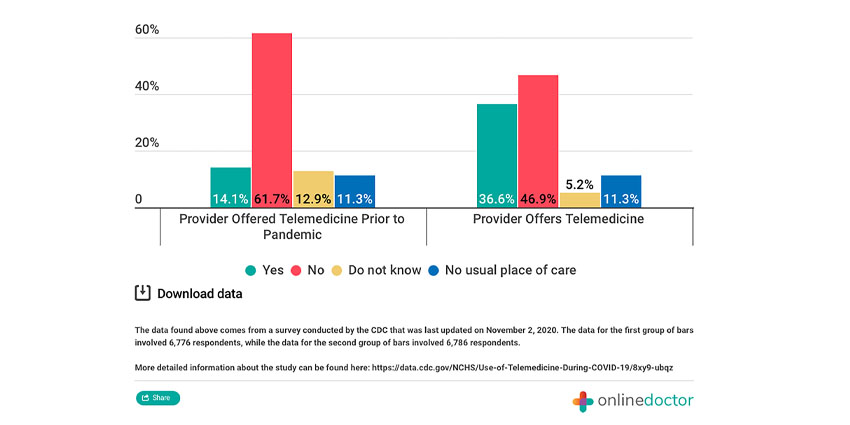
In support of its position, OnlineDoctor also used data from a Centers for Disease Control and Prevention (CDC) survey published in November 2020. According to the CDC, the survey “included questions about whether providers offered telemedicine (including video and telephone appointments)—both during and before the pandemic—and about the use of telemedicine during the pandemic.”
Referencing the CDC survey, OnlineDoctor stated that “just 14.1% of poll participants had a healthcare provider (doctor) that offered telemedicine services prior to the pandemic.” This figure has since jumped to 36.6%. This means the percentage of poll participants with a healthcare provider offering telemedicine services more than doubled during the pandemic. According to OnlineDoctor, this jump demonstrates that “more doctors are adapting to the pandemic by becoming online doctors and offering telehealth services.”
What does the future hold for telehealth services? OnlineDoctor has one theory: as doctors adapt, “[t]his will only speed up the trend in which telehealth and online doctor services become more popular at the expense of in-person doctor visits.”
Author
React:
Discussion
This is a fascinating development. In my practice we've seen similar outcomes with the revised protocol. The key differentiator seems to be patient selection criteria. Has anyone else noticed the correlation with BMI thresholds?
Great point. I'd push back slightly on the conclusion, the sample size in the cited study is too small to draw population-level inferences. That said, the directional signal is compelling and worth a larger RCT.
We implemented a similar approach last year. Early results are promising but we're still gathering 12-month follow-up data. Happy to share our protocol if anyone is interested.
Join the conversation
Orthopedic professionals are discussing this. Sign in and upgrade to read every comment and add your voice.