
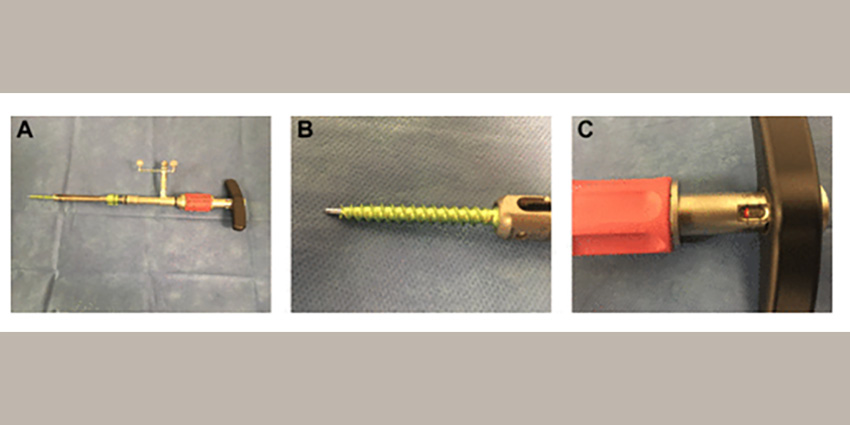
Surgeons from the Department of Neurological Surgery at Weill Cornell Brain and Spine Center, Weill Cornell Medicine, New York Presbyterian Hospital have developed a new single step pedicle screw system for minimally invasive spine surgery.
New 1-Step Pedicle Screw System Tested
2 min read Premium comments
Secondary#minimallyinvasivespinesurgery#pediclescrews
Their related research, “Novel MIS 3D NAV Single Step Pedicle Screw System (SSPSS): Workflow, Accuracy and Initial Clinical Experience,” appears in the January 12, 2021 edition of the Global Spine Journal.
In the prospective case series study, the researchers assessed patients who underwent pedicle screw fixation using this system between October 2017 and April 2018. Breaches were classified as grade 1 (<2 mm), grade 2 (2-4 mm), or grade 3 (<4 mm), and as cranial, caudal, medial, and lateral.
The result: 135 screws and 24 patients later the team found that their Single Step Pedicle Screw System was a very promising alternative to guide wires, Jamshidi needles and other instruments which help to minimize the risks of pedicle screw breaches.
Co-author Roger Härtl, M.D. is professor of Neurological Surgery and director of Spinal Surgery and Neurotrauma at the Weill Cornell Brain and Spine Center in New York, and the director of the Weill Cornell Medicine Center for Comprehensive Spine Care. “There is continuous development in the world of MISS techniques,” said Dr. Härtl to OTW. This is a single step system meaning it eliminates the need for guide wires, Jamshidi needles and pedicle preparation instruments.”
Making “minimally invasive” even more minimal
“It was interesting to realize that it is definitely a safe technique,” commented Dr. Härtl to OTW. “And, of course efficient, since it is a single-step percutaneous pedicle screw system. Our spine surgeons have refined minimally invasive spine surgery using a novel screw system that reduces the number of steps to insert a vertebral screw from five to just one—improving the accuracy of screw placement, reducing operative time, and restoring spinal stability in patients with a range of pathologies.”
“It means time saving. And this leads to shorter surgery time. Surgeons in the NewYork-Presbyterian Och Spine program are advancing the field through minimal access techniques, 3D navigational technologies, and innovative instrumentation to improve the lives of patients of all ages with every type of spine issue.”
Author
React:
Discussion
This is a fascinating development. In my practice we've seen similar outcomes with the revised protocol. The key differentiator seems to be patient selection criteria. Has anyone else noticed the correlation with BMI thresholds?
Great point. I'd push back slightly on the conclusion, the sample size in the cited study is too small to draw population-level inferences. That said, the directional signal is compelling and worth a larger RCT.
We implemented a similar approach last year. Early results are promising but we're still gathering 12-month follow-up data. Happy to share our protocol if anyone is interested.
Join the conversation
Orthopedic professionals are discussing this. Sign in and upgrade to read every comment and add your voice.