
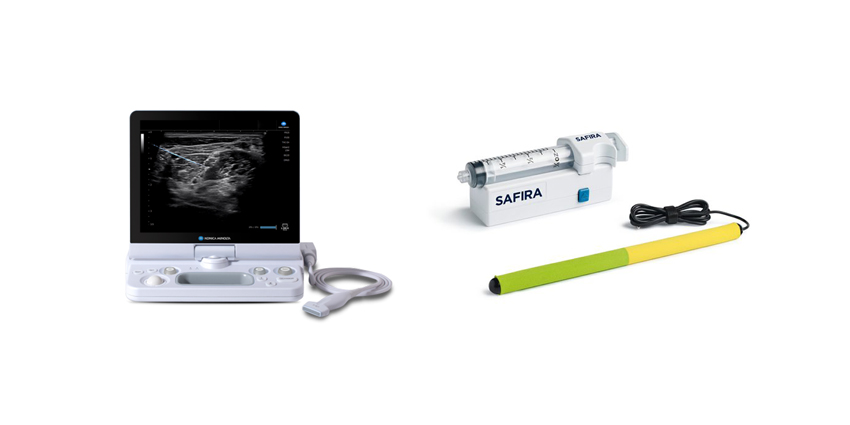
Konica Minolta Healthcare Americas Inc. and Medovate Ltd are teaming up to promote Medovate’s SAFIRA regional anesthesia injection with Konica Minolta’s range of ultrasound-guided procedures in the United States.
Konica Minolta, Medovate Partner for Anesthesia Safety
2 min read Premium comments
Secondary#konicaminoltahealthcareamericas#medovate#regionalanesthesia
SAFIRA or Safer Injection for Regional Anesthesia is a medical device designed to limit injection pressure and automatically stop injection at high pressure. The design is meant to reduce the risk of nerve injury and advance patient safety.
Studies have shown that regional anesthesia improves post-operative analgesia, cuts down on opioid consumption and anesthesia-related side effects. It also decreases length of stay, early rehabilitation and creates higher patient satisfaction than typically found with general anesthesia.
Both the American Society of Regional Anesthesia and Pain Medicine and the European Society of Regional Anesthesia and Pain Therapy recommend regional anesthesia over general anesthesia for COVID-19 patients where possible to reduce virus transmission.
This new partnership is a part of Konica Minolta’s UGPro Solution which combines education, procedures, and imaging equipment to expand the use of regional anesthesia.
“Regional anesthesia delivers numerous benefits for patients, physicians and hospitals, propelling its growth as an important alternative to general anesthesia,” said Eric Sumner, executive vice president of ultrasound sales at Konica Minolta.
“Medovate brings a unique combination of clinical innovation and expertise through its association with the United Kingdom’s National Health Service and we are proud to partner with them in this endeavor. Both Konica Minolta and Medovate are committed to promoting safer regional anesthesia with solutions that deliver clinical efficiency, simplify use and advance better outcomes for patients.”
Konica Minolta’s SONIMAGE HS2 System has an advanced algorithm, Simple Needle Visualization, which enhances needle visibility and improves accuracy of needle placement in ultrasound-guided regional anesthesia. The sensitivity of needle visualization can also be adjusted for different types of tissues.
Using SAFIRA with the SONIMAGE HS2 system turns the procedure into a one physician job, both companies said. Usually, an assistant is needed “…to inject the anesthetic solution at the required pressure while the anesthesiologist inserted the needle tip using ultrasound guidance.”
“Delivering best practices in regional anesthesia by creating value through innovation is a common vision uniting Medovate and Konica Minolta,” said Chris Rogers, sales and marketing director at Medovate.
“As a leading ultrasound manufacturer, physicians make informed decisions at the point-of-care to enhance patient safety, satisfaction, and their clinical experience. We are honored to partner with them to advance the importance and safety of ultrasound-guided techniques for regional anesthesia.”
Author
React:
Discussion
This is a fascinating development. In my practice we've seen similar outcomes with the revised protocol. The key differentiator seems to be patient selection criteria. Has anyone else noticed the correlation with BMI thresholds?
Great point. I'd push back slightly on the conclusion, the sample size in the cited study is too small to draw population-level inferences. That said, the directional signal is compelling and worth a larger RCT.
We implemented a similar approach last year. Early results are promising but we're still gathering 12-month follow-up data. Happy to share our protocol if anyone is interested.
Join the conversation
Orthopedic professionals are discussing this. Sign in and upgrade to read every comment and add your voice.