
Medtronic plc announced on December 16, 2020 that the FDA has granted 510(k) clearance earlier than originally anticipated for its Mazor Robotic Guidance system. It took the agency only two months to clear the system.
Medtronic’s Evolving 3-D Mazor Platform Gets New FDA Clearance
2 min read Premium comments
#510clearance#medtronic#mazorrobotics
The clearance of attachment and dissecting tools allows for the use of navigated interbody and Mazor’s Midas Rex high speed drills to provide for “unprecedented procedural integration” by seamlessly combining the Midas Rex™ drills with the “visibility and navigation from the StealthStation™ software,” according to the company announcement.
Indications and 3-D Imaging Capabilities
The 3-D imaging capabilities, according to the company, process and convert 2-D fluoroscopic projections from standard C-Arms into volumetric 3-D images.
FDA clearance documents state the tools are indicated for the “incision/cutting, drilling, burring and removal of hard tissue and bone in open and minimally invasive spine procedures.” Furthermore, the applications are intended “as an aid for locating anatomical structures in either open or percutaneous procedures.”
The use of associated applications is indicated “for any medical condition for which the use of stereotactic surgery may be appropriate and where reference to a rigid anatomical structure, such as a long bone or vertebra, can be identified relative to a CT- or MR-based model, fluoroscopic images, or digitized landmarks of the anatomy.”
Evolving Mazor Platform
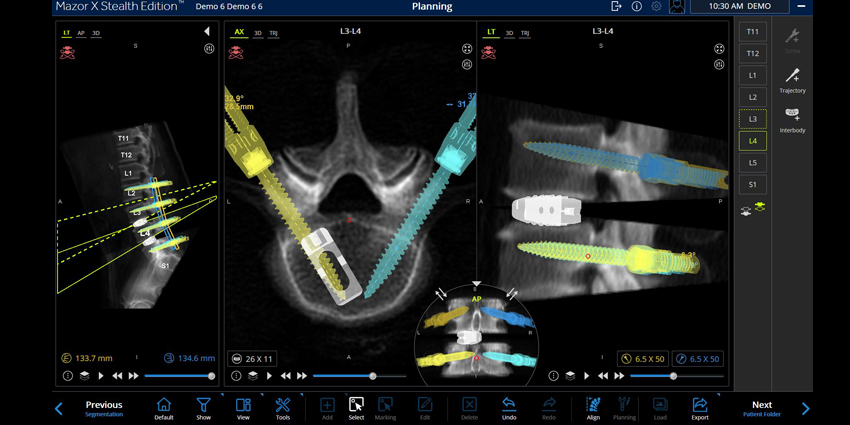
Since acquiring Mazor in 2018, Medtronic says it has evolved the Mazor platform to allow surgeons to “quickly visualize anatomy and spinal structures in relation to one another in 3D.” The interface, according to the company, “delivers fast and seamless access to plan and simulate cages and screws, with the goal of increasing efficiencies for surgeons.”

The drill systems are fully integrated throughout the Mazor procedure to allow for “improved trajectory precision starting with pilot hole creation and offering attachments and dissecting tools designed for accurate drilling with speeds up to 75,000 rpm.” Additionally, surgeons can utilize navigated interbody features on the system to “visualize disc prep and interbody placement during a robotic procedure.”
Eiman Shafa, M.D., of the Twin Cities Spine Center in Minnesota, said operating rooms are very complex environments, and he looks forward to “incorporating new functionality into our Mazor workflow to enhance the predictability and precision of a broader range of procedures leading to better patient outcomes. The ability to broaden surgical staff awareness about the procedure plan and potentially reduce fluoroscopy radiation should also improve our workflow creating a win-win for all hospital stakeholders.”
To read more about the system’s indications and safety warnings, click here.
Author
React:
Discussion
This is a fascinating development. In my practice we've seen similar outcomes with the revised protocol. The key differentiator seems to be patient selection criteria. Has anyone else noticed the correlation with BMI thresholds?
Great point. I'd push back slightly on the conclusion, the sample size in the cited study is too small to draw population-level inferences. That said, the directional signal is compelling and worth a larger RCT.
We implemented a similar approach last year. Early results are promising but we're still gathering 12-month follow-up data. Happy to share our protocol if anyone is interested.
Join the conversation
Orthopedic professionals are discussing this. Sign in and upgrade to read every comment and add your voice.