
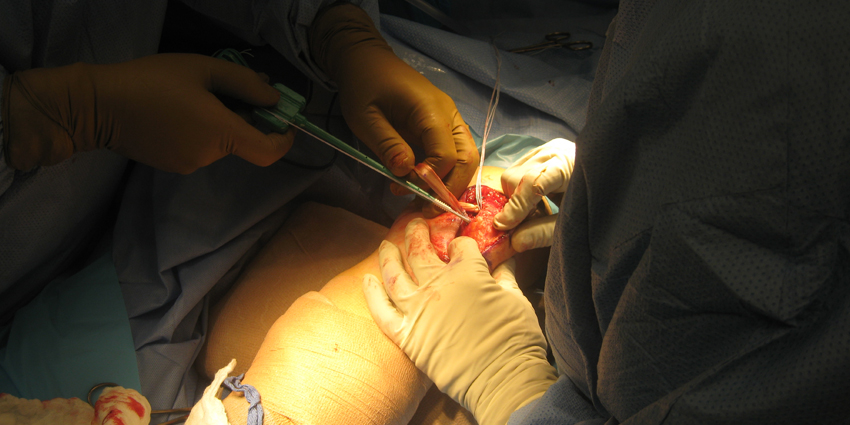
Trying to streamline the complex process of implant extraction following periprosthetic joint infection (PJI) after a revision total knee arthroplasty (rTKA), a team from the OrthoCarolina Hip & Knee Center in Charlotte, North Carolina, the University of California, San Francisco (UCSF), and Cleveland Clinic Florida examined 87 patients with PJI and extensive instrumentation.
Implant Extractions After TKA Infection: New Insights
3 min read Premium comments
#periprostheticjointinfectionSecondary#implantextraction#revisiontotalkneearthroplasty
Their work, “Irrigation and Debridement with Chronic Antibiotic Suppression Is as Effective as 2-Stage Exchange in Revision Total Knee Arthroplasty with Extensive Instrumentation,” was published in the January 6, 2021 edition of The Journal of Bone and Joint Surgery.
Jeff Barry, M.D., assistant professor of Orthopaedic Surgery and clinical fellowship director in the Division of Adult Reconstruction at UCSF and study co-author explained to OTW how the team tackled such a difficult issue as revision surgery after PJI. “Complex revision knees that become infected are really tough problems for patient and surgeon alike. The traditional gold standard of performing a two-stage exchange for prosthetic joint infection is often incredibly morbid when you consider the destruction required to remove some of these revision implants in a multiply operated soft-tissue envelope.”
“We were seeing patients starting the 2-stage process never finishing (and if they did high rates of infection recurrence). Meanwhile irrigation and debridement techniques continue to improve and the patients were doing quite well especially in the setting of chronic antibiotic suppression.”
The study examined 56 patients who had irrigation and debridement and 31 who had had a 2-stage exchange. Success, defined as no reoperation for infection, was similar for the two groups (62.5% the irrigation and debridement group compared with 67.7% for the 2-stage group).
According to the study authors, “Mortality rate was 39.3% for the irrigation and debridement group compared with 38.7% for the 2-stage group. Of those in the 2-stage group, 18 (58.1%) underwent reimplantation with a revision replacement. Of those 18 patients, 13 were still infection-free at the time of the most recent follow-up; however, when the analysis was expanded to all 31 patients in the 2-stage group, only 13 (41.9%) both had a successful reimplantation and did not require additional surgery for infection.”
“Nine (29.0%) of the 31 patients in the 2-stage group never underwent the second stage, and 4 (12.9%) of the 31 required arthrodesis at the second stage. In contrast, 35 (62.5%) of the 56 patients in the irrigation and debridement group were successfully managed, without additional surgery for the treatment of infection. At the time of the latest follow-up (mean, 3.2 years; range, 2 to 13 years), more patients in the irrigation and debridement group were ambulatory (76.8% in the irrigation and debridement group compared with 54.8% in the 2-stage group) and maintained a functional bending knee joint (85.7% in the irrigation and debridement group compared with 45.2% in the 2-stage group).”
Dr. Barry told OTW, “The most interesting results are that the patients who underwent the less morbid and less resource intensive surgery did just as well at a minimum of two years at having their infection under control as those who initiated the two-stage exchange process. Surprisingly as well, the irrigation and debridement patients were more likely to be ambulatory and have a knee that worked as opposed to ending up with an amputation or fusion for example.”
“In this unique patient population of infected revision total knees, surgeons should consider irrigation and debridement with antibiotic suppression and implant retention. The outcomes appear equivalent to 2-stage exchange in the intermediate term in regard to functional status and infection control. Given the morbidity of implant removal and difficulty in subsequent reconstruction, the irrigation and debridement may be the best option in some patients. It is important that this study should NOT be extrapolated to primary implants or simple revision implants where the overall body of literature would support 2-stage exchange for infection eradication.”
Author
React:
Discussion
This is a fascinating development. In my practice we've seen similar outcomes with the revised protocol. The key differentiator seems to be patient selection criteria. Has anyone else noticed the correlation with BMI thresholds?
Great point. I'd push back slightly on the conclusion, the sample size in the cited study is too small to draw population-level inferences. That said, the directional signal is compelling and worth a larger RCT.
We implemented a similar approach last year. Early results are promising but we're still gathering 12-month follow-up data. Happy to share our protocol if anyone is interested.
Join the conversation
Orthopedic professionals are discussing this. Sign in and upgrade to read every comment and add your voice.