
Stryker Corporation is betting serious dollars that smart implants will have an important role to play in the future of orthopedic implants. Late in 2020, Stryker announced the purchase of Dania Beach, Florida-based OrthoSensor, Inc., developer of an entirely new generation of “intelligent” implants and devices. (Financial terms weren’t disclosed.)
Here Come Smart Implants
5 min read Premium comments
#stryker#verasense#orthosensor
Founded in 2007, OrthoSensor “develops and commercializes intelligent orthopaedic devices and data services that provide quantitative feedback to surgeons and hospitals.”
Stryker Group President, Orthopaedics and Spine, Spencer Stiles is excited about this acquisition, saying, “Smart devices and implants will play a big role in orthopaedics and we are excited for OrthoSensor to join Stryker as we continue to innovate and advance smart sensor technologies, including intraoperative sensors, wearables and smart implants across our joint replacement business.”
Stiles continued, “Patient recovery will become more active as real-time measurement on key performance insights drive improved outcomes and patient satisfaction.”
Analyst Insights
Wells Fargo analysts appear to agree with Stiles that smart implants will be influential in orthopedics. An equity research team wrote a note regarding the acquisition.
The Wells Fargo research note listed three key takeaways:
- First, the news did not come as a surprise because OrthoSensor’s VERASENSE intraoperative sensor that allows for knee balancing has been incorporated in Stryker’s flagship Triathlon knee since 2011.
- Second, the analysts expect that the sensor technology will be integrated with Stryker’s Mako SmartRobotics platform. This will “provide data-driven feedback mechanism intra-operatively that will complement the precision of its cuts.”
- Third, the analysts expect Stryker will continue to improve its data analytics capabilities by incorporating remote patient monitoring with wearable sensors such as MotionSense and cloud-based computing such as OrthoLogIQ to its offering.
In conclusion, the Wells Fargo team believes that the OrthoSensor acquisition “validates our call that smart implants represent the next major breakthrough in orthopedics.”
The note was authored by Larry Biegelsen, Lei Huang, Shagun Singh, and Kevin Farshchi of Wells Fargo Securities, LLC.
Incorporating VERASENSE™ in the Triathlon® Knee System
How does VERASENSE work?
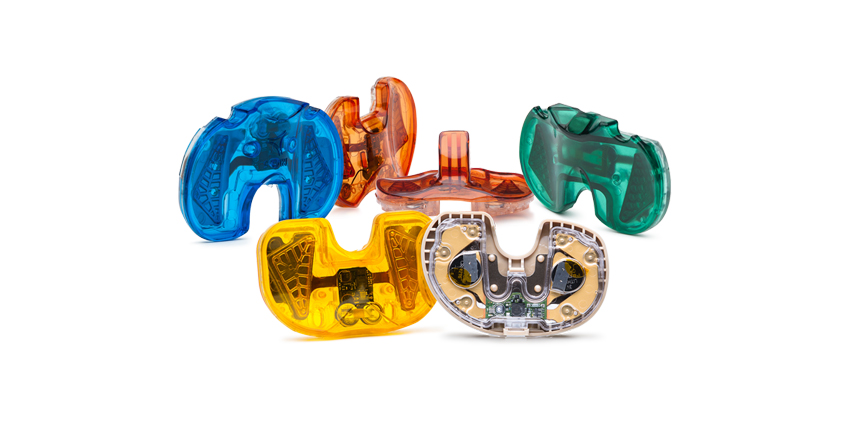
VERASENSE is a disposable instrument that measures tibial coronal alignment and ensures soft-tissue balance during primary and revision total knee arthroplasty. It includes wireless communication, center of load indicators, VERASENSE calibration indicators, load value, and kinetic tracking.
For nearly a decade, OrthoSensor’s VERASENSE sensor technology has been used with Stryker’s Triathlon knee system in total knee arthroplasty. Per the Stryker website, the Triathlon total knee system is a “primary total knee replacement system designed to work with the body.”
According to OrthoSensor, a surgeon using the VERASENSE sensor does not have to change his or her workflow in the operating room. The surgeon performs the total knee arthroplasty as they usually would. Once the surgeon “feels the knee is balanced,”’ the operating room staff activates the sensor. The surgeon “then places VERASENSE into the tibial tray and examines the mediolateral loading values and contact point rotation….” The sensor delivers real-time data to an intra-operative monitor. According to its brochure, this enables the surgeon to “perform real-time, quantified soft tissue balancing and implant positioning.”
Stryker is not OrthoSensor’s only partnership. OrthoSensor also partnered with Smith & Nephew and Zimmer Biomet. In addition to Triathlon, VERASENSE is compatible for use with Smith & Nephew Legion® and Journey II® and Zimmer Biomet Persona®, NexGen®, and Vanguard®.
The Mako SmartRobotics™ Platform
The Triathlon Total Knee can be used with the Mako system for Mako Total Knee. Mako’s robotic-arm assisted reconstructive service line includes Mako Total Knee, Mako Partial Knee, and Mako Total Hip.
The Stryker website indicates that Mako SmartRobotics combines the following three components into one platform: 3D CT-based planning, AccuStop haptic technology, and data analytics. Initially, the surgeon creates the patient’s surgical plan utilizing a CT scan that creates a 3D image of the patient’s anatomy. Then, during robotic-arm assisted surgery, the surgeon uses Mako AccuStop haptic technology to guide them to “cut what’s planned precisely for each patient.” For the Mako Total Knee application, this can result in “less soft tissue damage and greater bone preservation as compared to manual surgery.”
The platform also provides data analytics to help surgeons see trends to make informed decisions. The Mako SmartRobotics program includes two data platforms, the Hospital/ASC Reported Outcomes dashboard and RecoveryCOACH. RecoveryCOACH is the “patient engagement and patient reported outcomes collection portal and app.”
Integration may be in the near future for the technology. Quoting from the Wells Fargo research note, “Our diligence suggests that SYK [Stryker] will first look to integrate the technology within its MAKO SmartRobotics platform in order to get data-drive feedback on tissue tension between bone gaps to complement the 1mm precision of a robotic cut in order to drive better outcomes. It would not surprise us if this feature is made available in the next several quarters as the company has been working on it for the past year.”
Working Together: MotionSense™ and OrthoLogIQ®
OrthoSensor’s MotionSense mobile application for patients and OrthoLogIQ cloud-based data platform for surgeons work together to enhance patient care.
MotionSense is a mobile patient engagement application. It was created to assist patients through the total joint replacement experience, from surgery preparation to post-operative recovery.
Before surgery, patients can use the application to address commonly asked questions about the procedure as well as access checklists and educational insight. The application also transmits the Patient-Reported Outcome Measures (PROM) surveys to the surgeon before and after surgery.
After surgery, the application assists the patient with their recovery process. Application features include “a daily pain journal, home exercise program and helpful notifications.” PROM surveys are completed via the application at “pre-determined post-op [post-operative] follow-up events.” All of this enables the healthcare team to continuously monitor patient progress.
OrthoLogIQ provides orthopedic surgeons and staff access to “user-friendly dashboards that provide a snap-shot of each individual patient’s continuum of care.” The dashboards include patient demographic information, PROM survey results, and daily pain scores and steps. For VERASENSE users, intraoperative data from sensors is also available.
The Future of Remote Patient Monitoring
Stryker may have big plans for the future of remote patient monitoring. Quoting from the Wells Fargo research note, “Our diligence also suggests that SYK [Stryker] is looking to incorporate remote patient monitoring with wearable sensors (MotionSense) that will be placed above and below the knee to monitor the patient, especially post operatively. It would not surprise us if the manual sensor is made available by SYK [Stryker] sometime this year. The sensor will gather data on a patient’s physiological parameters such as activity and motion, as well as pressure and flow that is expected to have clinical relevance in determining movement and range of motion, stenosis and leakage, as well as recovery and function.”
The Wells Fargo note acknowledged that Stryker is not the only company pursuing smart implants and remote patient monitoring. It addressed Zimmer Biomet’s partnership with medical technology company Canary Medical, noting the differences in Zimmer Biomet’s and Stryker’s remote patient monitoring capabilities. Namely, battery requirements, implantability (ensuring compliance), and data gathering.
Looking forward, Well Fargo analysts believe this acquisition “validates the field of smart implants and intelligent surgery.”
What are your thoughts on smart devices and remote patient monitoring? Have these technologies changed your practice? Let us know in the comments below.
Author
React:
Discussion
This is a fascinating development. In my practice we've seen similar outcomes with the revised protocol. The key differentiator seems to be patient selection criteria. Has anyone else noticed the correlation with BMI thresholds?
Great point. I'd push back slightly on the conclusion, the sample size in the cited study is too small to draw population-level inferences. That said, the directional signal is compelling and worth a larger RCT.
We implemented a similar approach last year. Early results are promising but we're still gathering 12-month follow-up data. Happy to share our protocol if anyone is interested.
Join the conversation
Orthopedic professionals are discussing this. Sign in and upgrade to read every comment and add your voice.