
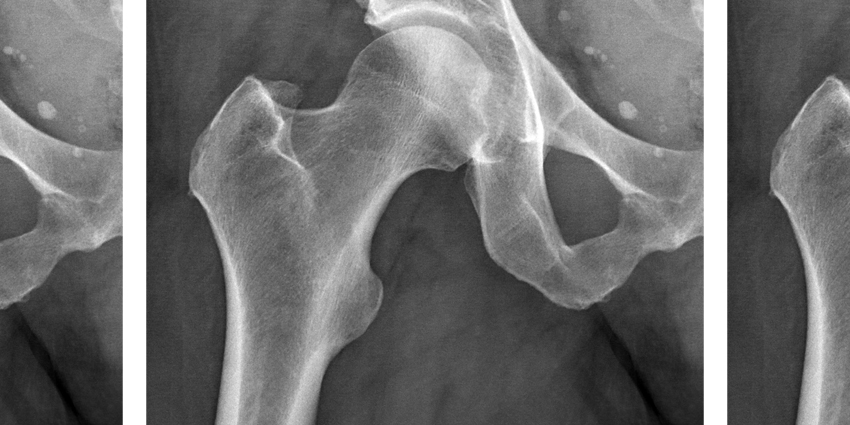
When a team from Midwest Orthpaedics at Rush in Chicago, Illinois, examined 86 patients (146 hips), they were a bit surprised at their findings. The study, “No Differences in Hip Joint Space Measurements Between Weightbearing or Supine Anteroposterior Pelvic Radiographs,” was published in the November 1, 2020 edition of Arthroscopy.
Hip Joint Space Width: Type of Radiograph Irrelevant?
2 min read Premium comments
Secondary#hipjointspacewidth#pelvicradiographs
Co-author Jorge Chahla, M.D., Ph.D. is a hip and knee surgeon at Midwest Orthpaedics at Rush. Dr. Chahla told OTW, “The idea that inspired this work was that among preoperative predictors of poor surgical outcome after hip arthroscopy for the treatment of femoral acetabular impingement [FAI] is joint space narrowing (< 2mm), wing hip arthroscopy when compared to patients with greater than 2mm of hip joint space width.”
“The impact of patient positioning and weight-bearing during radiographic imaging (supine vs standing radiographs) on joint space measurements is well established in the knee literature but not in the hip literature (sometimes dramatic) joint space narrowing changes with weight bearing X-rays. If significant differences exist, this could subsequently mislead a surgeon in the decision-making process.”
Joint space width measurements were made by two independent reviewers who were blinded to patient positioning, with each reviewer redoing some of the measurements so as to assess intra-rater reproducibility.
The result? They found no significant differences between joint space width measurements taken on standing and supine pelvic radiographs.
“We thought that the weight bearing X-rays would demonstrate more narrowing as in other joints,” said Dr. Chahla to OTW. “The most important result was that joint space width measurements on standing and supine pelvic radiographs were not significantly different.”
When OTW asked how this work might help move research forward, Dr. Chahla commented, “Given the importance of preoperative joint space measurements and their role in decision making of which patients are candidates for hip arthroscopy and which are not, this study provides valuable information for clinical care as a surgeon can accept either X-ray knowing that the joint space measurements will not defer. This allowed us to understand that in the anteroposterior position there were no overall changes but there might be positions in which there is a difference depending on where the cartilage wear is and therefore a comparison of “at risk” positions for impingement might be able to provide further information.”
Author
React:
Discussion
This is a fascinating development. In my practice we've seen similar outcomes with the revised protocol. The key differentiator seems to be patient selection criteria. Has anyone else noticed the correlation with BMI thresholds?
Great point. I'd push back slightly on the conclusion, the sample size in the cited study is too small to draw population-level inferences. That said, the directional signal is compelling and worth a larger RCT.
We implemented a similar approach last year. Early results are promising but we're still gathering 12-month follow-up data. Happy to share our protocol if anyone is interested.
Join the conversation
Orthopedic professionals are discussing this. Sign in and upgrade to read every comment and add your voice.