
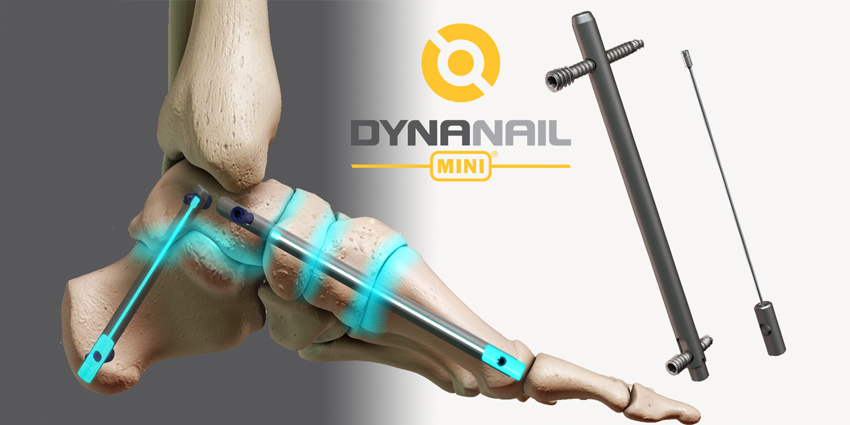
Surgeons treating patients with Charcot Foot and other severe midfoot conditions now have a new tool in their toolbox: DynaNail Mini Fusion System for Medial Column Fusion by MedShape, Inc.
DynaNail Now Available for Medial Column Fusion
2 min read Premium comments
Secondary#dynanailminifusionsystem#mediacolumnfushion#medshape
It features MedShape’s patented superelastic nickel titanium (NiTiNOL) technology and helps maintain active compression post-surgery to promote bone healing and joint stability.
The DynaNail TTC Fusion System was first launched in 2013 for hindfoot fusion. DynaNail Mini is the first internal fixation device designed specifically for medial column fusion.
DynaNail Mini was introduced in 2019 with 60-100 mm lengths for use in subtalar fusion procedures. This newest version comes in longer lengths (110-140 mm) which offer better stability and post-operative NiTiNOl compression across the midfoot bone anatomy, according to the company.
It has been under limited release since 2019 and a select group of foot and ankle surgeons across the country have been implanting them before this full market release.
“I use the DynaNail Mini for medial column fusion with my most challenging patients—including those with Charcot neuroarthropathy. Patients that are now a year post-surgery have achieved successful union, maintained alignment without additional hardware, and are doing well. I attribute my clinical success to the post-operative compression that the NiTiNOL Element in the DynaNail Mini provides and the overall strength of the nail. It helps facilitate healing in a way that you just do not see with static beaming devices,” said Kent Ellington, M.D., of OrthoCarolina Foot & Ankle Institute in Charlotte, North Carolina, one of the first surgeons to implant the DynaNail Mini in a medial column fusion.
Because of compromised bone healing and poor bone quality, Charcot neuropathic patients present a particular clinical challenge to orthopedic surgeons performing midfoot reconstruction.
Current internal beaming devices often lose compression post-surgery and break or migrate leading to nonunion, complications and even amputation. DynaNail’s NiTiNOL technology and its increased elasticity provides better load-sharing to the bone and reduces the risk of implant failure, the company said.
“This new version of the DynaNail Mini signifies a major milestone in further expanding MedShape’s NiTiNOL nail technology beyond the hindfoot into other foot and ankle and trauma applications including midfoot,” said Kurt Jacobus, chief executive officer of MedShape, Inc.
“We have been pleased with the clinical performance of the DynaNail Mini so far and are excited to offer another surgical solution for limb salvage to orthopedic surgeons.”
MedShape, Inc. is a medical device company located in Atlanta, Georgia, that specializes in joint fusion, fracture fixation and soft tissue repair in the foot and ankle.
Author
React:
Discussion
This is a fascinating development. In my practice we've seen similar outcomes with the revised protocol. The key differentiator seems to be patient selection criteria. Has anyone else noticed the correlation with BMI thresholds?
Great point. I'd push back slightly on the conclusion, the sample size in the cited study is too small to draw population-level inferences. That said, the directional signal is compelling and worth a larger RCT.
We implemented a similar approach last year. Early results are promising but we're still gathering 12-month follow-up data. Happy to share our protocol if anyone is interested.
Join the conversation
Orthopedic professionals are discussing this. Sign in and upgrade to read every comment and add your voice.