
On December 8, 2020, San Diego-based Carlsmed, Inc. announced its aprevo™️ patient-specific interbody devices were the first implantable devices ever to receive the FDA Breakthrough Device Designation AND 510(k) clearance. The devices are intervertebral body fusion devices indicated to treat adult spinal deformity.
Carlsmed: FDA Breakthrough Designation, Cash and Talent
2 min read Premium comments
#fda510kclearance#carlsmedSecondary#breakthroughdeviceprogram
Getting a Breakthrough Device Designation from the FDA is a big deal towards getting your product through regulatory and payment mazes. The designation is the FDA’s way of saying the device can provide an improved standard of care and, under the proposed MCIT pathway, would guarantees national coverage from the Centers for Medicare & Medicaid Services (CMS) for the first four years after market clearance.
The device, according to the company, is now “…the only spinal device to qualify for the Alternative Inpatient New Technology Add-On Payment (NTAP) Pathway for Transformative New Devices that was enacted by CMS beginning with NTAP applications for FY2021. Upon authorization of the NTAP, which is currently under review by CMS for FY2022 approval, hospitals will receive an add-on payment from CMS of up to 65% of the cost of the device.”
“Data Into Devices”
Carlsmed’s CEO, Mike Cordonnier told OTW that pre-operative data is used to create an optimal surgical plan and personalizes the devices to achieve that plan. In effect, the device “turns data into devices.”
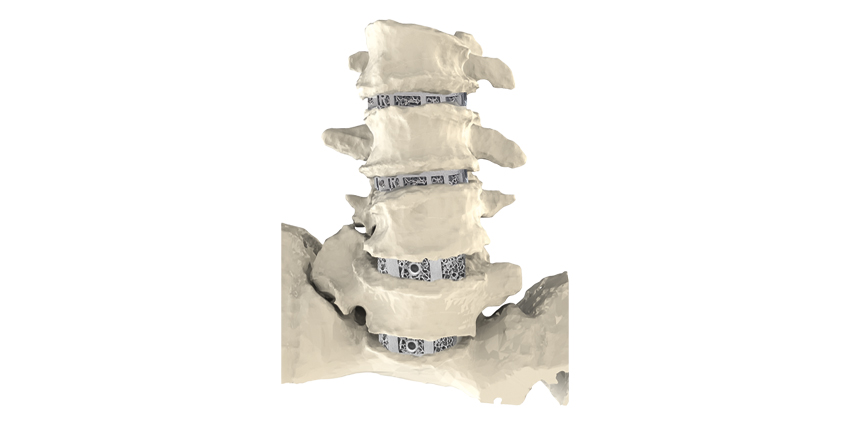
According to FDA documents, the aprevo™ ALIF (anterior lumbar interbody fusion) and LLIF (lateral lumbar interbody fusion) devices are designed to stabilize the lumbar spinal column and facilitate fusion. The devices incorporate patient specific features to allow the surgeon to tailor the deformity correction to the individual needs of the patient.
The individualized surgical correction plan and device configurations are developed using patient CT scans and are additively manufactured and made from titanium alloy and have a cavity intended for the packing of bone graft.
The devices are intended for interbody fusion “in skeletally mature patients and are to be used with supplemental fixation instrumentation cleared for use in the lumbar spine.” The anterior lumbar interbody and lateral interbody devices are indicated for use “as an adjunct to fusion at one or more levels of the lumbar spine in patients having an ODI>40 and diagnosed with severe symptomatic adult spinal deformity conditions.”
The devices are intended to be used with autograft and/or allogenic bone graft comprised of cancellous and/or corticocancellous bone graft. These implants may be implanted via a variety of open or minimally invasive approaches. These approaches may include anterior lumbar interbody fusion or lateral lumbar interbody fusion.
Money and Talent
There was more good news for the folks at Carlsmed. On December 16, the company announced the closing of a $10 million Series A financing effort. The financing was led by U.S. Venture Partners (USVP) and includes participation from The Vertical Group, Cove Fund, and Wavemaker Three-Sixty Health, among others.
The financing brought along three well known spine leaders to the company’s board—Jonathan Root, M.D., Phil Young, and Kevin Sidow. Sidow is past CEO of St. Francis Medical Technologies and Moximed, as well as past Worldwide President of DePuy Orthopedics. Root and Young have served on over 20 different medical technology company boards of directors.
Author
React:
Discussion
This is a fascinating development. In my practice we've seen similar outcomes with the revised protocol. The key differentiator seems to be patient selection criteria. Has anyone else noticed the correlation with BMI thresholds?
Great point. I'd push back slightly on the conclusion, the sample size in the cited study is too small to draw population-level inferences. That said, the directional signal is compelling and worth a larger RCT.
We implemented a similar approach last year. Early results are promising but we're still gathering 12-month follow-up data. Happy to share our protocol if anyone is interested.
Join the conversation
Orthopedic professionals are discussing this. Sign in and upgrade to read every comment and add your voice.