
Castel San Pietro, Switzerland-based, Medacta International SA, recently announced that it has launched the second iteration of instruments for the M.U.S.T. (Medacta Universal Screw Technology) pedicle screw system.
Next Generation M.U.S.T Instrumentation, a Must Have?
1 min read Premium comments
#medactaSecondary#mustinstruments#posteriorfixation
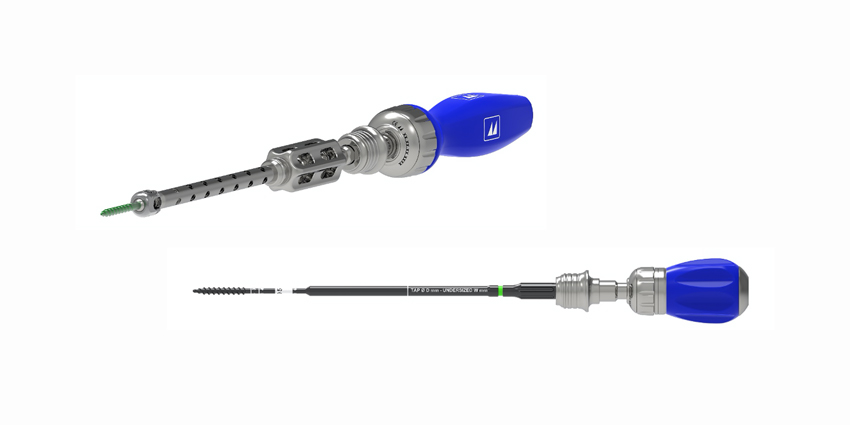
The next generation instruments feature an upgrade to the geometrical design that supports the surgical procedure. Examples of these geometric upgrades include a more ergonomic screwdriver that improves screw engagement and disengagement in challenging anatomies. A short reducer has also been added to quickly capture screws in orientations that may be difficult with larger instruments.
The instruments also received a chemically inert, thin carbon-based coating to reduce friction, surface fatigue, and tribo-oxidation, all of which can lead to premature device failure. The micrometric coating of metal and diamond-like carbon has been used in heavy industry to extend the life of high-tolerance machine parts such as bearings, gears, and other engine elements. The coating also reduces surface glare, making instrument markings easier to read in the brightly lit OR.
A collaboration between Medacta and Balgrist University Hospital in Zurich, Switzerland, led to the improvements that have been incorporated in the upgrade. Medical Director, Chief of Orthopaedics and Chief of the Division of Spine Surgery at Balgrist University Hospital, Prof. Dr. med. Mazda Farshad consulted on development of the instruments and has performed a series of surgeries using the new instruments.
Outcomes were reported as optimal, and Farshad says that, “The M.U.S.T. 2.0 is a reliable system based on established concepts and innovations that simplify the surgical flow of spinal procedure.” He added, “The evolution of the M.U.S.T. spinal instrumentation was strongly driven by cognizant observations of each surgical step and incremental improvements.”
The instruments are compatible with the current M.U.S.T. pedicle screw product line, which offers universal polyaxial screws, rods, and connectors for correction and stabilization of degenerative, deformity, and trauma cases. The M.U.S.T. 2.0 instruments are the first devices in the company’s portfolio to receive the carbon film coating.
Author
React:
Discussion
This is a fascinating development. In my practice we've seen similar outcomes with the revised protocol. The key differentiator seems to be patient selection criteria. Has anyone else noticed the correlation with BMI thresholds?
Great point. I'd push back slightly on the conclusion, the sample size in the cited study is too small to draw population-level inferences. That said, the directional signal is compelling and worth a larger RCT.
We implemented a similar approach last year. Early results are promising but we're still gathering 12-month follow-up data. Happy to share our protocol if anyone is interested.
Join the conversation
Orthopedic professionals are discussing this. Sign in and upgrade to read every comment and add your voice.