
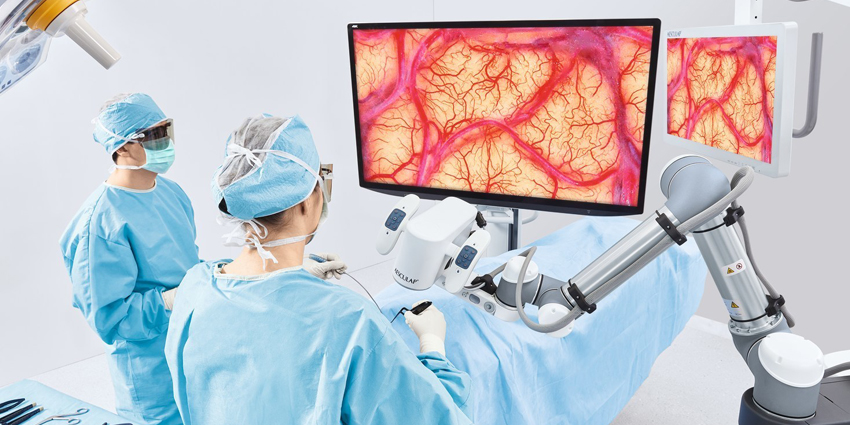
Aesculap, Inc., based in Center Valley, Pennsylvania, is launching the Aesculap Aeos™ robotic digital microscope. The microscope is the result of the collaboration between Aesculap and Santa Barbara, California-based True Digital Surgery, Inc. (TDS). Aesculap is a subsidiary of B. Braun and a medical device manufacturer, and makes a full portfolio of spine implants, including the ActivL lumbar disc replacement.
U.S. Launch of Aeos Robotic Digital Microscope
2 min read Premium comments
Secondary#aesculapaudio#roboticdigitalmicroscope#truedigitalsurgery
True Digital Surgery is a privately held Series B company that was previously known as TrueVision Systems and has been developing ophthalmic surgical imaging platforms since 2003. The company has done so through partnerships with the likes of Leica Microsystems GmbH and Alcon, which have resulted in systems such as the Leica M530 OH6, and Alcon’s NGenuity 3D. TDS’ current technology is based on these earlier projects and nearly 20 years of experience developing 3D digital microscopes.
The Aesculap Aeos is intended to provide 3D digital visualization and improve precision in neurosurgery, spine, and ear, nose, and throat operations. The companies claim that use of the microscope can help increase safety and efficiency during surgery by providing a viewing environment that allows for distancing and proper personal protection equipment (PPE) use to protect from potential coronavirus exposure.
They also claim that the robotic-assisted positioning and use of monitors allows Aeos to provide better ergonomics citing literature that up to 80% of neurosurgeons report pain after a day of surgery.
The system offers 3D modes, as well as fluorescence backlighting and 10x optical zoom for full resolution at any magnification. Future software updates may provide further customization options.
Chief Executive Officer and Chairman of True Digital Surgery Aidan Foley describes the Aeos as having “breakthrough technology that we like to say can ‘see beyond the tissue’… This platform was developed with True Digital Surgery’s unmatched experience in 3D visualization and vivid imagery, coupled with the invaluable insights and global sales and support capabilities gained from our strategic partnership with Aesculap.”
Aesculap President Chuck DiNardo says that “the Aesculap Aeos Robotic Digital Microscope is a strategically important addition to our U.S. portfolio,” and that it “provides healthcare providers with industry-leading advancements developed through a responsive approach that is focused on innovation, efficiency and sustainability.”
The Aeos, already available in Europe, was first purchased by Ostrava University Hospital in the Czech Republic in May 2020. An early user, Head the Department of Neurosurgery, doc. MUDr. Radim Lipina, Ph.D., at the hospital praised the system, saying, “In neurosurgery, I consider it a small revolution that will bring a lot of news. At our clinic, we have about 20 operations and the experience is really excellent.”
Author
React:
Discussion
This is a fascinating development. In my practice we've seen similar outcomes with the revised protocol. The key differentiator seems to be patient selection criteria. Has anyone else noticed the correlation with BMI thresholds?
Great point. I'd push back slightly on the conclusion, the sample size in the cited study is too small to draw population-level inferences. That said, the directional signal is compelling and worth a larger RCT.
We implemented a similar approach last year. Early results are promising but we're still gathering 12-month follow-up data. Happy to share our protocol if anyone is interested.
Join the conversation
Orthopedic professionals are discussing this. Sign in and upgrade to read every comment and add your voice.