
Most of what we know about risks in skateboarding does not come from competitive skateboarding events. Researchers say that a research program dedicated to this group is needed.
Skateboarding Head Injuries: A Dangerous Mystery
1 min read Premium comments
Secondary#competitiveskateboarding#headinjury#helmets
In the article, “Managing head injury risks in competitive skateboarding: What do we know?” published online on October 8, 2020 in the British Journal of Sports Medicine, researchers reviewed published literature on head injuries in skateboarding.
Videos of skateboarding competitions from Vans Park Professional League, Street League Skateboarding and Dew Tour were also reviewed to describe crashes and falls.
International Organization for Standardization (ISO), British Standards Institution (BSI), Snell, United States Consumer Product Safety Commission (CPSC) and American Society for Testing and Materials (ASTM) databases were also searched for skateboarding-styled helmet standards. A sample of helmets were put through standard impact tests.
The purpose of the study was to inform policy, practice and research regarding the management of head injury risks in competitive skateboarding, including whether or not helmet use should be mandated.
According to the analysis, most of the literature focused on recreational skateboarding among kids. More than half of the injuries recorded were to the head, but despite that, helmets were used less than 35% of the time.
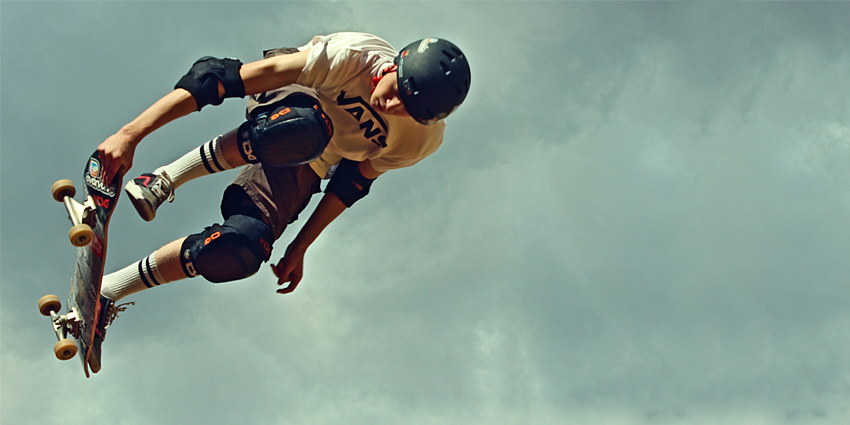
The video analyses found that there were high rates of falls and crashes during competitive skateboarding, but that at the same time, the athletes had the capacity to control falls and limit head impacts. Less than 5% of the competitive skateboarders wore helmets.
The researchers also found that all helmets, with the exception of one uncertified helmet, had similar impact attenuation performance; that is, at 0.8 m drop height, 114-148 g; at 1.5 m, 173-220 g; and at 2.0 m, 219-259 g. At second impact, the performance of each helmet tested was degraded.
The researchers wrote, “Helmets styled for skateboarding are available ‘off the shelf’ that will offer protection to the head against skull fractures and intracranial injuries in competitive skateboarding. There is an urgent need to commence a programme of research and development to understanding and control head injury risks.”
Author
React:
Discussion
This is a fascinating development. In my practice we've seen similar outcomes with the revised protocol. The key differentiator seems to be patient selection criteria. Has anyone else noticed the correlation with BMI thresholds?
Great point. I'd push back slightly on the conclusion, the sample size in the cited study is too small to draw population-level inferences. That said, the directional signal is compelling and worth a larger RCT.
We implemented a similar approach last year. Early results are promising but we're still gathering 12-month follow-up data. Happy to share our protocol if anyone is interested.
Join the conversation
Orthopedic professionals are discussing this. Sign in and upgrade to read every comment and add your voice.