
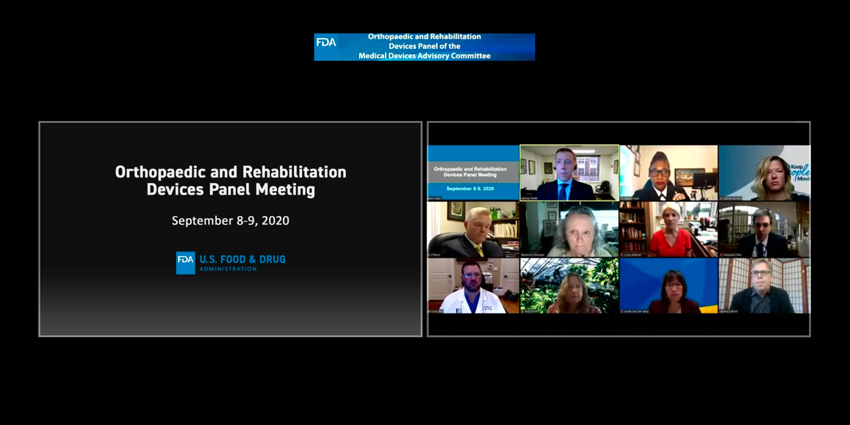
During a two-day virtual meeting of the FDA’s Orthopaedic and Rehabilitative Devices Panel on September 8-9, 2020, the panel recommended that bone growth stimulators and facet screw spinal device systems be reclassified and that semi-constrained toe—metatarsophalangeal (MTP)—joint prostheses be classified as Class II (general and special controls) devices. The panel also addressed intra-abdominal and intra-compartmental pressure monitoring devices.
Ortho Panel Backs FDA on Classification Recommendations
3 min read Premium comments
Secondary#bonegrowthstimulator#deviceclassifications#fdaorthopedicadvisorypanel
Bone Growth Stimulators
The FDA wants to down-classify bone growth stimulators from Class III to Class II. That means a manufacture only needs 510(k) clearance instead of the beastly costly premarket approval (PMA) process. Or put another way, new manufacturers in the market will have to clear a lower hurdle.
The Bone Growth Stimulator (BGS) Coalition told the advisory committee that manufacturers want to keep the devices in Class III. If the devices are down classified, industry wants the agency to require special controls. Think of it as a Class III Light.
Panelists agreed nearly unanimously on the three questions posed by FDA staff and concluded that down-classifying noninvasive bone growth stimulators is a sufficiently safe step for patients and supports manufacturers of the devices.
Panel members reportedly had concerns about risks of burns, electrical shocks or adverse events with use of the devices, and that the products’ biological aspects or effects were overly vague.
The panel recommended that the proposed reclassification include the condition that the devices be subject to rigorous clinical studies and post market surveillance for any new products.
Jon Serbousek, CEO and President of Orthofix Medical Inc., a device manufacturer, said he was glad to see the advisory committee embrace the “importance of rigorous PMA-like clinical data for these devices. Because bone growth therapy devices encompass a range of distinct technologies, waveform parameters, functionalities, designs, dosimetries and intended uses, it is imperative that manufacturers are required to submit robust clinical data under the approval or clearance process to ensure the safety and efficacy of these devices for patients.”
Scientists at the agency said the FDA is looking at biocompatibility and other nonclinical studies that can support some of the concerns the panel members raised about these devices.
Captain Raquel Peak, Ph.D., MPH, USPHS, director, OHT6, FDA Office of Orthopedic Devices, Office of Product Evaluation and Quality, said this product [class] has been in existence for four decades, “over which time it has generated only 300 mentions in the medical device reporting (MDR) database.”
Peak said about 200 of the MDRs were related to skin irritation and about 60 were related to pain. She added the agency looked at over 11,000 patients to come up with an analysis as to what the adverse events are. “The recalls are very low.”
Semi-Constrained Toe (metatarsophalangeal) Joint Prostheses
On the question of the toe prostheses, the panel said literature evidence was poor and limited. “However,” according to the meeting summary document, “there was a definitive conclusion from their review of the literature and their experience that there is a significant risk with use of this device category.” The panel strongly recommended that “significant regulatory oversight” should be put in place. The panel also recommended “rigorous studies in order [to] support robust and informed data generation for use of this device due to insufficient information on the risks.”
The panel did not agree with the agency’s proposed classification of Class II with special controls for cemented total first MTP joint implants. While not explicitly requested, there was a consensus that these devices should be classified as Class III.
Facet Screw Spinal Device Systems
The panel was asked to make recommendations regarding the proposed classification of facet screw spinal device systems, which are currently unclassified, pre-amendment devices, to Class II (general and special controls).
The panel agreed with the identified risks and mitigations as proposed by the FDA and had no substantive additional recommendations regarding risks/mitigations. The panel also agreed with the FDA’s proposed classification of Class II with special controls for the systems.
Pressure Monitoring Devices
For the pressure monitoring devices, the panel concurred with FDA’s proposed classification of Class II with special controls being appropriate for intracompartmental devices, with at least one panel member suggesting the FDA even consider Class I.
For the intra-abdominal devices, the panel was asked whether the identified special controls “appropriately mitigate the identified risks to health and whether additional or different special controls are recommended.” The panel agreed that the proposed risks were appropriate. Some panel members suggested the addition of user error as an identified risk, with a recommendation for adequate end user labeling to be included as a special control. The panel agreed with FDA’s proposed classification of Class II with special controls.
If you want to study all documents related to this ortho panel meeting, click here.
Author
React:
Discussion
This is a fascinating development. In my practice we've seen similar outcomes with the revised protocol. The key differentiator seems to be patient selection criteria. Has anyone else noticed the correlation with BMI thresholds?
Great point. I'd push back slightly on the conclusion, the sample size in the cited study is too small to draw population-level inferences. That said, the directional signal is compelling and worth a larger RCT.
We implemented a similar approach last year. Early results are promising but we're still gathering 12-month follow-up data. Happy to share our protocol if anyone is interested.
Join the conversation
Orthopedic professionals are discussing this. Sign in and upgrade to read every comment and add your voice.