
Boca Raton, Florida-based SurGenTec, announced on October 1, 2020 that the FDA granted 510(k) clearance for its 3D GraftRasp System.
Novel 3D GraftRasp System Cleared by FDA
2 min read Premium comments
#fda510kclearanceSecondary#surgentecaudio#3dgraftrasp
Intended Use
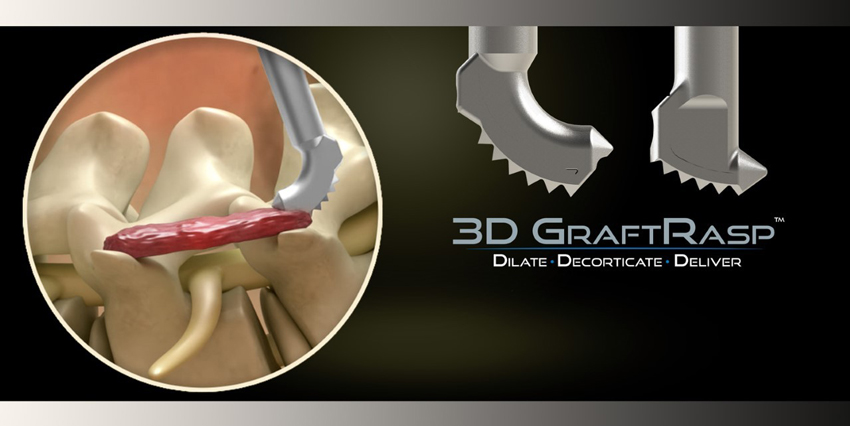
According to FDA clearance documents, the system is intended to be used in orthopedic procedures, “to rasp or decorticate bone from the transverse processes and/or facets, and for the delivery of hydrated allograft, autograft, or synthetic bone graft material to an orthopedic surgical site.”
Posterolateral fusion is the standard of care to treat lumbar spine disorders. Traditional, open spine surgery involves cutting or stripping the muscles from the spine and a bone graft is packed in gutters to promote fusion.
Minimally Invasive
Minimally invasive surgery involves a smaller incision and muscle dilation, allowing the surgeon to gently separate the muscles surrounding the spine rather than cutting them. However, the company says there are difficulties in accessing the region.
With the new system, surgeons can more easily access the anatomy with less invasive incisions.
Company Founder and CEO Travis Greenhalgh noted that in spine procedures, “the transverse processes and facet joints may now be targeted in a more efficient and effective surgical technique pioneered by SurGenTec.” He added that the system is the only device to receive FDA clearance for the stated intended use.
The System
Instruments include straight or curved rasps. The rasps have disposable foot plates with conical teeth that, according to the company, help ensure optimal decortification.
The company says the 3D GraftRasp is intended to be used in conjunction with the GraftGun delivery system “to facilitate controlled bone graft delivery to the surgical site. Autograft, allograft or synthetic bone graft is extruded with accuracy through an aperture in the rasp directly to the decorticated area, which instills confidence that bone graft is placed precisely where fusion is desired.”
“The 3D GraftRasp System was designed for synergy between the GraftRasp instrument and GraftGun. For ease of use and saving time the GraftGun tubes are pre-loaded with OsteoFlo NanoPutty (Synthetic), ViMax fiber cellular matrix, or Ossify DBM putty and Ossify cortical fibers. The universal GraftGun kit may also be utilized to allow surgeons the freedom to load the bone graft of their choice.”
The system is protected by more than 10 patents with more applications pending. The company plans to release iterations for other general orthopedic uses such as large-joint and the foot/ankle markets. The company is releasing the 3D GraftRasp System immediately and will be hosting physician training sessions in its new BioSkills Lab in Boca Raton.
Author
React:
Discussion
This is a fascinating development. In my practice we've seen similar outcomes with the revised protocol. The key differentiator seems to be patient selection criteria. Has anyone else noticed the correlation with BMI thresholds?
Great point. I'd push back slightly on the conclusion, the sample size in the cited study is too small to draw population-level inferences. That said, the directional signal is compelling and worth a larger RCT.
We implemented a similar approach last year. Early results are promising but we're still gathering 12-month follow-up data. Happy to share our protocol if anyone is interested.
Join the conversation
Orthopedic professionals are discussing this. Sign in and upgrade to read every comment and add your voice.