
Medtronic Spine is launching its first navigated titanium cage made with Titan nanoLOCK™. Titan nanoLOCK is a surface technology that the company obtained through the 2019 acquisition of Titan Spine.
Medtronic Launches Navigated Interbody With Titan nanoLOCK™
1 min read Premium comments
#medtronicSecondary#adaptix#nanolock#posteriorlumbarinterbodyfusion
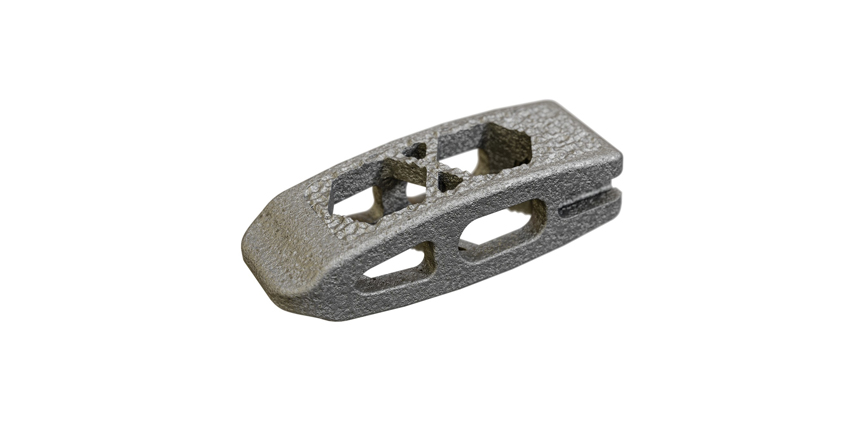
The Adaptix™ Interbody System is modeled on the design of the Capstone Spinal System, a posterior lumbar interbody fusion (PLIF) device. According to the company, the new system adds increased strength with its 3D-printed titanium structure, subsidence resistance based on testing, surface area measurements, and engineering principles, easy insertion, and bone growth.
The surface technology originally developed by Titan Spine is recognized as the first to be considered a nanotechnology for spinal devices by the FDA nanotechnology guidance document. The surface, created through 3D-printing, provides textures on the macro, micro, and nano levels. Evidence is building that all levels of texture contribute to the osteoconductive and osteogenic properties of bone building cells.
J. Justin Seale, M.D., a surgeon at OrthoArkansas Spine Institute said that the “unique features and world-class technologies make the Adaptix Interbody System a truly differentiated implant.” He adds, “Adaptix Interbody System allows me the best chance to meet my patients’ needs by confidently placing the implant under navigation and trusting the Titan nanoLOCK Surface Technology to allow the implant to promote fusion. Surface technology, material type, and implant design all play a role in bone growth process during fusion.”
Sharrolyn Josse, vice president and general manager of Medtronic Core Spine and Biologics, described the Adaptix as, “an exciting addition to our portfolio that leads with our Titan nanoLOCK Surface Technology. It is a fully navigated procedure, leveraging our leadership in navigation.”
The navigated device is compatible with Medtronic’s StealthStation™ and O-arm™ imaging. It can also be used with Grafton™ DBM Inject. The system received US FDA 510(k) clearance in August 2020.
Author
React:
Discussion
This is a fascinating development. In my practice we've seen similar outcomes with the revised protocol. The key differentiator seems to be patient selection criteria. Has anyone else noticed the correlation with BMI thresholds?
Great point. I'd push back slightly on the conclusion, the sample size in the cited study is too small to draw population-level inferences. That said, the directional signal is compelling and worth a larger RCT.
We implemented a similar approach last year. Early results are promising but we're still gathering 12-month follow-up data. Happy to share our protocol if anyone is interested.
Join the conversation
Orthopedic professionals are discussing this. Sign in and upgrade to read every comment and add your voice.