
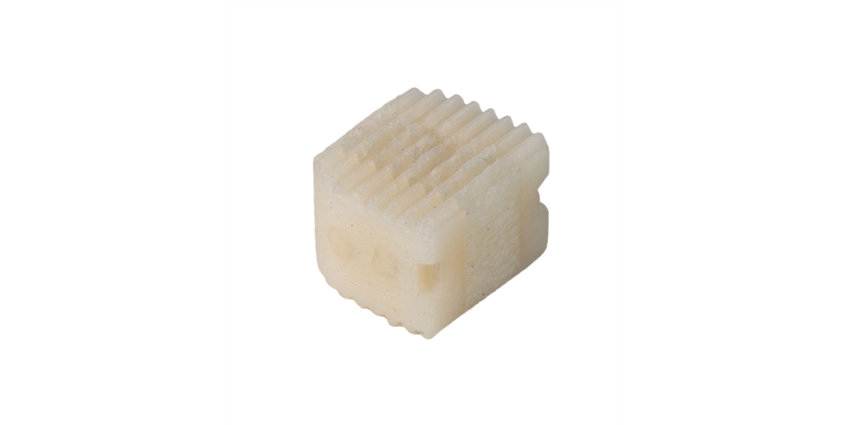
LifeNet Health, a Virginia Beach, Virginia, 501(c)(3) non-profit tissue bank and allograft processor recently announced the launch of the VertiGraft® ACIS VG2™. The ACIS VG2 is the latest addition to the VertiGraft product line, which includes lumbar interbody spaces and previous versions of the cervical spacer. The new version is the first to be compatible with ACIS instrumentation.
LifeNet Launches VertiGraft ACIS VG2 Structural Allograft for ACDF
1 min read Premium comments
Secondary#acisvg2#interbodyspacer#vertigraft
The VG2 is available in small and medium footprint sizes as well as parallel and 7o lordotic options and a range of heights from 5-12mm. The ACIS is chamfered for easy insertion, and is grooved to reduce the risk of expulsion. The machined allograft device is composed of cortical endplates and a cancellous core to facilitate early vascularization and bone remodeling. A prospective study published in 2005 showed that earlier versions of LifeNet’s allograft spacers led to 100% fusion rates at 12 months in a cohort of 74 ACDF (anterior cervical discectomy and fusion) patients.
LifeNet Health General Manager of Global Spine and General Orthopedics Heather Pierce said that “VertiGraft ACIS VG2 brings together the latest in structural allograft technology with state-of-the-art spinal instrumentation…. The result is greater efficiency and flexibility for clinicians and effective healing for patients.”
Beyond the machining process, LifeNet Health also uses its proprietary allograft preparation methods to ensure safety and convenience in the OR. The Allowash XG® provides sterility and removes most marrow and blood elements and Preservon® uses a glycerol-based preservation solution to provide room-temperature shelf stability. Preservon also keeps the allograft in a hydrated state, eliminating the need for a rehydration step during surgery, and maintaining bone strength.
LifeNet Health offers a full portfolio of spine interbodies for cervical and lumbar fusion, vertebral body replacements for corpectomy, and a wide array of allograft-based biologics. It also offers allograft products for a number of other orthopedic and vascular solutions.
Author
React:
Discussion
This is a fascinating development. In my practice we've seen similar outcomes with the revised protocol. The key differentiator seems to be patient selection criteria. Has anyone else noticed the correlation with BMI thresholds?
Great point. I'd push back slightly on the conclusion, the sample size in the cited study is too small to draw population-level inferences. That said, the directional signal is compelling and worth a larger RCT.
We implemented a similar approach last year. Early results are promising but we're still gathering 12-month follow-up data. Happy to share our protocol if anyone is interested.
Join the conversation
Orthopedic professionals are discussing this. Sign in and upgrade to read every comment and add your voice.