
Israeli-based CartiHeal Ltd, has been granted “Breakthrough Device Designation” by the FDA for the company’s Agili-C Implant. The designation comes after interim results were announced in December 2019 showing that the predictive probability of success from a pivotal investigational device exemption (IDE) clinical study was greater than 95%.
FDA Grants Breakthrough Designation for Agili-C
2 min read Premium comments
Secondary#cartilagerepair#cartiheal#fdabreakthroughdevicedesignation
The study is funded by Johnson & Johnson, Bioventus, Elron, Accelmed, Access Medical Ventures, aMoon and Peregrine Ventures. In January 2020, we wrote that the study is one of the most ambitious and promising cartilage repair studies in history.
Gaining the designation means the agency believes the Agili-C offers “significant” advantages over existing products.
According to the FDA, the designation allows the company to get feedback from FDA staff on device development through “sprint” discussions, data development plans and a clinical protocol agreement. The company also receives prioritized review on future regulatory submissions, including Q-Submissions, Investigational Device Exemption applications and marketing submissions.
In short, the designation is designed “to speed up the development, assessment, and review, while preserving the statutory standards for premarket approval, 510(k) clearance, and De Novo marketing authorization.”
Agili-C
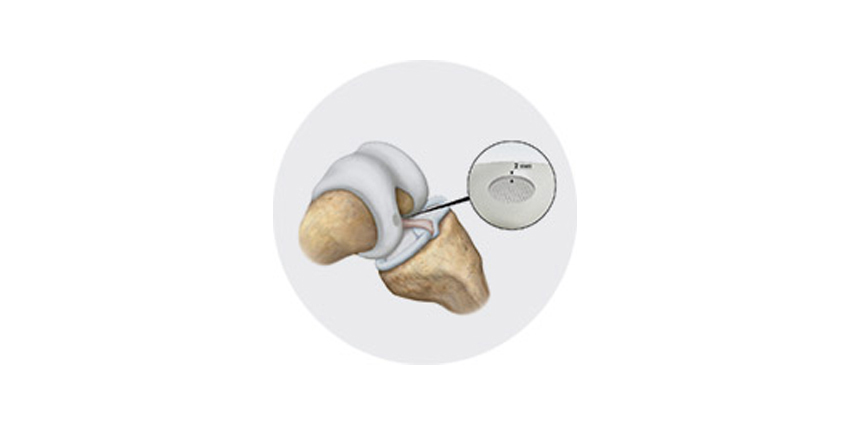
Agili-C is a proprietary biocompatible and biodegradable tapered-shape implant for the treatment of cartilage lesions in arthritic and non-arthritic joints. The company says the cell-free, off-the-shelf implant is CE marked for use in cartilage and osteochondral defects.
It is manufactured from aragonite (calcium-carbonate), derived from sea coral. When implanted into a pre-prepared osteochondral hole it acts as a 3D scaffold that potentially supports and promotes the regeneration of the articular cartilage and its underlying subchondral bone.
The device has been implanted in over 500 study patients with knee, ankle, and great toe cartilage lesions in a series of clinical trials in Europe and Israel, “treating a broad spectrum of cartilage lesions, from single focal lesions to multiple and large defects in osteoarthritic patients.”
Pivotal IDE Study
In an October 12, 2020 press release, the company said it is currently conducting the pivotal IDE clinical study designed to evaluate the implant superiority over the current surgical standard of care—microfracture and debridement. In total, 251 subjects have been enrolled in 26 sites in the U.S., Europe and Israel. The study includes subjects with both mild to moderate osteoarthritis and focal defects, without arthritic changes. Final study results are expected next year.
Breakthrough Device Designation Program
To qualify for the FDA designation program, sponsors need to meet two criteria.
First, the device provides for more effective treatment or diagnosis of life-threatening or irreversibly debilitating human disease or conditions.
Second, the device meets at least one of the following: breakthrough technology, no approved or cleared alternatives exist, offers significant advantages over existing approved or cleared products, and device availability is in the best interest of patients.
You can learn more about the program in Sections II and IV of the Breakthrough Devices Program final guidance.
Author
React:
Discussion
This is a fascinating development. In my practice we've seen similar outcomes with the revised protocol. The key differentiator seems to be patient selection criteria. Has anyone else noticed the correlation with BMI thresholds?
Great point. I'd push back slightly on the conclusion, the sample size in the cited study is too small to draw population-level inferences. That said, the directional signal is compelling and worth a larger RCT.
We implemented a similar approach last year. Early results are promising but we're still gathering 12-month follow-up data. Happy to share our protocol if anyone is interested.
Join the conversation
Orthopedic professionals are discussing this. Sign in and upgrade to read every comment and add your voice.