
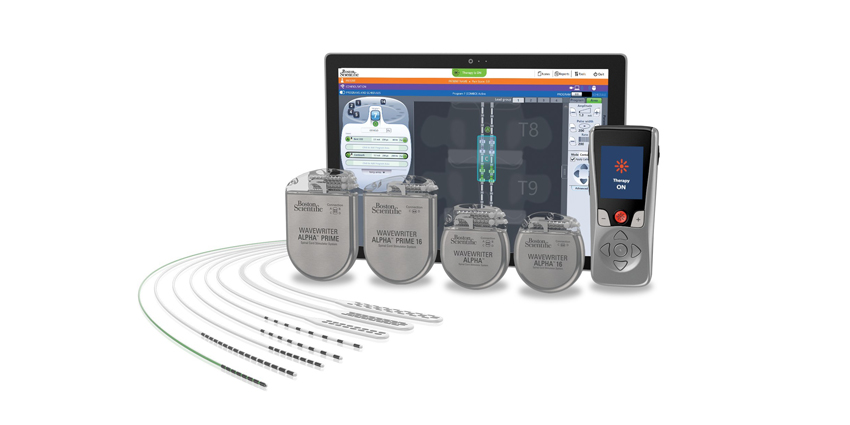
Marlborough, Massachusetts-based Boston Scientific Corporation recently announced the launch of the company’s WaveWriter Alpha line of implantable spinal cord stimulators (SCS) in Europe. The portfolio includes a selection of rechargeable or non-rechargeable, Bluetooth-enabled implantable pulse generators, and an array of electrode options. The pulse generators are programable through exterior devices and deliver the prescribed stimulation intended to reduce chronic pain.
EU Launch for WaveWriter Alpha Implantable Spinal Stim
2 min read Premium comments
#bostonscientific#spinalcordstimulationSecondary#wavewriter
The WaveWriter Alpha includes a rechargeable pulse generator available in 16- and 32-lead options; it requires replacement less frequently than the WaveWriter Alpha Prime, a non-rechargeable version, also available with 16 or 32 leads. The lifespan of the implantable pulse generators depend on the stimulation program and frequency of use, the rechargeable version is expected to last at least 5 years, and up to 25 years, while the WaveWriter Alpha Prime, when used on nominal program settings (based on literature) is expected to last 5 years before requiring replacement.
The WaveWriter Alpha systems use a combination therapy to layer paraesthesia, and paraesthesia-free options at the same time. With up to 32 leads, many nerves can be targeted depending on what is needed for a specific patient. The devices were tested in the COMBO randomized control trial by comparing the use of multiple stimulation modalities with conventional SCS therapy (typically referred to as tonic stimulation). The vast majority of patients (88%) responded positively to multiple modalities with greater than 50% reduction in pain, a standard measurement of success in SCS clinical trials. Disability was also greatly improved, with an average of 26 points of improvement.
Jan Vesper, M.D. Ph.D., from University Hospital of Düsseldorf, Germany said, “The combination of different therapy features that promote simplicity like the WaveWriter Alpha SCS Systems enable enhanced personalization in the advanced treatment of chronic pain.”
Jan Willem Kallewaard, M.D., an anesthesiologist from Rijnstate Hospital, Arnhem, The Netherlands, added his support of the technology and expressed his satisfaction of using it for his patients, “With the WaveWriter Alpha SCS Systems, not only are patients likely to achieve a successful outcome, but their quality of life is also being dramatically improved by regaining many functional abilities.”
“The launch of the WaveWriter Alpha SCS Systems in Europe represent a significant step forward in the treatment of chronic pain,” said company Senior Vice President, and President, Neuromodulation Maulik Nanavaty, Ph.D. “By unifying our portfolio of SCS devices and offering the latest therapy advances, we remain committed to advancing meaningful innovation, providing both physicians and patients access to the full benefits of our entire portfolio of devices.”
The WaveWriter Alpha product line is currently awaiting U.S. FDA approval.
Author
React:
Discussion
This is a fascinating development. In my practice we've seen similar outcomes with the revised protocol. The key differentiator seems to be patient selection criteria. Has anyone else noticed the correlation with BMI thresholds?
Great point. I'd push back slightly on the conclusion, the sample size in the cited study is too small to draw population-level inferences. That said, the directional signal is compelling and worth a larger RCT.
We implemented a similar approach last year. Early results are promising but we're still gathering 12-month follow-up data. Happy to share our protocol if anyone is interested.
Join the conversation
Orthopedic professionals are discussing this. Sign in and upgrade to read every comment and add your voice.