
Saint Louis, Missouri-based CoreLink, LLC. recently announced the launch of some unique instruments for its Oblique Lumbar Interbody Fusion (OLIF) system.
CoreLink Launches 3D Printed Instrument Set for OLIF System
1 min read Premium comments
#olifSecondary#3dprinting#corelinksurgical
The instruments are made by additive manufacturing, also known as 3D printing, of surgical steel. The set includes almost 100 instruments, of which 40 are procedure-specific tools. Disc preparation and insertion instruments are designed to access the disc space with an oblique angle and should limit the need for implant rotation common when using tools and implants designed for other procedures.
The system also includes an advanced retractor system. OLIF-specific instruments are helpful for OLIF procedures that had typically been performed with tools intended for anterior or lateral approaches, so didn’t perfectly fit the needs of surgeons.
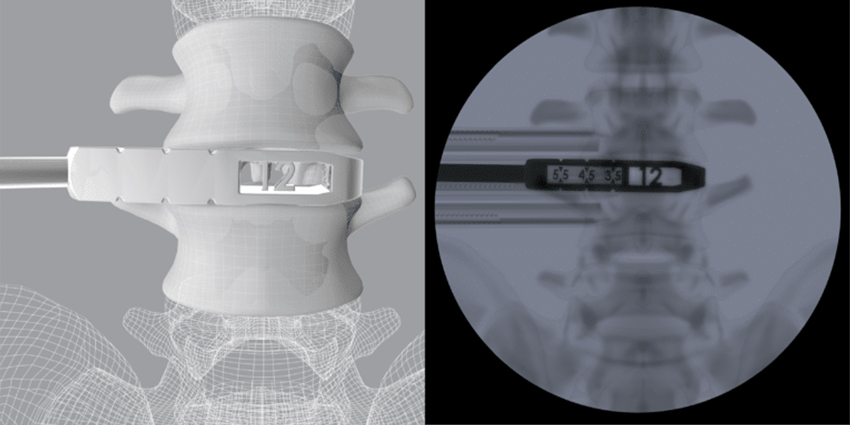
One of the most novel features of the 3D-printed set is the inclusion of specialized trials that have the sizing embedded in the structure, rather than the typical solid metal trials. Essentially providing a built-in ruler. When using intraoperative fluoroscopy, the trial height and lengths are easily visible in imaging for making accurate determinations of the needed implant size without repeated trial insertions.
Chief Executive Officer Jay Bartling said of the product line expansion, “The addition of OLIF instrumentation bolsters our minimally invasive spine surgery options and builds on our robust lateral access, fusion, and stabilization platforms. We’ve taken the approach a step further with 3D printed surgical steel instrumentation, our latest foray into additive manufacturing technology. This allows us to build light-weight instruments with features that would not be possible using traditional subtractive methods.” He recognized the achievements of his product development team by saying, “We challenged ourselves to a strong year of product development and our team has been consistently delivering.”
The instrument system is also compatible with the company’s CL5 PEEK and F3D titanium alloy lateral interbody cages.
Author
React:
Discussion
This is a fascinating development. In my practice we've seen similar outcomes with the revised protocol. The key differentiator seems to be patient selection criteria. Has anyone else noticed the correlation with BMI thresholds?
Great point. I'd push back slightly on the conclusion, the sample size in the cited study is too small to draw population-level inferences. That said, the directional signal is compelling and worth a larger RCT.
We implemented a similar approach last year. Early results are promising but we're still gathering 12-month follow-up data. Happy to share our protocol if anyone is interested.
Join the conversation
Orthopedic professionals are discussing this. Sign in and upgrade to read every comment and add your voice.