
Getting a CT scan in a patient’s natural weight-bearing state provides a better roadmap for surgical planning. At least that is the theory behind CurveBeam’s CT imaging system.
CE Mark for CurveBeam’s CT Imaging System
2 min read Premium comments
Secondary#curvebeam#cemark#ctscan
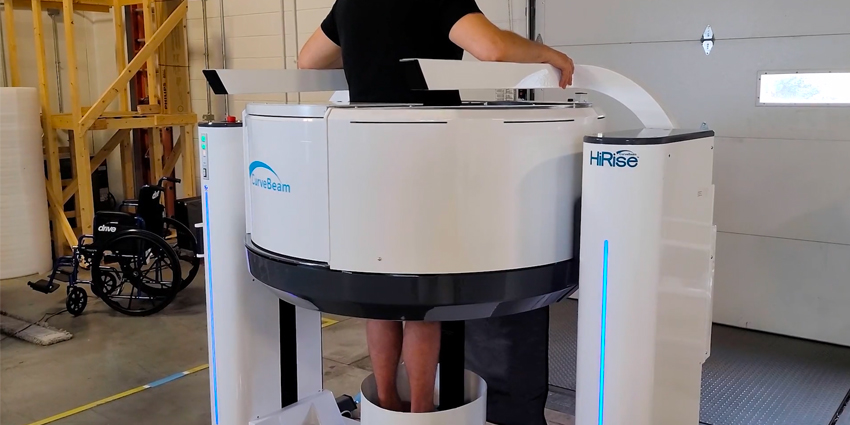
On October 1, 2020, the company announced that its new weight bearing CT imaging system, the HiRise, a weight bearing CT imaging system for the lower extremity, received CE marking.
The company says it expects FDA 510(k) clearance by the end of 2020.
The system, according to the company, is the first that lets patients stand naturally on both feet during a scan. The HiRise can scan anywhere along the lower extremity from the hip & pelvis to the feet, a novel application the company says is not available in any other system.
Dr. Sajid Butt, a consultant radiologist at Royal National Orthopedic Hospital-Stanmore, said, “Physiological assessment of the bones and joints has obvious advantages, but getting this data via multiplanar imaging enables accurate road maps for effective surgical planning. No other weight bearing imaging modality can provide as much information as the HiRise.”
Guy Long, CurveBeam’s director of European Affairs, said the launch of the company’s third-generation device comes less than a decade after introducing the first weight bearing CT system for foot and ankle.
Cone Beam Technology
The HiRise utilizes cone beam CT technology and is designed for the orthopedic point-of-care setting.
Here are the benefits, as described by the company:
“Compact – Systems can be sited in small spaces and next to existing imaging equipment. Cooling systems are not required.
Easy to Install – Systems fit through a standard doorway and plug into a standard wall outlet.
Self-Shielded – CurveBeam systems are self-shielded, and independent assessments have concluded that scatter radiation is close to zero once you reach a distance of six feet from the unit. Therefore, in most cases, minimal to no shielding modifications are required for CurveBeam system installations. However, only a qualified medical physicist may make this determination.”
Weightbearing CT
In the September 26, 2016 edition of Podiatry Today, Albert Armstrong, DPM, CWS, Dean of the School of Podiatric Medicine at Barry University, wrote that weightbearing CT, “is a powerful tool that can enhance biomechanical evaluation, preoperative planning, postoperative evaluation, wound management and sports medicine as well as the treatment of arthritic conditions (especially degenerative joint disease) and trauma (especially when looking for occult or hairline fractures). This technology is an asset to podiatric medicine now and will continue to be so in the future.”
To see the HiRise in action, click here.
Author
React:
Discussion
This is a fascinating development. In my practice we've seen similar outcomes with the revised protocol. The key differentiator seems to be patient selection criteria. Has anyone else noticed the correlation with BMI thresholds?
Great point. I'd push back slightly on the conclusion, the sample size in the cited study is too small to draw population-level inferences. That said, the directional signal is compelling and worth a larger RCT.
We implemented a similar approach last year. Early results are promising but we're still gathering 12-month follow-up data. Happy to share our protocol if anyone is interested.
Join the conversation
Orthopedic professionals are discussing this. Sign in and upgrade to read every comment and add your voice.