
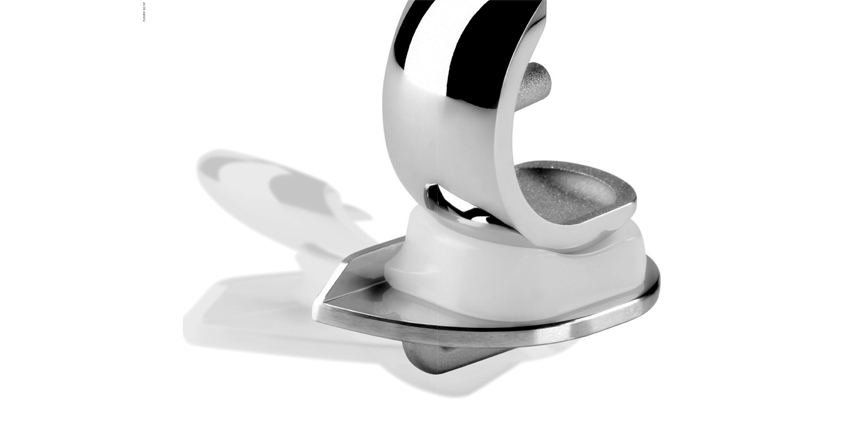
A team from the UK has published results of the first in vivo study to measure wear and creep after knee replacement, in particular, after mobile-bearing unicompartmental knee replacement.
Are Poly Wear Rates Higher for Cemented vs Uncemented Unis?
1 min read Premium comments
Secondaryaudio#polyethylenecreep#polyethylenewear
The study, “Low polyethylene creep and wear following mobile-bearing unicompartmental knee replacement,” appears in the September 17, 2020 edition of Knee Surgery, Sports Traumatology, Arthroscopy.
Professors David Murray and Stephen Mellon with the Oxford Orthopaedic Engineering Centre in the UK and co-authors on the study explained the genesis of the study to OTW, “We had heard a presentation that suggested that the polyethylene wear rate was higher following cementless rather than cemented unicompartmental knee replacement and were worried that this might cause failure of the cementless components in the long term.”
“To assess the fixation of the cementless Oxford unicompartmental knee replacement we undertook a randomised study using radiostereometric analysis (RSA) to compare the migration of cemented and cementless components. We reanalysed these radiostereometric analysis radiographs to assess the distance between the femoral and tibia components which is the bearing thickness. With radiographs taken post-operatively and at 3 months, 6 months, 1 year, 2 years and 5 years, we were able to calculate the wear rate from the gradual decrease in bearing thickness.”
“The wear rate was found to be identical for cemented and cementless components,” said Dr. Mellon to OTW. “The mean wear rate was low which suggests most patients can expect to have no issues with their bearings due to wear for at least 20 years after their primary operation. The wear rate elevates by a small but statistically significant amount when the base of the bearing goes beyond the medial margin of the tibial component i.e. bearing overhang.”
“Although polyethylene creep has been observed with other joint replacements it had never been shown with the mobile bearing of the Oxford Unicompartmental Knee Replacement. We found creep occurs in the immediate post-operative period. It is finished by around 6 months and after this point bearing thickness changes due to wear alone. Creep is deformation that occurs to the bearing as a result of reorganisation of the material in response to loading.”
Author
React:
Discussion
This is a fascinating development. In my practice we've seen similar outcomes with the revised protocol. The key differentiator seems to be patient selection criteria. Has anyone else noticed the correlation with BMI thresholds?
Great point. I'd push back slightly on the conclusion, the sample size in the cited study is too small to draw population-level inferences. That said, the directional signal is compelling and worth a larger RCT.
We implemented a similar approach last year. Early results are promising but we're still gathering 12-month follow-up data. Happy to share our protocol if anyone is interested.
Join the conversation
Orthopedic professionals are discussing this. Sign in and upgrade to read every comment and add your voice.