
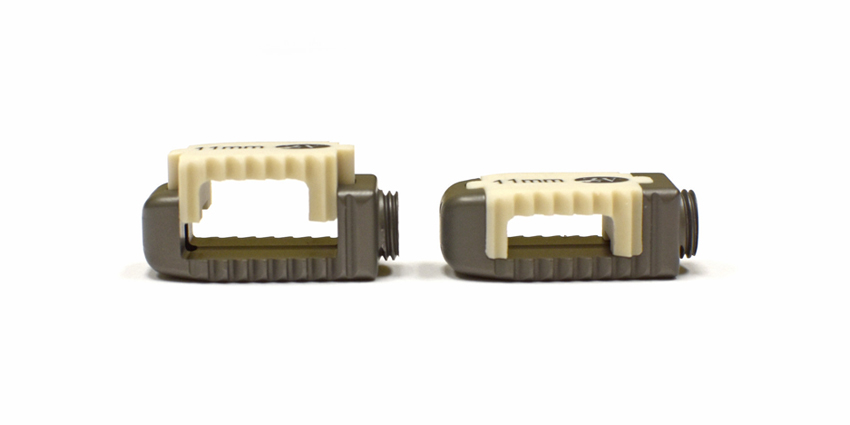
Zavation Medical Products, LLC. recently announced the launch of its Lateral Expandable Interbody Fusion (LEIF) cage. The company, based in Flowood, Mississippi, designed the implant to be expanded laterally after being inserted through either a posterior lumbar interbody fusion (PLIF) or transforaminal lumbar interbody fusion (TLIF) approach. The lateral expansion, controlled similarly to typical vertically expandable cages, offers greater endplate contact surface area to reduce the risk of subsidence, and to double the size of the graft window.
Zavation Launches Laterally Expanding Cage for Lumbar Fusion
1 min read Premium comments
Secondary#zavation#lateralexpandinginterbodycage
The cage is made primarily of titanium with the expanding side made of PEEK. A variety of heights and geometric options are available to best fit patient anatomy. The device is indicated for up to 2 contiguous levels of fusion with autogenous bone graft from L2 to S1. Fusion with the device also requires supplemental fixation.
Jimmy Miller, M.D., J.D., a neurosurgeon from Greenwood Leflore Hospital, in Greenwood, Mississippi, described his experience with the new cage. “There are several very important advantages of the hybrid LEIF cage. First, the expanded cage has a large size that lessens the likelihood of subsidence. Second, it has a large footprint and an increased available space for graft material that promotes bony fusion. Third, once expanded the hybrid LEIF cage is wider than the annulotomy through which it was inserted, lessening the possibility of posterior migration. Fourth, it has the increased strength of a titanium alloy,” he said in a press release from the company.
The current version of the device succeeds the all-PEEK version first cleared by the U.S. FDA in 2015 under the same name. The LEIF joins similar laterally expanding designs from other manufacturers, such as the Longbow and TiBow from Life Spine, Inc. and the Latis from Globus Medical, Inc. among others. The ubiquity of laterally expanding posterior implants suggests the necessity of offering such devices when offering a complete spine implant product line.
Author
React:
Discussion
This is a fascinating development. In my practice we've seen similar outcomes with the revised protocol. The key differentiator seems to be patient selection criteria. Has anyone else noticed the correlation with BMI thresholds?
Great point. I'd push back slightly on the conclusion, the sample size in the cited study is too small to draw population-level inferences. That said, the directional signal is compelling and worth a larger RCT.
We implemented a similar approach last year. Early results are promising but we're still gathering 12-month follow-up data. Happy to share our protocol if anyone is interested.
Join the conversation
Orthopedic professionals are discussing this. Sign in and upgrade to read every comment and add your voice.