
It’s one thing to tell surgeons to stop prescribing opioids to help curb the national crisis, but it’s another to actually have evidence for effective alternatives. Thankfully, that list is growing with recent publications supporting a pair of drugs that have been shown to reduce opioid use during and after surgery.
The Effort to Reduce Opioid Use Gets a Boost From New Drugs
2 min read Premium comments
#opioidSecondary#caldolor#dsuvia#reducingopioids#sufentanil
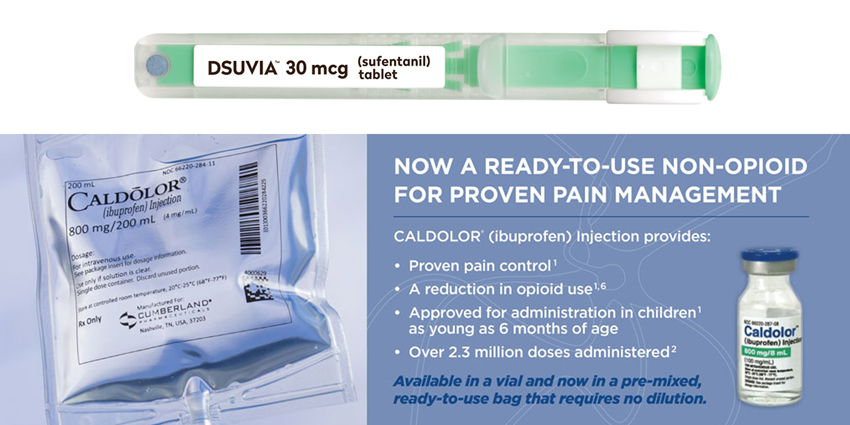
The first, Caldolor®, from Cumberland Pharmaceuticals, Inc., is an ibuprofen injection that is shown to reduce opioid use, as well as over-the-counter medication. A recent review of nine clinical studies was published in Clinical Therapeutics.
The analysis, “Narrative Summary of Recently Published Literature on Intravenous Ibuprofen,” found that Caldolor achieves a higher plasma concentration more quickly than oral ibuprofen and improves post-surgical recovery, surgical stress, and post-surgical pain, in addition to reduced opioid use.
Cumberland Pharmaceuticals Chief Executive Officer A.J. Kazimi said, “We are proud to see the continued support for the use of Caldolor in postoperative care, with the resulting reduction of opioid use. We feel confident that this newly published narrative provides additional insights into how intravenous ibuprofen can help healthcare professionals and patients as elective surgeries resume.”
A second study, “Reduced Opioid Use and Reduced Time in the Post anesthesia Care Unit Following Preoperative Administration of Sublingual Sufentanil in an Ambulatory Surgery Setting,” was published in the Journal of Clinical Anesthesia and Pain Management in August 2020.
The prospective study followed 127 patients who received a single 30 mcg dose of sublingual sufentanil before surgery at an outpatient surgical center. The drug is an opioid analgesic made by AcelRx Pharmaceuticals, Inc. under the brand name DSUVIA®, and was approved by the FDA in 2018. Its potency is approximately 5-times that of Fentanyl, and 500-times morphine.
The authors reported a significant reduction in intraoperative IV opioid (61.7% of treated patients vs. 97.5% in the control). Post-operative opioid needs were significantly and substantially reduced (10.5% of treated patients vs 63% of the control). Treated patients used less than half of the amount of opioids, measured as milligram morphine equivalents (MME), perioperatively (11.8MME vs. 24.6MME). PACU discharge was 34% faster for treated patients compared with controls.
AcelRx Chief Medical Officer and Co-Founder Pamela Palmer, M.D., Ph.D. said that: “the standard of care for perioperative opioid administration has not been disrupted for over 100 years. We should no longer accept the rapid plasma fluctuations of IV bolus opioid administration as the status quo…which ultimately results in higher overall opioid exposure. DSUVIA for the first time offers a unique pharmacokinetic profile for an opioid in the perioperative setting…We expect this study to be one of several upcoming datasets to support the broad acceptance of DSUVIA as an alternative to IV opioids.”
These studies make it clear that reducing opioids is not only about sending patients home with smaller prescriptions, or alternative pain relief options. With better use of analgesics, even opioid-based drugs, before and during surgery patients will wake up in less pain, and be less likely to reach for a bottle of opioids than if they had been treated with the standard-of-care.
Author
React:
Discussion
This is a fascinating development. In my practice we've seen similar outcomes with the revised protocol. The key differentiator seems to be patient selection criteria. Has anyone else noticed the correlation with BMI thresholds?
Great point. I'd push back slightly on the conclusion, the sample size in the cited study is too small to draw population-level inferences. That said, the directional signal is compelling and worth a larger RCT.
We implemented a similar approach last year. Early results are promising but we're still gathering 12-month follow-up data. Happy to share our protocol if anyone is interested.
Join the conversation
Orthopedic professionals are discussing this. Sign in and upgrade to read every comment and add your voice.