
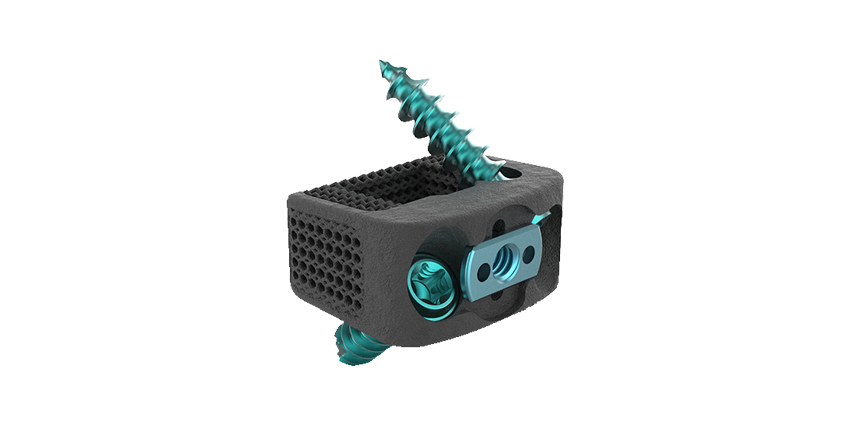
Noblesville, Indiana-based Nexxt Spine, LLC. has announced the release of a new version of its stand-alone cervical interbody device with an integrated turn lock function. Similar to the previous version, the Stand-Alone Cervical Turn Lock (TL) System includes the company’s Nexxt Matrixx® 3D-printed titanium interbody with variable pore sizes, a pair screws, and the addition of a turn lock to prevent screw backout.
Stand-Alone Cervical System Updated With Turn Lock
1 min read Premium comments
Secondary#nexxtspine#standalone#cervicalinterbodydevice
The device offers a zero-profile design with that eliminates the need for supplemental fixation. The device is available in a range of sizes from 12 x 14 mm to 16 x 18mm, heights from 5-12mm, and lordosis up to 6o. Self-guided instrumentation, and, now, preventable screw backout are some highlights of the new system for surgeons. The devices come presterilized, as well. The turn lock update was cleared by the U.S. FDA back in March 2020.
The Nexxt Matrixx, featured in several of the company’s current interbody devices, is an engineered lattice of 3D printed titanium with varying pore sizes and a modulus of elasticity similar to polyether ether ketone (PEEK). The varied pore sizes and texture are designed to induce attachment and activation of endogenous bone growing cells. Company President Andy Elsbury was quoted in a press release: “Our products are constantly evolving to better serve our surgeons’ needs; showcased by the release of Stand Alone TL.” He continued with appreciation for the teams responsible for the launch. “The Nexxt Spine development team has their fingers on the pulse of industry preferences. With the luxury of in-house manufacturing we are able to innovate and deliver design iterations and new products at an impressive rate.”
The company also teased the Q4 release of ALIF and Lateral lumbar plates from the Struxxure portfolio, which currently consists of only cervical plates. The lumbar plates received 510(k) clearance in mid-September 2020.
Author
React:
Discussion
This is a fascinating development. In my practice we've seen similar outcomes with the revised protocol. The key differentiator seems to be patient selection criteria. Has anyone else noticed the correlation with BMI thresholds?
Great point. I'd push back slightly on the conclusion, the sample size in the cited study is too small to draw population-level inferences. That said, the directional signal is compelling and worth a larger RCT.
We implemented a similar approach last year. Early results are promising but we're still gathering 12-month follow-up data. Happy to share our protocol if anyone is interested.
Join the conversation
Orthopedic professionals are discussing this. Sign in and upgrade to read every comment and add your voice.