
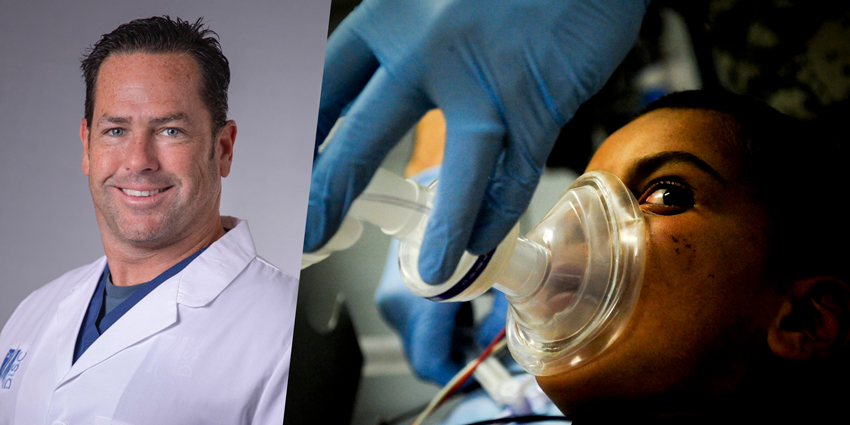
The goal of the anesthesiologist in the operating room is to provide optimal conditions for the surgeon. “The surgeon shouldn’t have to think about his or her patients’ anesthesia. Usually, this involves leaving our ego at the door,” Joseph Barrows, M.D., Medical Director and Chief of Anesthesiology at the DISC Sports and Spine clinic in Newport Beach, California, told Orthopedics This Week in a recent interview. “You don’t want to be the rate limiting step during the surgery,” he continued.
One of the Most Vital OR Doctors Likely Won’t Say a Word
3 min read Premium comments
#spinesurgery#anesthesia#josephbarrows
Barrows also shared some advice and anecdotes from his tenure at DISC where he has striven to improve patient outcomes and satisfaction. He has made progress in reducing post-operative nausea and vomiting (PONV) in his patients, to less than 5%, which he said greatly improves patients’ overall satisfaction with a procedure. The idea of improving overall satisfaction with a medical procedure by greatly improving the ending has been shown to be effective in other areas, such as colonoscopies.
Barrows shared some tips for reducing PONV with us. Much of PONV is due to pain, narcotics, anxiety, and dehydration, so these are the areas he focuses on improving. He provides patients with 1-2 liters of additional fluids to address dehydration, a dose of Decadron to handle inflammation and a serotonin receptor agonist (such as Zofran). Additionally, Barrows recommends the use of Propofol on an IV drip to maintain sedation and to allow the use of up to 50% less anesthetic gas. Finally, under careful observation, Barrows practices “deep extubation,” (i.e., the removal of the endotracheal tube while the patient is still anesthetized), to prevent bucking and discomfort.
Due to the nature of spine surgery, some techniques, such as nerve blocks that can be used in other orthopedic procedures are not available options. This means that the patient will typically need more drugs for pain. Barrows says that due to the nature of the outpatient surgery setting, he needs to wake his patients up within 5-10 minutes after surgery so that a neurological exam can be conducted before the patient begins the discharge process. He considers his job complete only after the patient is awake and has successfully passed their exam.
Barrows was proud to say that he has had virtually no issues with anesthesiology during his nearly 10-year tenure at DISC. He did share one anecdote that highlighted the importance of the anesthesiologist’s responsibility to a patient’s safety in the OR. He described the situation of a patient with dropping blood pressure due to a bleed. Barrows began treating the drop medically, but after a few minutes asked the surgeon if he could fix the bleed. The surgeon admitted that he could not and the patient was transferred to a hospital. By being realistic and working together, the physicians prevented the patient from suffering from any long-term adverse events.
A 2018 publication in BackBone, the journal of the American College of Spine Surgery, is dedicated to the anesthesiologist who works in the spine OR. The article, written by Jack Buckley, M.D. and Natalie Moreland, M.D. from the University of California at Los Angeles, attempts a fairly comprehensive review of what makes anesthesia for spine surgery unique. “Anesthesia Pitfalls and Considerations for Spine Surgery,” is packed with advice on preoperative care, airway management, intubations with fiberoptic or laryngoscopes, patient positioning, nerve and eye injuries, intraoperative care, and analgesia. For some topics, such as airway recommendations for patients with cervical spine disease, the authors highlight the need for additional evidence from clinical studies to support one technique over another.
Our interview with Barrows, and the publication in BackBone make it clear that spine surgery provides challenges to anesthesiologist beyond what they experience in other orthopedic procedures. The anesthesiologist should be one of the spine surgeon’s greatest allies before, during, and after surgery and needs to be involved in each step of the patient’s care.
Author
React:
Discussion
This is a fascinating development. In my practice we've seen similar outcomes with the revised protocol. The key differentiator seems to be patient selection criteria. Has anyone else noticed the correlation with BMI thresholds?
Great point. I'd push back slightly on the conclusion, the sample size in the cited study is too small to draw population-level inferences. That said, the directional signal is compelling and worth a larger RCT.
We implemented a similar approach last year. Early results are promising but we're still gathering 12-month follow-up data. Happy to share our protocol if anyone is interested.
Join the conversation
Orthopedic professionals are discussing this. Sign in and upgrade to read every comment and add your voice.