
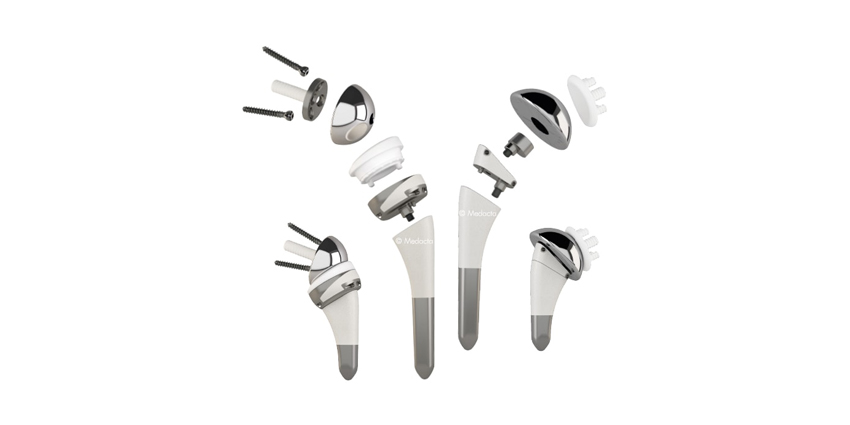
Medacta International, Inc., has received 510(k) clearance from the FDA for its Lateralized Glenosphere. The implant received CE marking in 2019 and, according to the company, expands the offering for its reverse shoulder system.
Medacta Receives Clearance to Expand Shoulder System
2 min read Premium comments
#fda510kclearance#medactaSecondary#shoulderreplacement
The company says the device features “a more lateralized center of rotation compared to the standard glenosphere” currently offered with its shoulder system. “The potential benefits of a more lateralized construct include an improved range of motion and a reduced risk of scapular notching.”
Reverse Shoulder System
The reverse shoulder system was cleared by the FDA in 2017 and is indicated for “treatment of humeral fractures and for primary or revision total shoulder replacement in patients with a grossly deficient rotator cuff shoulder joint with severe arthropathy or a previously failed joint replacement and a grossly rotator cuff deficient shoulder joint.”
The FDA clearance documents state the glenoid baseplate “is intended to be fixed on the glenoid bone by means of a central press-fit and with the help of Glenoid Polyaxial Locking Screws. The Glenoidsphere is intended to be assembled with the Glenoid Baseplate by means of a taper Morse connection and secured by the Glenoidsphere Screw.”
The system is a modular solution that features a broad range of options, including wide-ranging sizes, adjustable offset and innovative configurations both in the anatomic and in the reverse configuration. Included in the system are 2 stem options, standard and short, 3 humeral inclination options for total shoulder arthroplasty (TSA) (128°/135°/142°) and 2 for RSA (145° and 155°), 4 sizes for reverse shoulder arthroplasty (RSA) glenosphere and 10 cemented pegged glenoid for TSA for an optimized mismatch.
Earlier this year, the company introduced the Long Humeral Diaphysis, expanding the system. This new option, according to the company, “together with the Lateralized Glenosphere, makes the Medacta Shoulder System increasingly complete and innovative.”
Medacta
Medacta was established in 1999 in Switzerland and developed offerings focused on minimally invasive surgical techniques, in particular its Anterior Minimally Invasive Surgery (“AMIS”) technique for hip replacements.
The company then developed the “MySolutions” technology, which offers surgeons personalized pre-operative planning and implant placement methodologies by creating personalized kinematic models and 3D planning tools for use in hip, knee, shoulder, and spine procedures.
In February 2017, the company entered the shoulder arthroplasty market by announcing the completion of the first surgery utilizing its shoulder system, performed by Professor Ralph Hertel in Bern, Switzerland. — WE
Author
React:
Discussion
This is a fascinating development. In my practice we've seen similar outcomes with the revised protocol. The key differentiator seems to be patient selection criteria. Has anyone else noticed the correlation with BMI thresholds?
Great point. I'd push back slightly on the conclusion, the sample size in the cited study is too small to draw population-level inferences. That said, the directional signal is compelling and worth a larger RCT.
We implemented a similar approach last year. Early results are promising but we're still gathering 12-month follow-up data. Happy to share our protocol if anyone is interested.
Join the conversation
Orthopedic professionals are discussing this. Sign in and upgrade to read every comment and add your voice.