
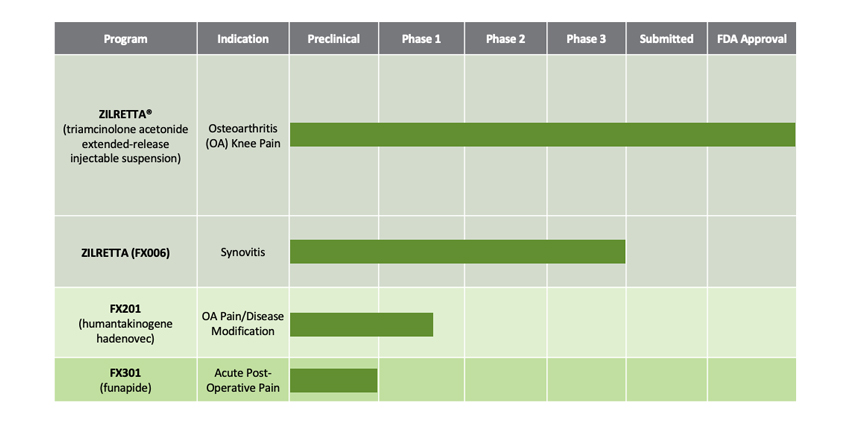
Flexion Therapeutics, Inc., based in Burlington, Massachusetts, announced that the first patient has been enrolled for the second cohort of the Phase 1 dose-escalation trial evaluating the safety and tolerability of FX201, an intra-articular, IL-1Ra gene therapy product candidate being developed for the treatment of osteoarthritis (OA).
Key Trial of Novel OA Gene Therapy Advances
2 min read Premium comments
#osteoarthritisSecondary#flexiontherapeutics#fx201
“We are encouraged by the continued progress of the single ascending dose study of FX201,” said company President and CEO Michael Clayman, M.D. “OA is a painful, progressive disease which has no cure and although it remains early days, the data from the first cohort of five patients supports the advancement of this important program which we believe could establish a new standard for durability of pain relief and potentially modify disease progression.”
The company reported, “The open-label, dose-escalation study is expected to enroll 15 to 24 patients, 30-80 years of age and test three doses (low, mid and high dose) of FX201 in cohorts of five to eight patients. Each patient will only receive one injection of FX201. Following the completion of the first cohort in which five patients (Kellgren-Lawrence Grade 2 or 3) were treated with the low dose of FX201, safety data were collected and reviewed by an independent DMC [Drug Monitoring Committee]. After evaluating the first cohort safety data, the DMC supported continuing the trial and initiating treatment in the next dosing cohort which will include KL [Kellgren-Lawrence] Grade 4 patients…”
Pain Relief and Functional Improvement
“FX201 (humantakinogene hadenovec) is a novel, intra-articular gene therapy product candidate which utilizes a helper-dependent adenovirus (HDAd) vector based on human serotype 5 (Ad5) that is designed to transfer a gene to cells in the joint to produce an anti-inflammatory protein, interleukin-1 receptor antagonist (IL-1Ra), under the control of an inflammation-sensitive promoter,” the company reports. “Inflammation is a known cause of pain, and chronic inflammation is thought to play a major role in the progression of OA.”
Dr. Clayman told OTW, “The advancement of FX201 into the next cohort of our single, ascending dose study represents important progress in informing our understanding of the safety, tolerability and systemic biodistribution profile of this novel program.”
Asked how they decided on the dosing, Dr. Clayman told OTW, “We looked at our collective animal model data (which is substantial) and performed the kind of scaling that gave us comfort that our dose range in the single ascending dose study would encompass the likely safe and effective dose.”
“While it is still early days for the program, the preclinical data that supported the initiation of clinical trials suggest that a single injection of FX201 could potentially enable expression of IL-1Ra in an osteoarthritic joint for at least a year. By persistently suppressing Inflammation, FX201 holds the potential to both provide an unprecedented duration of pain relief and modify disease progression which would be unquestionably transformative for knee osteoarthritis.”
“We look forward to sharing data from the study next year.”
Author
React:
Discussion
This is a fascinating development. In my practice we've seen similar outcomes with the revised protocol. The key differentiator seems to be patient selection criteria. Has anyone else noticed the correlation with BMI thresholds?
Great point. I'd push back slightly on the conclusion, the sample size in the cited study is too small to draw population-level inferences. That said, the directional signal is compelling and worth a larger RCT.
We implemented a similar approach last year. Early results are promising but we're still gathering 12-month follow-up data. Happy to share our protocol if anyone is interested.
Join the conversation
Orthopedic professionals are discussing this. Sign in and upgrade to read every comment and add your voice.