
The COVID-19 pandemic may have forced cancellation of their in-person professional meetings planned for this fall, but the International Congress for Joint Reconstruction (ICJR) hasn’t stopped educating orthopedic professionals.
ICJR’s DAA Hip Virtual CME Course Starts on October 6
2 min read Premium comments
#internationalcongressforjointreconstruction#icjr#orthopedicsthisweekvirtualconventions
Instead, the in-person meetings will become virtual CME series: ICJR faculty will provide the organization’s trademark high-quality orthopedic education, while OTW Virtual Conventions will provide the platform for attendees to not only earn CMEs, but also to interact with faculty, other attendees, and industry from the convenience and comfort of their home or office.
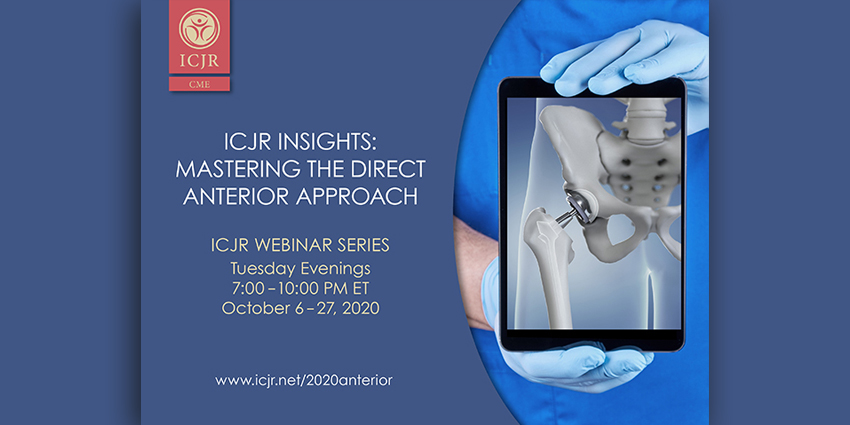
One of the most popular courses is the annual Direct Anterior Approach Hip Course. Starting on Tuesday, October 6, surgeons who are currently using the direct anterior approach for total hip arthroplasty (THA) can participate in the four-week virtual CME series, ICJR Insights: Mastering the Direct Anterior Approach.
The expert faculty—led by Course Chairs Stefan W. Kreuzer, M.D., and Joseph T. Moskal, M.D., FACS—will share their insights on what’s unique about the direct anterior approach to help surgeons expand their knowledge and skills. Topics will include:
- Comparing the direct anterior approach with other surgical approaches for THA, including length of stay, rehabilitation, postoperative restrictions, complications, and return to activities of daily living
- Examining patient selection criteria used to identify patients for whom THA through the direct anterior approach may be indicated, as well as those for whom this approach may be contraindicated
- Evaluating techniques and technologies to facilitate acetabular exposure, femoral releases, and component positioning in direct anterior approach THA, including specialized instrumentation, surgical tables, and computer navigation

“In spite of not being able to convene in person, we have put together an event with a stellar faculty that will bring a high level of content to aid surgeons in their journey to perfect the direct anterior approach,” Dr. Kreuzer said. “The seasoned international faculty members possess an unprecedented knowledge of the direct anterior approach.”
Subsequent webinars in the series will take place on consecutive Tuesday evenings: October 13, October 20, and October 27. The educational portion of all 4 webinars will begin at 7:00 pm EDT.
Attendees will also have ample to explore the booths in the interactive Virtual Exhibit Hall, made possible by the OTW Virtual Conventions platform, and learn more about new products and technologies. The exhibit hall will open at 6:00 pm EDT for one hour before the sessions begin and at 10:00 pm EDT for one hour after they end.
In keeping with ICJR’s mission of educating the orthopedic community, presentations from ICJR Insights: Mastering the Direct Anterior Approach will be available on ICJR’s website, ICJR.net, shortly after the four live webinars have been completed.
Author
React:
Discussion
This is a fascinating development. In my practice we've seen similar outcomes with the revised protocol. The key differentiator seems to be patient selection criteria. Has anyone else noticed the correlation with BMI thresholds?
Great point. I'd push back slightly on the conclusion, the sample size in the cited study is too small to draw population-level inferences. That said, the directional signal is compelling and worth a larger RCT.
We implemented a similar approach last year. Early results are promising but we're still gathering 12-month follow-up data. Happy to share our protocol if anyone is interested.
Join the conversation
Orthopedic professionals are discussing this. Sign in and upgrade to read every comment and add your voice.