
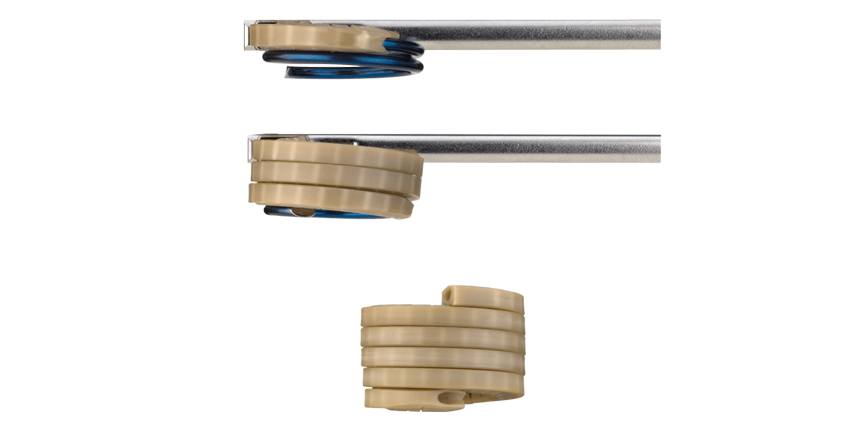
The Kiva™ VCF Treatment System from Maryland-based IZI Medical Products, LLC. has recently been approved for CE marking, which allows for its sale in the EU and participating regions. The system, acquired from Benvenue Medical in 2018, consists of a polyether ether ketone-based (PEEK) vertebral body augmentation implant to help restore vertebral body height and bone integrity.
CE Mark Approved for IZI’s KIVA VCF System
2 min read Premium comments
Secondary#izimedical#kiva#vertebralcompressionfracture
The Kiva device uses a nitinol coil to create a channel in the collapsed vertebral body, a hollow spiral of PEEK is inserted around the nitinol coil and used to jack up the collapsed vertebral body as it forms a column. Bone cement is injected after the nitinol coil is removed. The device gives an alternative to balloon-based kyphoplasty procedures, and implantable devices that have complex expansion mechanisms. The system uses a unipedicular, midline approach to provide minimally invasive treatment. Clinical studies of the device has found similar or better performance when compared with balloon kyphoplasty.
Alexis Kelekis, M.D., Ph.D., EBIR, FSIR, a Professor of Radiology and Interventional Radiology at National and Kapodistrian University of Athens, in Greece, is a proponent of the system. Kelekis has said that Kiva “is the ideal augmentation device when cortical bone damage is involved” because [of] the Kiva’s cement containment characteristics.” Kelekis continued by describing Kiva’s utility in treating patients treated for metastatic cancer of the spine, “It is perfect to fill the void left post-ablation when treating metastatic VCFs [vertebral compression fractures] as it prevents further collapse. Physicians like the Kiva PEEK implant as it provides additional structural stability. We can avoid increased volumes of cement and its inherent risks, one of which is extravasation, with a great biomechanical result leading to long term clinical benefit.”
Reduction in the amount of cement needed has been credited with the system’s ability to reduce the rate of adjacent level fractures, which is often a criticism of the very hard bone cement used to augment fractured vertebral bodies. Company CEO Greg Groenke said in a press release from the company, “We are excited to provide this novel implant technology to the European market and have made significant investments in our international distribution network to broaden our VCF offering.”
Author
React:
Discussion
This is a fascinating development. In my practice we've seen similar outcomes with the revised protocol. The key differentiator seems to be patient selection criteria. Has anyone else noticed the correlation with BMI thresholds?
Great point. I'd push back slightly on the conclusion, the sample size in the cited study is too small to draw population-level inferences. That said, the directional signal is compelling and worth a larger RCT.
We implemented a similar approach last year. Early results are promising but we're still gathering 12-month follow-up data. Happy to share our protocol if anyone is interested.
Join the conversation
Orthopedic professionals are discussing this. Sign in and upgrade to read every comment and add your voice.