
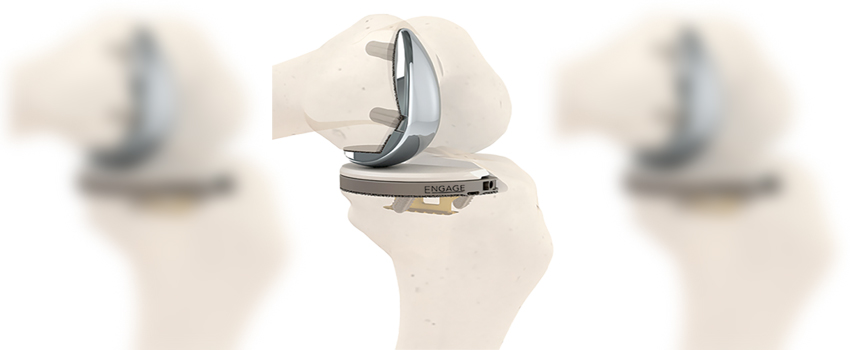
The FDA has granted 510(k) clearance to the first cementless partial knee system in the U.S.—the Engage® Surgical Partial Knee System.
510(k) Clearance for 1st Cementless Partial Knee System in U.S.
2 min read Premium comments
Secondary#cementlesspartialkneesystem#engageanchor#engagesurgical
According to Engage CEO Dan Justin: “The Engage Surgical Partial Knee System is the first partial knee implant cleared by the FDA for both cemented and cementless indications, and the only cementless partial knee currently available in the United States. We believe that our Engage Anchor technology coupled with our Affinium3DTM engineered porous surface has raised the bar for cementless implant long-term biologic fixation and stability.”
Per the FDA documents, the new knee system is indicated for moderately disabling joint disease of the knee resulting from painful osteo- or post traumatic arthritis. It is also indicated for revision of previous unsuccessful surgical procedures, including prior unicompartmental knee arthroplasty. Also, it may be used as an alternative to tibial osteotomy in patients with unicompartmental osteoarthritis.
Engage’s “femoral component and tibial tray are intended for cementless or cemented fixation. The porous surfaces of both the femoral and tibial tray components provide biological fixation when used in a cementless application. When the tibial tray is implanted without the use of bone cement, the tibial anchor should be used. When the tibial tray is implanted with bone cement, the tibial anchor should not be used.”
Dan Justin told OTW, “Our goal is to provide partial knee patients with the better outcomes they deserve. In order to achieve this, our implants first underwent extensive mechanical testing and computer simulation. This benchtop testing confirmed that the Engage Anchor technology creates superior stability and compressive forces at the tibial tray-to-bone interface. Achieving these test results proved to be a major milestone for the product, as it provided evidence that the Engage technology creates a more stable implant while providing the environment needed for osseointegration.”
Extensive Testing and Refinement by a Wide Range of Experienced Surgeons
According to Justin, “Engage Surgical worked with experienced surgeons from a variety of backgrounds to complete over seventy-five cadaver labs to refine our instrumentation and ligament guided technique. That milestone of investing in this large number of clinically-based, hands-on surgeon evaluations is paying dividends now that we have launched our limited market release of our system. The instrumentation and techniques perfected in those labs are now resulting in clinically accurate implant positioning and precise bone cuts allowing for excellent implant-to-bone apposition.”
Step Aside, Robotics
“Our best-in-class ligament-guided approach eliminates the need for surgical robotic assistance, which is ideal for outpatient surgery centers and hospitals alike. Surgeons who are using our system are excited about what they can now offer their patients. We are doing our part to bring excitement and more options to their operating rooms and clinical practices.”
Justin added, “Our system is currently available in select locations through our ongoing Limited Market Release. Follow-up on the first patients has been extraordinary. We have received positive feedback from happy patients and surgeons. Our full U.S. launch will be in 2021.”
Author
React:
Discussion
This is a fascinating development. In my practice we've seen similar outcomes with the revised protocol. The key differentiator seems to be patient selection criteria. Has anyone else noticed the correlation with BMI thresholds?
Great point. I'd push back slightly on the conclusion, the sample size in the cited study is too small to draw population-level inferences. That said, the directional signal is compelling and worth a larger RCT.
We implemented a similar approach last year. Early results are promising but we're still gathering 12-month follow-up data. Happy to share our protocol if anyone is interested.
Join the conversation
Orthopedic professionals are discussing this. Sign in and upgrade to read every comment and add your voice.