
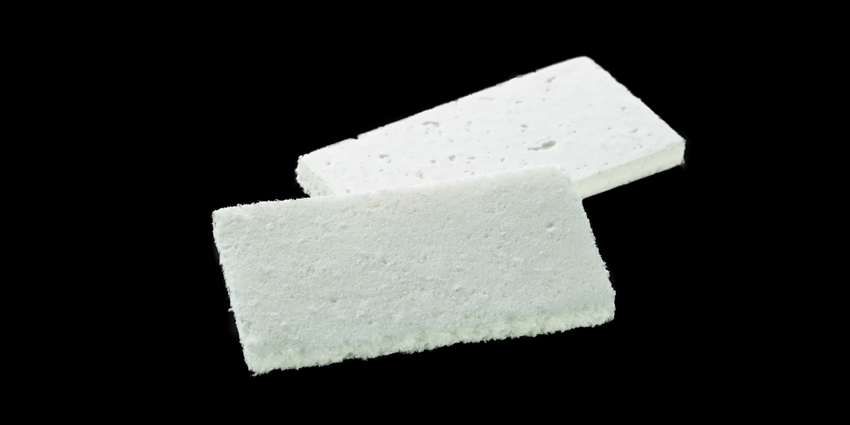
Belgrade, Montana-based Xtant Medical Holdings, Inc. recently announced the launch of its Matriform® Si synthetic bone graft for spinal fusion in the U.S. The silicate synthetic bone graft, provided in strips, is made primarily of beta-tricalcium phosphate (b-TCP) with homogenous incorporation of silicate (bioglass) and porcine collagen.
Silicated Bone Graft Launched in US by Xtant Medical
1 min read Premium comments
Secondary#xtantmedical#curasanag#matriformsi
The silicate accounts for 4% of the material. The flexible strip offers benefits in handling and shape memory to promote direct contact with bone surfaces. The material is osteoconductive and resorbable; it is intended for use with autograft in posteriolaterial spinal fusions.
Xtant Medical Chief Commercial Officer Kevin Brandt said of the material, “We are excited to launch Matriform Si in the U.S., which expands our biologics portfolio offering and increases our footprint in the U.S. orthopedic Bone Graft Substitute market. This innovative synthetic is an ultraporous, interconnected structure that is designed to enhance new bone formation and mechanical stability while preventing premature dissolution for spinal fusion procedures. Our team remains committed to advancing our product portfolio, supporting distributors, and providing new tools for surgeons to drive better patient care. Bringing the Matriform Si to market is a testament to our team’s focus and dedication.”
Xtant’s addition of Matriform Si greatly expands the company’s biologics portfolio, which consisted primarily of allograft-based products, such as demineralized bone matrix (DBM), amniotic tissue, viable cell allografts, and structural allograft. The company also sells cervical and thoracolumbar plates, interbody fusion devices, sacroiliac joint fusion implants, facet fusion screws, and pedicle screw and interspinous process-based posterior fixation systems.
The bone graft was cleared by the FDA in 2018. It is manufactured by curasan AG, under the name CERACELL® Ortho Foam. Xtant Medical signed a private label distribution agreement in 2017 to sell curasan’s products under the Matriform brand name.
Author
React:
Discussion
This is a fascinating development. In my practice we've seen similar outcomes with the revised protocol. The key differentiator seems to be patient selection criteria. Has anyone else noticed the correlation with BMI thresholds?
Great point. I'd push back slightly on the conclusion, the sample size in the cited study is too small to draw population-level inferences. That said, the directional signal is compelling and worth a larger RCT.
We implemented a similar approach last year. Early results are promising but we're still gathering 12-month follow-up data. Happy to share our protocol if anyone is interested.
Join the conversation
Orthopedic professionals are discussing this. Sign in and upgrade to read every comment and add your voice.