
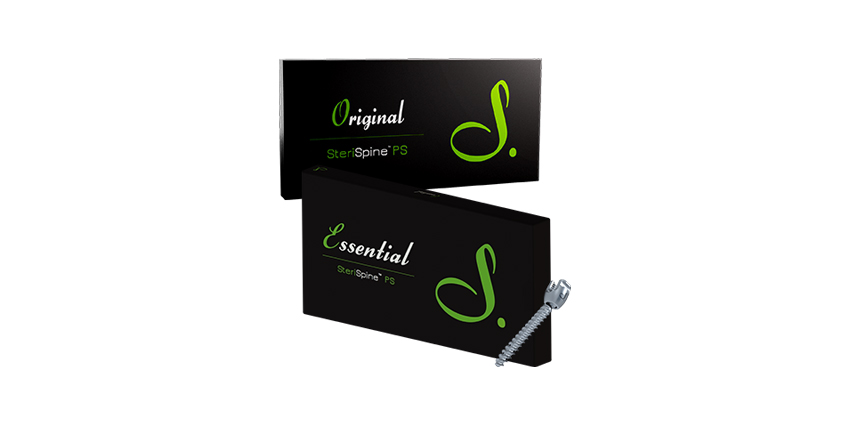
Safe Orthopaedics SA, based just outside of Paris, France, in Éragny, recently announced the U.S. FDA clearance of its second generation SteriSpine™ PS, a pedicle screw system for non-cervical fixation.
Safe Orthopaedics’ 2nd Generation Pedicle Screw System Cleared
1 min read Premium comments
Secondary#thoracolumbarfusion#pediclescrews#safeorthopaedics#sterispine
The company produces ready-to-use spine implants and instruments that are delivered sterile and intended for single use. The second-generation instruments are thinner and more rigid than its predecessor, but also radiolucent. They are intended to provide greater applicability in minimally invasive approaches and to be used on a greater number of spine pathologies.
The second generation also adds a cross-connector kit, multi-axial fenestrated screws, and screws available in diameters as small as 4.5 mm.
The updated pedicle screw system was available in Europe, Japan, and elsewhere in the Asia Pacific area earlier in 2020. The company is currently preparing for its U.S. commercial launch.
“Obtaining the FDA approval for the 2nd Generation SteriSpine™ PS in the United States is an important milestone in entering our second decade, as we observe a real adoption of ready-to-use technologies on a global scale and growing competition. Thanks to the feedback from our European users, we have designed this thinner, more rigid and totally radiolucent evolution for an easier minimally invasive surgery, now meeting the expectations of American surgeons,” comments company CEO Pierre Dumouchel.
“The acceleration of outpatient surgeries, in dedicated centers called Ambulatory Surgery Centers (ASC), represents a new business opportunity for Safe Orthopedics. Combined with a very short production cycle made possible by the acquisition of LCI Medical. In 2021 we will launch a new distribution method, totally digital and perfectly fitted to the ASC.”
The company has also announced its acquisition of the Japanese patent for its Oak screw, which is included in the SteriSpine PS range.
Several recent studies initiated or funded by another single-use instrument maker have found that pre-sterilized, disposable instruments and implants lead to lower operative costs from lower infection rates that lead to reoperation, logistics improvements, and transportation and re-sterilization costs. The energy use in production and disposal is also lower on a per procedure basis than reusable systems.
Author
React:
Discussion
This is a fascinating development. In my practice we've seen similar outcomes with the revised protocol. The key differentiator seems to be patient selection criteria. Has anyone else noticed the correlation with BMI thresholds?
Great point. I'd push back slightly on the conclusion, the sample size in the cited study is too small to draw population-level inferences. That said, the directional signal is compelling and worth a larger RCT.
We implemented a similar approach last year. Early results are promising but we're still gathering 12-month follow-up data. Happy to share our protocol if anyone is interested.
Join the conversation
Orthopedic professionals are discussing this. Sign in and upgrade to read every comment and add your voice.