
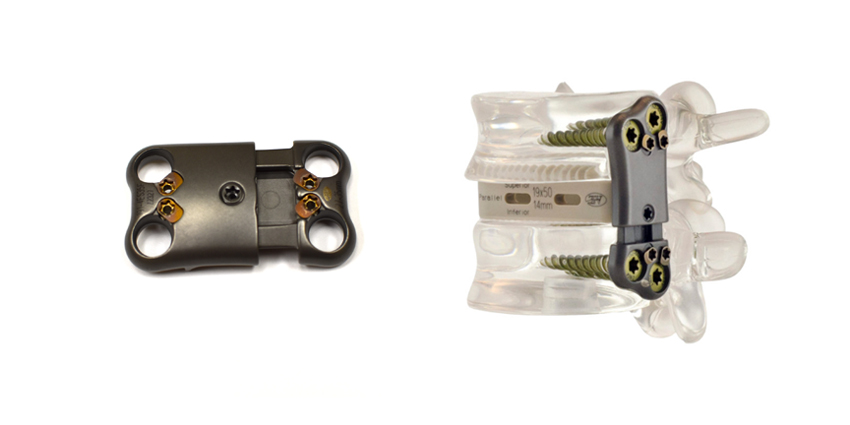
Flowood, Mississippi-based Zavation, LLC. has launched a new line of expandable lumbar plates called Z-Span. The two titanium alloy plates are designed for lateral or anterior use, respectively. The company specializes in manufacturing spine implants at its Mississippi and Florida facilities.
New Line of Expandable Lumbar Fusion Plates Launched
1 min read Premium comments
Secondary#zavation#anteriorlumbarplate#expandableplate
The anterior expandable lumbar plate has a low-profile design and features a ledge for guiding proper positioning. It is intended for use below the bifurcation of the great vessels in the lumbar spine (L1-S1) through an anterior surgical approach.
The lateral expandable lumbar plate is intended for use above the bifurcation of the great vessels through a lateral or anterolateral approach for L1-L5.
Both the anterior and lateral plates are indicated as supplemental fixation, typically required for use in interbody fusion procedures. The plates can be extended during implantation to accommodate a range of patient anatomies and reducing the need for surgical kits to contain multiple plates of varying sizes.
This can lead to less time spent sizing plates to the patient, as well as costs associated with re-sterilization of unused implants. Mechanical testing reported for the devices suggest that they perform as well or superior to the predicate devices, the previous version of the Z-Span, and the Antegra-T, originally from Synthes.
A spine surgeon at Bienville Orthopaedic Specialists in Mississippi, Eric Graham, M.D. described the benefits of the plates, “This design eliminates the frustration of trying several plates in an effort to best match each patient’s anatomy. This equates to a more efficient surgery.”
The company, formed in 2012, originally received FDA clearance for the Z-Span product line in 2016 with an update cleared in 2017 to include coverage of the expandable line. The launch of the expandable Z-Span plates contributes to the company’s progress to “provide devices and instruments that simplify and streamline the procedure,” according to Lawrence Walker, VP of Engineering at Zavation.
Author
React:
Discussion
This is a fascinating development. In my practice we've seen similar outcomes with the revised protocol. The key differentiator seems to be patient selection criteria. Has anyone else noticed the correlation with BMI thresholds?
Great point. I'd push back slightly on the conclusion, the sample size in the cited study is too small to draw population-level inferences. That said, the directional signal is compelling and worth a larger RCT.
We implemented a similar approach last year. Early results are promising but we're still gathering 12-month follow-up data. Happy to share our protocol if anyone is interested.
Join the conversation
Orthopedic professionals are discussing this. Sign in and upgrade to read every comment and add your voice.