
What do you do if you have an idea to make a procedure faster, safer, and more effective? That question led Inspired Spine Chief Medical Officer, and surgeon, Hamid Abbasi, M.D., Ph.D., to try to get his idea in front of a device manufacturer a few years ago. After six months without a response he began to look for other options. His search resulted in a collaboration with Advanced Research Medical, LLC. to develop the procedures, and devices, themselves, transforming Inspired Spine into a total spinal health provider.
Healthcare Provider Takes Initiative on Instrument Design
4 min read Premium comments
#sijointfusion#inspiredspine#tridentsijointfusionsystem
The company’s most recent development is a compact instrument and implant system for performing sacroiliac (SI) joint fusion, called Trident. The SI joint, due to its low mobility and difficulty in properly diagnosing it as a pain generator, has long been ignored as a source of back pain.
Within the last few years, however, the paradigm has shifted largely thanks to vocal proponents and improved diagnostic techniques, and research that has implicated the SI joint in up to 23% of low back pain and 43% of low back pain in patients who have received a prior lumbar fusion. The SI joint fusion device environment has become congested as device manufacturers develop or acquire the technology.
Earlier in 2020, the Centers for Medicare and Medicaid Services (CMS) enacted a 27% increase in the reimbursement rate for the procedure, providing even more incentive for surgeons to seek out SI joint fusion solutions.
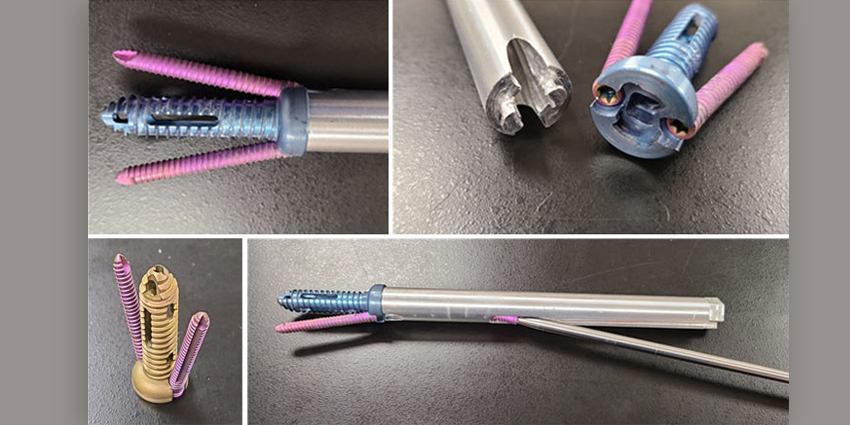
The Trident™ Sacroiliac Joint Fusion System reduces the number of specialized instruments and procedural steps significantly, allowing for a faster and simpler procedure. The device consists of a large cannulated and fenestrated main screw. The delivery sleeve and driver has integrated guides through which side screws and drivers are inserted. The device allows for a lateral to medial approach through a single incision and working channel, rather than up to 3 incisions and channels required for other SI joint fusion systems.
Having an integrated guide for the second and third screws also alleviates the need to perform additional imaging, which is usually challenging due to imaging artifacts from the first screw. The self-drilling, and self-tapping screws also collect bone fragments during insertion, eliminating the need for supplemental biologics. Fluting of the side screws provide a channel for new bone to grow through.
The procedure for inserting all three screws takes about 15 minutes compared with up to an hour for other SI joint fusion systems. “We continue to raise the standard of care for back pain treatment as this SI Joint fusion technique represents another Inspired Spine breakthrough for surgeons and patients alike,” stated Abbasi.
Kenneth Barra, VP of Operations at Advanced Research Medical, LLC., and his team are able to shorten the product design timeline to 2-4 weeks and repeatedly refine the design through preclinical testing. The latest project, the Trident, is currently patent pending and awaiting mechanical testing to support FDA 510(k) submission in October. Based on recent FDA timelines, the companies expect clearance in February 2021.
The Trident is the group’s second procedure and device combination that they have pioneered. The first was the Oblique Lateral Lumbar Interbody Fusion (OLLIF), which uses a trajectory that allows discectomy and implant insertion through Kambin’s Triangle, a triangular space between the superior endplate, superior articular process, and the exiting nerve root.
The OLLIF surgical approach is muscle sparing and requires less than one-third of the time as a traditional transforaminal lumbar interbody fusion (TLIF). The OLLIF procedure is also much less traumatic than TLIF or PLIF, requires no muscle cutting or detachment allowing for faster and more complete recovery. Many patients are ambulatory a few hours after surgery and typically discharged within 24 hours, resulting in greater patient satisfaction and recovery and substantially lower hospital costs.
One study published by the company calculated a hospital savings of up to $9,500 per case compared with TLIF. Another benefit of the OLLIF approach is that surgical time does not increase with patient BMI [body mass index] as it does with TLIF. The company announced its 1,400th OLLIF procedure earlier in 2020.
Two derivatives to the OLLIF technique have also been developed by Inspired Spine. Minimally invasive direct lumbar interbody fusion (MIS-DLIF) provides better access to L5-S1, and minimally invasive direct thoracic interbody fusion (MIS-DTIF) allows for minimally invasive fusion in the thoracic spine, preventing the risks, such as deflating the lung, required for traditional thoracic approaches. Both derivatives utilize the OLLIF implant cleared by the FDA in 2018.
To support the development and broader deployment of its procedures and devices, the medical provider has established the Inspired Spine Institute. The Institute consists of three branches that all help to ensure the procedures are delivering the level of outcomes expected for patients. The first is patient education, which helps patients understand what procedure is best for them and what to expect from surgery.
The second arm of the Institute is research and development; Inspired Spine collects an extensive amount of data on patients that they have treated and fine-tuned new procedures. The result, so far, has been seven peer reviewed publications supporting the benefits claimed of the OLLIF procedure, all of which are available in free full text on PubMed Central.
The last arm of the institute is its training program. Abbasi and other surgeons at Inspired Spine offer a “mini fellowship” for established spine surgeons looking to improve their practice. The training commences by observing Dr. Abbasi performing the OLLIF immediately followed by a hands-on lab at Inspired Spine’s Burnsville, Minnesota campus. The next phase of training is known as the “Soft Transition,” where Dr. Abbasi will travels to the surgeon’s home hospital to initially perform and ultimately assist in a series of cases until the surgeon’s demonstrated proficiency meets Inspired Spine’s certification requirements.
The Institute also offers monthly “Grand Rounds” style case reviews that are attended by providers around the world. Abbasi says that surgeons are more apt to share experiences with providers at other institutions.
These services are all provided at no charge or “open source” in Abbasi’s words. Inspired Spine believes that offering the training to surgeons will result in better outcomes for patients. Chief Executive Officer John Siegel considers Inspired Spine’s customers to be “patients, rather than doctors who order the devices, because the delivery of healthcare is about improving people’s quality of life.”
Author
React:
Discussion
This is a fascinating development. In my practice we've seen similar outcomes with the revised protocol. The key differentiator seems to be patient selection criteria. Has anyone else noticed the correlation with BMI thresholds?
Great point. I'd push back slightly on the conclusion, the sample size in the cited study is too small to draw population-level inferences. That said, the directional signal is compelling and worth a larger RCT.
We implemented a similar approach last year. Early results are promising but we're still gathering 12-month follow-up data. Happy to share our protocol if anyone is interested.
Join the conversation
Orthopedic professionals are discussing this. Sign in and upgrade to read every comment and add your voice.