
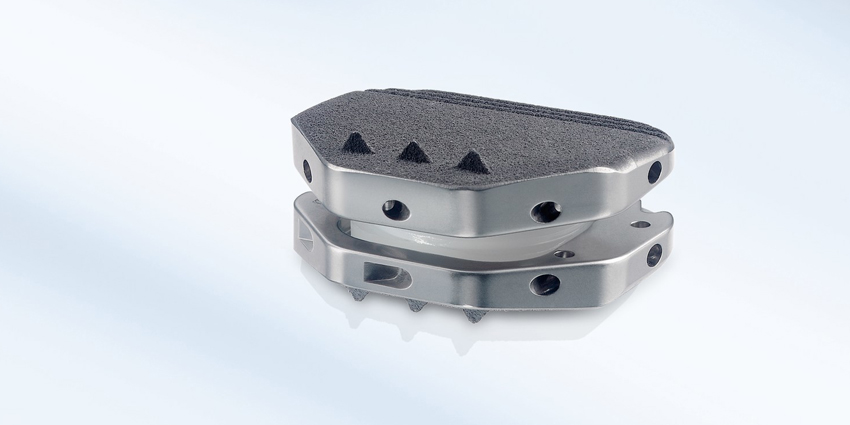
The ActivL® Artificial Disc for lumbar disc replacement from Aesculap Implant Systems, LLC. celebrated five years of FDA approval in June 2020. The device provides an alternative to fusion in the lumbar spine when treating patients for degenerative disc disease (DDD) at one level between L4-S1.
Good Payor News on 5th Anniversary of Aesculap’s ActivL
2 min read Premium comments
#activl#totaldiscreplacementSecondary#aesculap#lumbardiscreplacement
The device combines a pair of cobalt chromium endplates sandwiching an ultra-high molecular weight polyethylene inlay. The semi-constrained device allows for rotation, laterally bending, flexion and extension, but not lateral translation.
Over the past five years the device has become part of the standard of care for DDD in some patient groups. A North American Spine Society (NASS) panel concluded in 2017 that sufficient evidence exists to support the use of lumbar disc replacement for DDD.
Additionally, studies have found lower rates of adjacent segment disease (ASD) in patients receiving lumbar disc replacement, rather than fusion. Reduction of ASD is a primary argument for proponents of motion preservation strategies, such as lumbar disc replacement. Long term benefits have also been seen in patients who originally received disc replacement in the ActivL Artificial Disc IDE trial, with 95% of the patients requiring no additional surgeries at the index or adjacent level up to seven years after surgery. Finally, in the past few years many multiples of patients have gained access to lumbar disc replacement through positive payer decisions by commercial insurers and the military insurer, TRICARE.
Another step toward coverage of millions of commercially insured Americans came with updated clinical guidelines from the National Imaging Associates (NIA). NIA is a Magellan Health Company that has determined lumbar total disc replacement to be medically necessary. The guidelines are followed by numerous commercial payers that cover up to 8.5 million insured Americans. The updated guidelines were informed by a 2013 Cochrane Review, the 2019 NASS Coverage Policy Recommendation and a 2017 meta-analysis providing level-one evidence authored by Jack Zigler, M.D. and Matthew Gornet, M.D.
Kim Norton, a reimbursement consultant for Aesculap Implant Systems and V.P of Reimbursement for Simplify Medical, Inc. described part of the process that resulted in the decision, “For several years, we have noted that NIA Magellan had outdated references in their clinical guidelines for Lumbar Total Disc Replacement. It took us several tries to get this issue in front of the right decision makers, so we were pleased to see that they were able to objectively review the strong evidence for lumbar TDR and update their guidelines based on that.”
In a press release in June, Aesculap President Chuck DiNardo said, “It is rewarding to see the tremendous results of our team’s persistent conversations, strong clinical publication strategy and collaboration with spine surgeon advocates. We would have done a disservice to U.S. spine patients if we had relented our focus.”
While ActivL is one of two lumbar disc replacement devices commercially available in the United States, payer decisions regarding lumbar disc replacement apply to both devices. The second lumbar disc replacement is the ProDisc-L from Centinel Spine, LLC., which was first approved by the FDA in 2006.
Author
React:
Discussion
This is a fascinating development. In my practice we've seen similar outcomes with the revised protocol. The key differentiator seems to be patient selection criteria. Has anyone else noticed the correlation with BMI thresholds?
Great point. I'd push back slightly on the conclusion, the sample size in the cited study is too small to draw population-level inferences. That said, the directional signal is compelling and worth a larger RCT.
We implemented a similar approach last year. Early results are promising but we're still gathering 12-month follow-up data. Happy to share our protocol if anyone is interested.
Join the conversation
Orthopedic professionals are discussing this. Sign in and upgrade to read every comment and add your voice.