
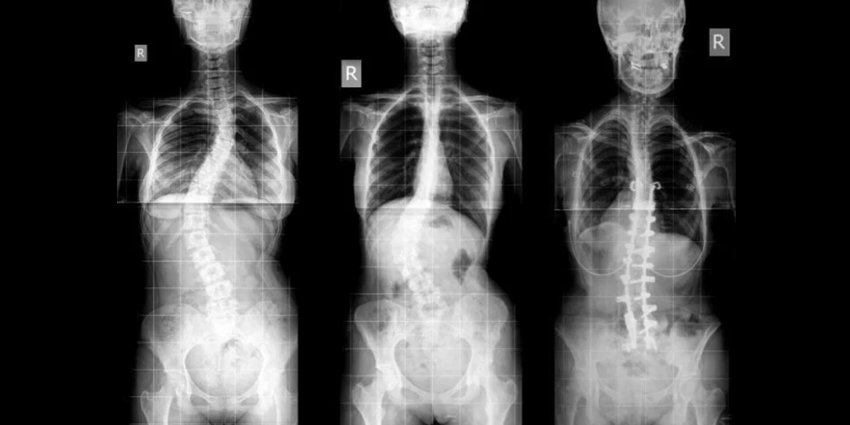
Like many procedures in spine surgery, asymmetric pedicle subtraction osteotomies are performed for making corrections to both coronal and sagittal alignment in adult spinal deformity (ASD) but have not been adequately studied. Pedicle subtraction osteotomy (PSO) is a form of 3-column osteotomy (3CO) where the posterior elements and a wedge of a vertebral body are removed to allow for sagittal correction in rigid deformities. An asymmetric PSO (APSO) is similar but the wedge removed from the vertebral body is higher on the side opposite the coronal imbalance.
Asymmetrical PSO Effective for Multiplanar Correction in ASD
2 min read Premium comments
Secondary#adultspinaldeformity#3columnosteotomy#pediclesubtractionosteotomy
A group at the California Deformity Institute at the University of California San Francisco (UCSF) that specializes in high risk spine procedures recently took a step to correct the gap in the literature.
Their study published in the Journal of Neurosurgery: Spine titled “Asymmetrical pedicle subtraction osteotomy for correction of concurrent sagittal-coronal imbalance in adult spinal deformity: a comparative analysis” took a look at 390 patients who underwent a 3CO.
Of these, 52 were APSOs to correct a concurrent sagittal-coronal deformity (CVA > 4.0 cm), and 338 had a standard PSO to correct an isolated sagittal imbalance. One of the study’s authors, Christopher Ames, M.D., claimed that this was the largest series focusing on APSO published to date. He also added that the group uses Medicrea AI-based preoperative planning and custom rods. Other studies in the literature are either case studies or small groups of under 20 patients.
Preoperative deformity was overall greater in the APSO group, not only in coronal imbalance, but also sagittal (SVA = 13.0 vs 10.7). The group found that those undergoing APSO required more fusions and higher upper instrumented vertebrae (UIV) than those with PSO. APSO was successful in correcting imbalance and reaching normalization for all patients.
The perioperative complication rate for all patients was high at 34.9%, but not significantly different between the groups. However, APSO required greater recovery time with an average of 3.1 days in the ICU and 10.8 in the hospital versus 2.3 and 8.3 days for PSO patients. After 2 years both groups experienced similar rates of mechanical complications, such as proximal junctional kyphosis, pseudarthrosis, rod fracture and reoperation.
The group concluded that for patients needing both sagittal and coronal correction, APSO is a suitable choice given then similarity in outcomes and similar risk profile compared with standard PSO.
Author
React:
Discussion
This is a fascinating development. In my practice we've seen similar outcomes with the revised protocol. The key differentiator seems to be patient selection criteria. Has anyone else noticed the correlation with BMI thresholds?
Great point. I'd push back slightly on the conclusion, the sample size in the cited study is too small to draw population-level inferences. That said, the directional signal is compelling and worth a larger RCT.
We implemented a similar approach last year. Early results are promising but we're still gathering 12-month follow-up data. Happy to share our protocol if anyone is interested.
Join the conversation
Orthopedic professionals are discussing this. Sign in and upgrade to read every comment and add your voice.