
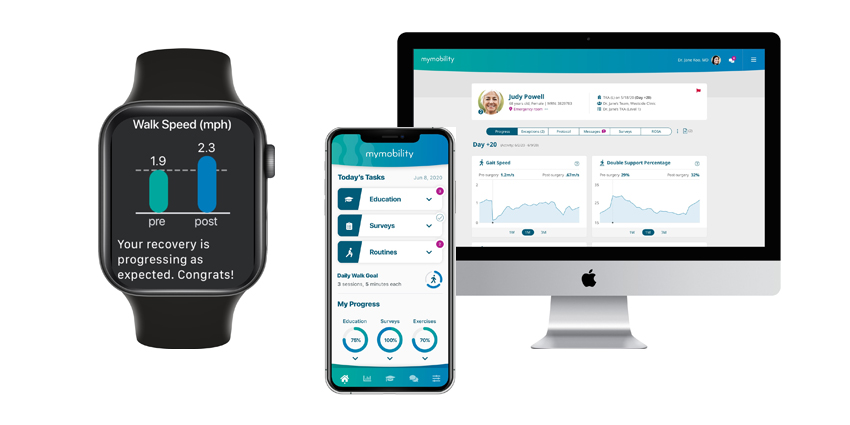
Zimmer Biomet Holdings, Inc. has announced new features for its digital platform, “mymobility with Apple Watch, creating a first-of-its-kind remote care management system.” The new mobility metrics assess gait quality, giving healthcare professionals additional patient virtual contact and real-time patient data to inform the decision-making process.
Zimmer Updates mymobility and Apple Watch Functions
2 min read Premium comments
#zimmerbiometSecondary#applewatch#gaitanalysis
According to Zimmer Biomet, “With the patient’s permission, the new gait quality metrics leverage the power of Apple’s ecosystem by using sensors in the Apple Watch and iPhone to passively collect walking speed and double-support time (period of time when both feet are in contact with the ground) when walking on flat level surfaces – without GPS. These gait quality measurement features will be available to hip and knee joint replacement patients and their healthcare professionals through the mymobility digital platform later this year.”
“Digital transformation of care has been central to Zimmer Biomet’s ongoing evolution and growth prior to the COVID-19 pandemic and is even more important now,” said Bryan Hanson, president and CEO of Zimmer Biomet. “Through mymobility with Apple Watch, we are providing new and effective ways to optimize the patient experience and mitigate patient issues, without requiring additional in-office visits.”
“While many patients progress according to the treatment plan and their goals, this isn’t the case for all patients. The gait tracking features and automated check-in notifications can help identify which patients aren’t recovering as expected and what factors might be contributing,” said Dr. Andrew Freiberg, company chief medical officer. “This real-time data sharing and new gait measurement feature help provide care teams with more oversight and guidance related to their patients’ recovery through a highly engaged and connected joint replacement experience.”
When we asked Hanson about the development process, he told OTW, “Our key milestones throughout the development process were really focused on empowering physicians with real-time data. For instance, we are now able to provide a qualitative assessment of a patient’s gait. This was not possible before and that quality, not just quantity, of steps matter. Our mymobility technology enables care teams to compare their patients’ progress against a database to better manage post-operative care and identify issues sooner.”
“Additionally, we’ve integrated our mymobility with Apple Watch data with OrthoIntel, Zimmer Biomet’s Orthopedic Intelligence Platform. This is a completely new approach that enables the sharing of key progress and metrics to help surgeons optimize care and uncover data insights that could ultimately improve patient outcomes.”
And how will all of this advance clinical care? “This definitely alters clinical care,” Hanson told OTW. “mymobility enables virtual monitoring, measurement and engagement with the physician, instead of requiring an in-person trip to the doctor’s office. With the addition of gait quality data, surgeons will have a complete view of their patients’ functional activity, progress and potential issues. And, importantly, the patients will receive regular communication and education throughout their episode of care, helping drive engagement that may not even be possible with traditional care.”
Author
React:
Discussion
This is a fascinating development. In my practice we've seen similar outcomes with the revised protocol. The key differentiator seems to be patient selection criteria. Has anyone else noticed the correlation with BMI thresholds?
Great point. I'd push back slightly on the conclusion, the sample size in the cited study is too small to draw population-level inferences. That said, the directional signal is compelling and worth a larger RCT.
We implemented a similar approach last year. Early results are promising but we're still gathering 12-month follow-up data. Happy to share our protocol if anyone is interested.
Join the conversation
Orthopedic professionals are discussing this. Sign in and upgrade to read every comment and add your voice.