
HAPPE Spine, LLC., a Holland, Michigan-based start-up, announced recently that it has received U.S. patent protections for its porous, bioactive polyether ether ketone (PEEK) material.
New Patent Issued for HAPPE Spine’s PEEK Biomaterial
2 min read Premium comments
#peekSecondary#hydroxyapatite#happespine
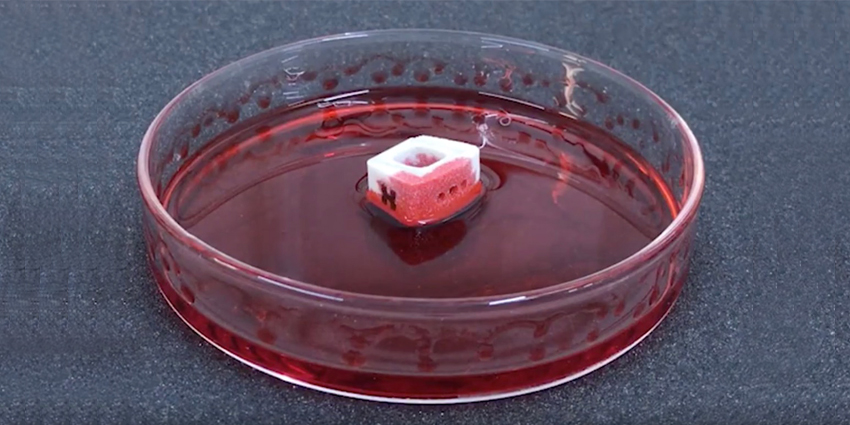
PEEK and hydroxyapatite (HA) are incorporated into a porous material through a proprietary process. The company plans to use the material to produce interbody fusion devices. The company’s name, pronounced “Happy”, is an acronym of the name describing the material, Hydroxy Apatite Porous PEEK.
HAPPE Spine was incorporated in 2018 by Genesis Innovation Group, LLC., with additional funding from cultivate(MD) Capital Fund I, LLC. and cultivate(MD) Capital Fund II, LLC. The fabrication technology was developed by Ryan Roeder, Ph.D., and researchers from the University of Notre Dame. A recent publication in the Journal of the Mechanical Behavior of Biomedical Materials by Roeder suggests that spherical salt is involved in the formation of the porous PEEK, a process similar to the one used by NuVasive, Inc. in the production of its COHERE, porous surface PEEK device.
The research presented in the article, “Effects of porogen morphology on the architecture, permeability, and mechanical properties of hydroxyapatite whisker reinforced polyetheretherketone scaffolds,” probes the effect of porogen morphology (the size and shape of the particles responsible for forming pores during fabrication) on characteristics of the finished material. In a presentation from February 2020 at the State of Spine Surgery meeting, Roeder told the audience that the device to offer “both the bioactivity of hydroxyapatite for bone on-growth, and porosity for bone in-growth.”
Roeder commented in a press release from the company that he is “extremely pleased that we’ve received another patent protecting our technology for porous and bioactive PEEK.” He also commented on the technology included in the patent, “A key to our technology, recognized in this patent, is that our hydroxyapatite particles are exposed on pore surfaces creating a hydrophilic, micro-roughened and bioactive surface that promotes bone ingrowth. Furthermore, due to a whisker-like shape, our hydroxyapatite particles are firmly embedded in the PEEK matrix for long-term bioactivity and mechanical reinforcement.”
The HAPPE Spine Engineering Director Doug Snell, also pleased with the milestone, added, “It is exciting to see all aspects of the HAPPE porous PEEK technology coming to fruition in our cervical interbody implant, which is the first of our many spine and orthopedic product applications… Forming a contiguous construct of load-bearing dense hydroxyapatite PEEK seamlessly integrated into a 75% porous HA PEEK scaffold is a challenging task. Our team has come together and created a robust process that forms this complex structure reliably and it is now a highly scalable production process able to meet the industry standard and it’s demand.” Snell formerly held the role of director of engineering at Spinal Simplicity.
Author
React:
Discussion
This is a fascinating development. In my practice we've seen similar outcomes with the revised protocol. The key differentiator seems to be patient selection criteria. Has anyone else noticed the correlation with BMI thresholds?
Great point. I'd push back slightly on the conclusion, the sample size in the cited study is too small to draw population-level inferences. That said, the directional signal is compelling and worth a larger RCT.
We implemented a similar approach last year. Early results are promising but we're still gathering 12-month follow-up data. Happy to share our protocol if anyone is interested.
Join the conversation
Orthopedic professionals are discussing this. Sign in and upgrade to read every comment and add your voice.