
One of the biggest healthcare companies in the world, Medtronic plc, has agreed to acquire Medicrea®, a France-based spinal surgery company focused on artificial intelligence, predictive modeling, and patient specific implants.
Medtronic to Acquire Medicrea
5 min read Premium comments
#medtronicSecondary#medicrea
Acquisition Details
The transaction was approved unanimously by members of both companies’ boards of directors. The agreement was an all-cash tender offer for all outstanding shares of Medicrea priced at €7.00 per Medicrea share.
According to the press release, the price of €7.00 per share represents a premium of:
- 22% over the closing price of Medicrea shares on July 14, 2020
- 33% over the 1-month volume weighted average price of Medicrea shares as of July 14, 2020
- 56% over the 3-month volume weighted average price of Medicrea shares as of July 14, 2020
The transaction is subject to customary closing conditions. This includes relevant United States merger control clearance, regulatory clearance from the French Markets Authority, and applicable foreign investment clearance in France. The parties anticipate filing the transaction with the French Markets Authority in September 2020. They expect the acquisition to close by the end of calendar year 2020.
Medtronic’s Innovative Spine Portfolio
Medtronic is the largest supplier of spinal implants, instruments, robotic assist devices, imaging systems, and related biologics. Its spine business is part of Medtronic’s Restorative Therapies Group, along with Brain Therapies, Pain Therapies, and Specialty Therapies.
Jacob Paul is senior vice president and president of the Cranial and Spinal Technologies division at Medtronic. The Cranial and Spinal Technologies division is part of the Restorative Therapies Group.
Paul discussed the acquisition and its impact on Medtronic’s spine portfolio. Paul said, “Combining Medtronic’s innovative portfolio of spine implants, robotics, navigation, and 3D imaging technology with Medicrea’s capabilities and solutions in data analytics, artificial intelligence and personalized implants, would enhance Medtronic’s fully-integrated procedural solution for surgical planning and delivery.”
Paul continued, “This marks another important step in furthering our commitment to improving outcomes in spine care. Medtronic will become the first company to be able to offer an integrated solution including artificial intelligence driven surgical planning, personalized spinal implants and robotic assisted surgical delivery, which will significantly benefit our customers and their patients.”
This year, Medtronic ranked number one in the Forbes healthcare category and number 129 on the Forbes Global 2000 list. The 2020 Forbes Global 2000 list analyzed financial results for the 12-month period ending on April 30, 2020. During that time period, Medtronic recorded $31.1 billion in sales, $5.3 billion in profit, and $131 billion in market value.
COVID-19 has had a dramatic impact on all industries. Geoff Martha, Medtronic chief executive officer, told Forbes, “Importantly, we are starting to enter the early stages of a global recovery. As hospitals begin to resume broader treatment of non-COVID-19 patients around the world, we expect our business to begin to recover as well.”
Medicrea’s Focus on Predictive Medicine
Medicrea focuses on predictive medicine and has over 30 CE Marked or 510(k) approved implant technologies. With a manufacturing facility in Lyon, France, Medicrea develops and manufactures “3D-printed titanium patient-specific implants.” Its products have been used in more than 175,000 spinal surgeries for scoliosis, complex adult and pediatric degenerative deformation, and trauma.
OTW spoke with Paul about Medtronic’s initial interest in Medicrea. Paul said that he was impressed with Medicrea’s evolution and its product portfolio.
Paul told OTW, “Medicrea was founded in 2002 as a pediatric deformity implant company, but in 2014 that’s when things really got interesting as the company began to pivot as a data company. Medicrea established its expertise as a leader in patient-specific technology for spine as the first company to develop and receive FDA clearance for a patient-specific spinal implant in November of 2014 with the UNiD™ Rod.”
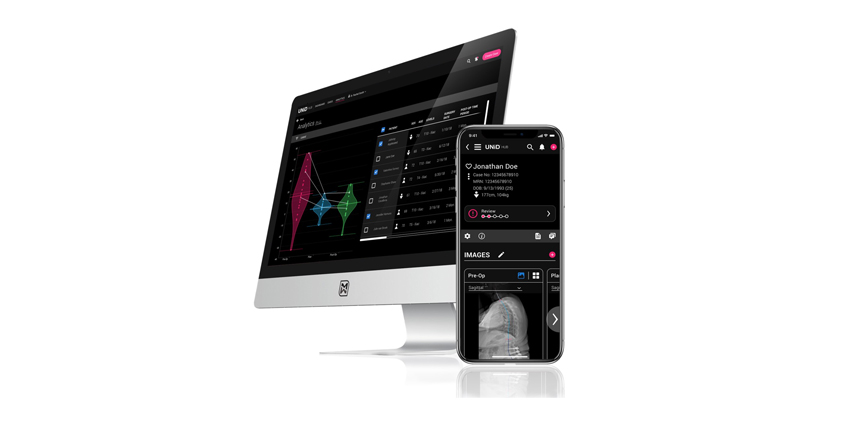
Paul continued, “They would later unveil their flagship UNiD® ASI (Adaptive Spine Intelligence) technology, a comprehensive surgical solution that enables the creation of personalized implants and facilitates patient-specific pre-operative case planning and surgery execution. The storage and analytics service platform is unique in that it helps the surgeon pre-operatively plan cases with AI informed insights with the goal of showing how unfused sections of the spine respond to different surgical plans while providing a personalized rod for optimal correction. Rod bending is a difficult art, learned over many years with large variability between surgeons.”
Medicrea Founder, Chairman, and Chief Executive Officer Denys Sournac shared Paul’s regard for customized implants. Sournac said, “Spine surgery is one of the more complex procedures in healthcare because of the high number of different parameters to take into consideration. It is impossible for the human brain to compute all of them for one single patient.”
Sournac continued, “The medical world has been waiting for the arrival of customization in spinal surgery. With scientific progress in understanding sagittal balance and spinal injury, combined with the advent of new digital technologies, it is now possible to offer spinal patients entirely customized implants.
Medicrea’s product portfolio includes:
- UNiD ASI
- PASS® range
- PASS LP®
- LigaPASS®0
- TULIP GENESIS™
- TULIP PRIME™
- C-JAWS®
- IMPIX®-C
- IMPIX-MANTA®
- IB3D-TB™
Analyst Insights
The Wells Fargo team wrote that although the acquisition was comparatively small for Medtronic, it was noteworthy for two reasons: “First, it represents the third spine acquisition MDT [Medtronic] has made since it acquired Mazor in 2018 for $1.7B [billion] and Titan Spine in 2019. Clearly, MDT [Medtronic] is committed to its spine business which has performed better in recent quarters after years of under-performance. Second, this represents one of the first post-COVID acquisitions in medtech.”
Needham & Company Analysts Mike Matson and David Saxon also commented that it was a smaller transaction. Nonetheless, the analysts said, “We believe that Medicrea’s technology is complementary to MDT’s [Medtronic] imaging, navigation, and robotics offering and its Surgical Synergy strategy of bundling its capital equipment with its implants.”
Executives Are Positive Regarding Acquisition
Sournac is excited about the acquisition saying, “We are thrilled to be joining forces with Medtronic because we share a similar mission to restore the long-term quality of life for patients. Now, together, we can help more patients in more places benefit from consistently high-quality surgical care.”
Paul shared Sournac’s positivity. Looking forward, Paul is confident in Medicrea’s capabilities. Paul told OTW, “Medicrea’s capabilities and solutions in data, analytics and customized implants play a critical role in Medtronic’s continued focus on the future of spine surgery by refining procedures, with the hopes of reducing variability and improving procedural outcomes.”
Medtronic’s Expanding Spine Portfolio
Medtronic has been actively expanding its spine portfolio. As the analysts noted, Medicrea is Medtronic’s third spine acquisition in recent years. For OTW’s coverage of Medtronic’s recent acquisitions see “Medtronic to Acquire Titan Spine” and “Medtronic and Mazor Robotics Tie the Knot.”
OTW asked Paul about Medtronic’s plans to further expand its spinal division. Paul told OTW, “Medicrea is a clear strategic fit for Medtronic, and reinforces our commitment to transform spine outcomes with data solutions that support our long term strategy.”
Paul continued, “We will continue to invest in innovative technologies that complement our growth strategy and benefit our customers in improving spine care.”
Author
React:
Discussion
This is a fascinating development. In my practice we've seen similar outcomes with the revised protocol. The key differentiator seems to be patient selection criteria. Has anyone else noticed the correlation with BMI thresholds?
Great point. I'd push back slightly on the conclusion, the sample size in the cited study is too small to draw population-level inferences. That said, the directional signal is compelling and worth a larger RCT.
We implemented a similar approach last year. Early results are promising but we're still gathering 12-month follow-up data. Happy to share our protocol if anyone is interested.
Join the conversation
Orthopedic professionals are discussing this. Sign in and upgrade to read every comment and add your voice.