
A strategic partnership agreement was signed between MBA Surgical Empowerment of Gijón, Spain, and Colorado-based Mighty Oak Medical, Inc. Thanks to the agreement, MBA Surgical Empowerment will market Mighty Oak Medical’s Firefly® surgical guide system in Spain and Portugal.
MBA Surgical Brings Mighty Oak’s Firefly to Spain and Portugal
1 min read Premium comments
Secondary#mightyoakmedical#mbasurgicalemplowerment#pedicalscrewguide
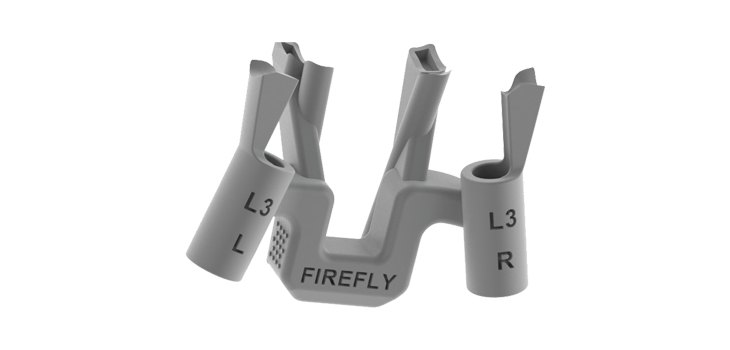
The Firefly surgical guide system provides a solution for improving pedicle screw placement in facilities that do not have surgical navigation available. With a patient’s preoperative CT images, a surgeon will receive an exact 3D-printed replica of his or her patient’s spine and a set of pedicle screw guides for exact placement of the pedicle screws.
The company reports pedicle screw placement accuracy of 99.7%, equivalent to navigated or even robotic assisted pedicle screw placement. CEO of MBA Surgical Empowerment, Carlos Marina, is pleased with the agreement and Mighty Oak’s product. “We are offering technology with demonstrated results, which provides safety benefits, less radiation exposure, and reduced surgical time, without the initial costs and with unmatched precision,” Marina said.
Similarly, Mighty Oak is happy that its product will reach more patients through distribution by MBA Surgical Empowerment. Mighty Oak President Heidi Frey is excited for “the opportunity to expand the scope of Firefly® as the solution of choice for spinal surgery. We look forward to working with surgeons in Spain and Portugal to achieve the best possible results for their patients.”
The Firefly system has been used to place over 15,000 screws globally. The system is similar to Medacta International’s MySpine™ system. Both are available for traditional pedicle screw trajectories as well as midline cortical trajectories. The Medacta system is only cleared for use with Medacta pedicle screws, whereas Mighty Oak’s system can be used on-label with any 510(k) cleared pedicle screw system.
Author
React:
Discussion
This is a fascinating development. In my practice we've seen similar outcomes with the revised protocol. The key differentiator seems to be patient selection criteria. Has anyone else noticed the correlation with BMI thresholds?
Great point. I'd push back slightly on the conclusion, the sample size in the cited study is too small to draw population-level inferences. That said, the directional signal is compelling and worth a larger RCT.
We implemented a similar approach last year. Early results are promising but we're still gathering 12-month follow-up data. Happy to share our protocol if anyone is interested.
Join the conversation
Orthopedic professionals are discussing this. Sign in and upgrade to read every comment and add your voice.