
St. Louis-based CoreLink, LLC, is FDA 510(k) cleared to launch its F3D-C2 Stand-alone Cervical System in the U.S.
FDA Clears Novel CoreLink 3D Stand-alone Cervical System
2 min read Premium comments
#fda510kclearanceSecondary#spinefusion#corelinksurgical
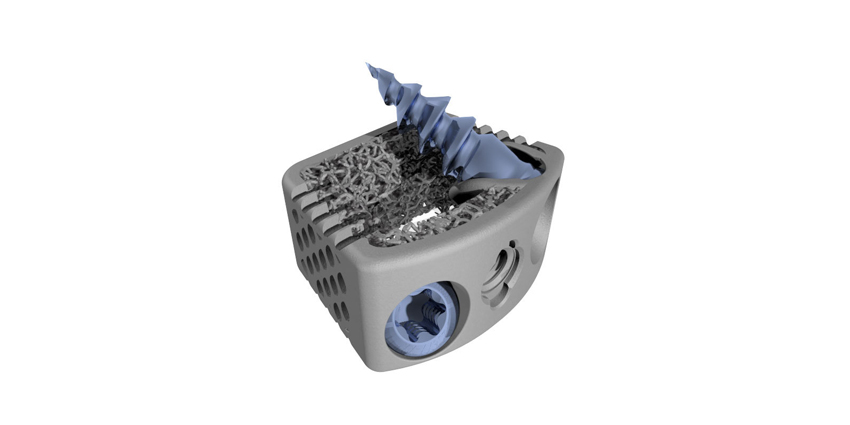
According to company CEO Jay Bartling, the system is the “only 3D printed spine technology with both a trabecular structure and directional support lattices designed to allow for fusion throughout the entire implant.”
The system is made “…of an additively manufactured spacer with two bone screw anchors secured by a locking mechanism printed within the cage.” In a June 30, 2020 press release, the company stated that stand-alone cervical devices “eliminate the need for a supplemental fixation plate, making anterior cervical discectomy and fusion (ACDF) procedures easier and faster to complete.”
The System
The FDA clearance summary says the system’s cage is additively manufactured from Ti-6Al-4V per ASTM F3001, while the screws are machined from Ti-6Al-4V per ASTM F136. “The spacer and screw components are available in an assortment of dimensional combinations to accommodate the individual anatomic and clinical circumstances of each patient. The basic shape of the spacer is a trapezoidal column to provide surgical stabilization of the spine. The inferior/superior aspects of the spacer incorporate a vertical cavity which can be packed with bone graft.”
Indications
The system, according to FDA documents, is indicated “for use in skeletally mature patients with degenerative disc disease of the cervical spine with accompanying radicular symptoms at one or two contiguous disc levels. The [system] is used to facilitate intervertebral body fusion in the cervical spine and is placed via an anterior approach at one- or two-disc levels (C2-T1) using autograft bone.
The company stated its proprietary patented 3D printed Mimetic Metal technology is incorporated into the spacer to “emulate key characteristics of natural bone.” The technology, according to the company, has less stiffness than machined titanium and reduced implant density “minimizes imaging artifact.” The device can be placed using freehand or guided techniques and modular guides facilitate working under a microscope.
Product Development
“Despite the challenges that have occurred in our industry recently,” Bartling said the company has continued to invest aggressively in new product development.
In the past year, the company has expanded the footprint of its now, 70,000 square foot facility in St. Louis, launched seven new commercial products, and hired new leadership for operations, sales and marketing. The new products include the SIber™ Posterior SI Allograft System, the Oro™ Lateral Plate System, the M3 Stand-Alone ALIF System and implant systems for lateral fusion—the F3D and CL5 Lateral interbody fusion devices.
The company claims it designs and manufactures more than 99% of its products in-house. It includes two titanium 3D printers (Mimetic Metal), mills, and swiss lathes to create additional titanium and PEEK devices, and equipment to rapidly prototype and biomechanically test on site.
Author
React:
Discussion
This is a fascinating development. In my practice we've seen similar outcomes with the revised protocol. The key differentiator seems to be patient selection criteria. Has anyone else noticed the correlation with BMI thresholds?
Great point. I'd push back slightly on the conclusion, the sample size in the cited study is too small to draw population-level inferences. That said, the directional signal is compelling and worth a larger RCT.
We implemented a similar approach last year. Early results are promising but we're still gathering 12-month follow-up data. Happy to share our protocol if anyone is interested.
Join the conversation
Orthopedic professionals are discussing this. Sign in and upgrade to read every comment and add your voice.