
A bat passes a virus to a human in China. Five months later, over 100,000 Americans are dead and 40 million are unemployed.
Trump Dumps W.H.O. – Who Cares? Doctors Do.
6 min read Premium comments
#donaldtrump#worldhealthorganization
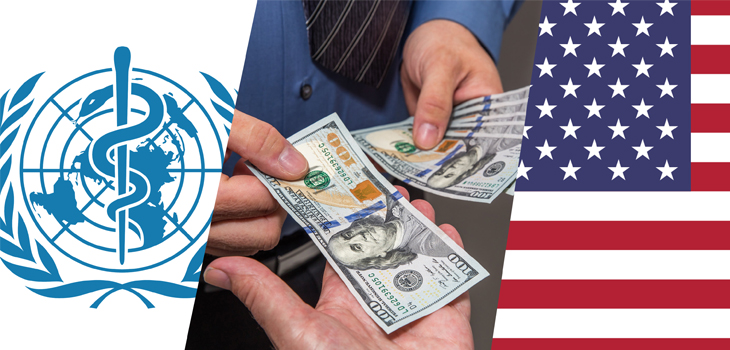
Finding the World Health Organization (W.H.O.) complicit in a coverup of data and “a puppet” of China, the American President, Donald Trump, announced on May 29, 2020, that the U.S. was “terminating our relationship” with the organization.
The president had already temporarily halted U.S. funding for the organization for 60 to 90 days to review the group’s handling of the coronavirus pandemic, which he said was severely mismanaged and covered up the spread of the coronavirus.
Who Cares?
What exactly does the W.H.O. do and, who cares if the U.S. remains a member?
It turns out the American Medical Association (AMA) cares. The Association immediately put out this statement:
“In the grip of a global pandemic that has already killed more than 100,000 Americans, severing ties with the World Health Organization serves no logical purpose and makes finding a way out of this public health crisis dramatically more challenging.”
“This senseless action will have significant, harmful repercussions now and far beyond this perilous moment, particularly as the W.H.O. is leading worldwide vaccine development and drug trials to combat the pandemic. COVID-19 affects us all and does not respect borders; defeating it requires the entire world working together.”
“In the strongest terms possible, the American Medical Association urges the President to reverse course and not abandon our country’s leadership position in the global fight against COVID-19.”
Spine Surgeons – Mixed Sentiments
We asked our good friend and spine surgeon, Izzy Lieberman, M.D., of the Texas Back Institute, if he cared. Lieberman knows about world health, having spent 15 years building the Uganda Spine Mission Program and delivering health care services to those most in need and least able to afford it.
“Yes, I do care, but it is with mixed sentiments. The W.H.O. exists to ‘improve people’s lives, to reduce the burden of disease, and to provide access to responsive health care for all people’.”
“I have experienced both the positive and the negative of this mission. On the one hand I agree there must be some guiding regulations by which to provide health care to the less fortunate, however some of the restrictions are actually precluding the delivery of care. For example, restrictions on expiry dates for medical devices and pharmaceuticals, many devices and medications that could provide lifesaving care are wasted by too stringent a regulatory process.”
“I do not feel that the U.S. involvement or lack thereof will make any change in the W.H.O.’s ability to maintain its mandate, I do not feel that the U.S. involvement or lack thereof will have any direct impact on the Uganda Spine Surgery Mission.”
“The only reason I can think of for the U.S. to stay in the W.H.O. would be to continue supporting the planet as a gesture of goodwill and provider of expertise.”
Safdar Khan, M.D., is the chief of Spine at Ohio State University. He is also from Pakistan and received his medical degree there.
“It is undeniable that worldwide health issues require a coordinated worldwide response. Unfortunately, diseases do not recognize national borders. When scientists and clinicians are able to work collaboratively their effectiveness is enhanced.”
“Whether or not the W.H.O. is the proper vehicle for this collaboration and whether there is a certain amount of empty rhetoric is a fair question. But shaking things up in the middle of a health care emergency is unwise.”
“In my home country of Pakistan, I have seen the organization’s work enhance the effectiveness of Pakistani’s public health system by collaborating with government entities in health security, nutrition, mental health issues and surveillance.”
“The W.H.O. needs to improve by better infrastructure, communication and funding underserved/underfunded programs in developed and developing nations without the specter of politicization. Personally, I hope the organization is given a chance to make these improvements. What happens in Pakistan shows up at my university in the time it takes to fly there.”
Pandemic Answers Demanded
The W.H.O. has critics who are demanding to know why the organization did not challenge China, which, according to an Associated Press (AP) report, delayed releasing important information on the coronavirus in the early days of the outbreak. Even Canadian Prime Minister Justin Trudeau was quoted as saying “there are many questions that need to be answered.”
The AP report said the international health agency recognized “time was of the essence.” Dr. Mike Ryan, the executive director of W.H.O.’s health emergencies program, reportedly complained on January 8, “the fact is, we’re two to three weeks into an event, we don’t have a laboratory diagnosis, we don’t have an age, sex or geographic distribution, we don’t have an epi curve.”
The crux of the criticism against China’s delay, reported the AP, “lies in the fact that more than two weeks had passed since the partial sequence had been decoded and more than a week since three other labs had full sequences before the sequences were finally published.”
The W.H.O. declared a public health emergency of international concern on January 30, with just over 10,000 cases, of which 80 were outside of mainland China.
The World Health Organization
The organization was created in 1948 as the United Nations’ (UN) global health agency and is a member-driven organization, whose 194 member states convene as the World Health Assembly to set policy and direction. It is divided into a headquarters staff in Geneva and six semi-autonomous regional offices, whose heads are elected by the member states.
Activities range from promoting the polio vaccine to supporting childhood nutrition to playing a leadership role in the case of health emergencies.
“There will be guidelines on what kind of essential medicines there should be, what kind of essential diagnostics there should be, what might be the regimens to use in relation to HIV in different countries, taking into account the resources available,” says Rifat Atun, professor of global health systems at Harvard University. “Countries are not under any obligation legally to follow these guidelines, but many do in relation to epidemics.”
The organization’s current budget is $4.8 billion, “around the size of a large U.S. hospital. It’s about one quarter of the budget of the U.S. Centers for Disease Control and Prevention,” says Lawrence Gostin, a law professor at Georgetown University.
Of the total budget, $957 million comes from assessments and $4.9 billion comes from voluntary contributions. The U.S. accounts for about one-fifth of its funding, while China contributed roughly 1%.
Countries also make additional voluntary contributions, as does the United Nations, philanthropic foundations, and nongovernmental organizations. Donors typically earmark these monies for specific causes. The largest allocation from voluntary contributions goes to polio, which has an $863 million budget in 2020-2021. “It means that the organization is primarily driven by a lot of the outside influences of donors in terms of how it can budget,” says Jennifer Kates, director of global health at Kaiser Family Foundation.
In addition, the U.S. pledged more than $656 million for specific programs.
Impact
Sandro Galea, M.D., dean of the Boston University School of Public Health, and chair of the Board of Directors of the Association of Schools and Programs of Public Health, said the decision to withdraw from the W.H.O., “is shortsighted at best and, at worst, willfully destructive. It places global public health at needless risk and leaves us vulnerable to the next pandemic. It helps ensure that when the next virus comes—and we know it will, just like we knew we would one day face something like Covid-19—the conditions will be ripe for it to be even worse than the present challenge.”
Galea’s Association reaffirmed that the American academic public health community will continue to engage with the W.H.O. regardless of this country’s official membership status.”
Anyone paying attention knows the U.S. has been withdrawing from international collaborations under the current administration. This is the first withdrawal from a major medical organization.
There is some question as to whether the president can withdraw from the W.H.O. under his own authority. But the president can withhold the funding until Congress challenges his action.
President Trump said he will redirect funds to unspecified global public health needs.
Interdependent World
Pulitzer-Prize winning The New York Times editorial columnist Tom Friedman reminded us of the interdependence of our world.
“As the world gets more deeply intertwined, everyone’s behavior—the values that each of us bring to this interdependent world—matters more than ever. And, therefore, so does the ‘Golden Rule.’ It has never been more important.”
“Do unto others as you wish them to do unto you, because more people in more places in more ways on more days can now do unto you and you unto them like never before.”
“Who knew that there were regular direct flights from Wuhan, China, to America?”
Author
React:
Discussion
This is a fascinating development. In my practice we've seen similar outcomes with the revised protocol. The key differentiator seems to be patient selection criteria. Has anyone else noticed the correlation with BMI thresholds?
Great point. I'd push back slightly on the conclusion, the sample size in the cited study is too small to draw population-level inferences. That said, the directional signal is compelling and worth a larger RCT.
We implemented a similar approach last year. Early results are promising but we're still gathering 12-month follow-up data. Happy to share our protocol if anyone is interested.
Join the conversation
Orthopedic professionals are discussing this. Sign in and upgrade to read every comment and add your voice.