
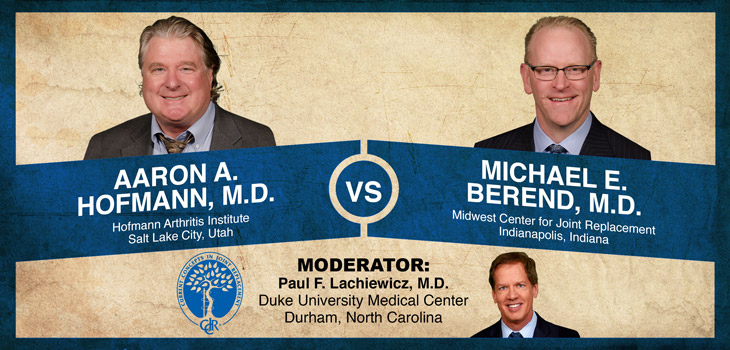
This week’s Orthopaedic Crossfire® debate was part of the 35th Annual Current Concepts in Joint Replacement® (CCJR®), Winter meeting, which took place in Orlando. This week’s topic is “The Primary Modular Tibia: Regardless of Age & BMI.” For is Aaron A. Hofmann, M.D., Hofmann Arthritis Institute, Salt Lake City, Utah. Opposing is Michael E. Berend, M.D., Midwest Center for Joint Replacement, Indianapolis, Indiana. Moderating is Paul F. Lachiewicz, M.D., Duke University Medical Center, Durham, North Carolina.
The Primary Modular Tibia: Regardless of Age & BMI
10 min read Premium comments
Great Debates#aaronhofmann#michaelberend#primarymodulartibia
Dr. Hofmann: I do have a major conflict of interest: I use some all-poly tibias. That’s a confession of sins to start with.
As I’ve gotten older, I’ve learned to never say “never’” or “always” in orthopedics. There is a place for everything, but I primarily use modular tibias. Interesting that we refer back to Dr. Ranawat so often. He taught us so much and he proposed that we use the all-poly tibia in elderly patients weighing 180 pounds or less. I looked at my schedule—I couldn’t find any of those. There’s a place for all-poly tibias, but not very often.
Here’s the basic problem with all-poly tibias, load transfer to the tibia and the bending loads that affect the fixation or the bone underneath (Reilly, 1982).
Certainly not having modularity has some problems. In a case, a patient fell off the toilet and ruptured the medial collateral ligament. I couldn’t just pop in a more constrained all-poly insert. So, this patient went back for a repair and actually turned out well. You really tie your hands…at least one hand…behind your back if you’re using all-poly tibias all the time.
They certainly can take out more bone. Sometimes that’s a good thing. In an infected case, that was a great place for an all-poly tibia, but not in our standard patients. One patient that I’ve been watching for the last couple of years who refuses to have a revision. He’s worn out the poly on his monoblock tibia. I don’t really know what to do with this patient. It would have been so simple if he had a modular tibia to revise.
Metal-backed tibias definitely equal versatility for bone defects, for convenience, for poly exchange, the obese patient. It protects the bone better. Tibial insert-tray modularity was introduced in the 1980s. Isolated exchange can be done. And as you get older, I realize almost every week I’m doing a poly exchange on a patient of mine that’s anywhere from 20 to 30 years out—and they do wear out. They’re poly and I don’t have to revise everything on these elderly patients.
Isolated exchange did not have a good track record, but that’s because the polyethylene was radiated in air and that is a problem. We certainly have better poly. We have better locking mechanisms. So, using crosslinked poly is important. I think that might be the answer long-term rather than throwing out the baby with the bath water.
Not all locking mechanisms are the same. I like to use either a more robust, or even one with a screw. I took one out at 25 years and the screw held. You could still read the words on the backside of the polyethylene, indicating that the poly is not moving and that locking mechanism is working.
Modularity equals versatility. I’d like to stick with that most of the time.
An 85-year-old patient I had 22 years later, fell off the sidewalk and ruptured her PCL [posterior cruciate ligament]. We simply exchanged to an ultracongruent insert…that was a simple operation, 20-minute operation for that patient where it would have been a major operation if we had to revise everything. So, I like ultra-congruent inserts in those cases of PCL deficiency. You can add spacers to metal-backed tibias. You can add stems in the case of hardware removal or old tibial fractures. You can use the same tibial components for revision.
I like new stuff. I like my old 1952 tractor…that’s the first tractor my father ever bought…but I like my Kubota that has a front-end loader and a backhoe and has all bells and all the whistles. I also like my wife’s Mercedes. I like this 1957 Chevy that I saw in Cuba, but I prefer the new over the old. Let’s make orthopedics stay great by sticking with the modular tibia.
Dr. Berend: I think if you used one-piece implants, you wouldn’t have to change the polys every week. I think there is a lot of agreement as to how we approach arthroplasty, but I would also say that you don’t need modularity in every case. Use it when you need it. If you want to eliminate poly wear, I think there is excellent long-term evidence of how to do that.
I agree modularity is clearly the Gold Standard. I would pose the question, ‘do the advantages of modularity outweigh long-term concerns over poly wear?’ We learned a lot from the uncemented phase of things—as to how polymer wears in a knee arthroplasty. The important question is: ‘What role do age and BMI {body mass index} play in selection of the implant?’
We’ve learned a lot about ways to potentially reduce polyethylene wear in knee arthroplasty. Improving the locking mechanism has certainly brought that forward. Perhaps we change the femoral material. We introduce more mobility with a mobile-bearing type device. We change crosslinking or add things to the poly. I think a non-modular implant with long-term data such as the AGC and IB1. Different compression molding techniques have really been the hallmark of reducing the poly wear in knee arthroplasty.
So, if you want to eliminate poly wear, a one-piece implant will do that for you.
So, I would propose using modularity when you need it, but not always. And I’d say in two-thirds of our cases we can use a one-piece implant.
These are the 3 general conditions when I use modularity:
- The first is if you want to change the articular congruity with an anterior stabilized or “dished” or ultra-congruent implant. I think it’s an excellent option if your flexion laxity is a little bit greater than your extension, then you don’t want to mess with the bone cuts, you can add an ultra-congruent type device. If you want to get into 1mm increments for balancing the gaps, I think we use modularity in those cases with the 11 or 13 implants. If you want to use a PS or perhaps you have iatrogenic imperfecta and you might need the little bit more stabilization of a PS+ type implant, we’ll use modularity.
- And then as Aaron pointed out, stems, augments are sort of the rare primary case where you need something else.
- Or perhaps in the very young, we still use one-piece implants, but if you want some other type of polyethylene option, modularity works.
Our premise is: we use one-piece implants with modular capabilities. And I would say, “What are the results of this workflow?” So, we’ve done this for a number of years.
We looked at a 10-year period. We’d done roughly 10,000 knee arthroplasties of all flavors. The indications for selecting one-piece versus modular implants were based on the surgeon’s selection. We found a sub-cohort of 2,000 knees with the same articulation, with two different designs. One was modular and one was a one-piece that had the ability to remove the polyethylene later if need be. Roughly half of them were the one-piece implant. It’s a cemented cobalt-chromium tray, standard demographics for almost all series.
If you look at reoperation for the modular prosthesis, 0.6% required a reoperation at mid-term follow-up. Two of these were for infection; 4 were aseptic (Kaplan Meier Survivorship; p=0.76. Wilcoxon test). There was no difference in survivorship between the one-piece implants at early follow-up compared to the non-modular implants.
Same reoperation rates for the monobloc—4 infections; 4 aseptic revisions. And this type of implant is one-piece when implanted and you can remove the device if you need to change the polyethylene.
I, like Aaron, have started to use the all-polyethylene implants. I think it is a price performer. For some patients, the geometry is better. It does remove a little bit more bone. We unfortunately had a very bad track record with the AGC all polyethylene implant, so we were hesitant to do this. But we began to dabble in this again. We only do it in skinny folks.
Looking at our non-modular implants, the metal-backed AGC and the one-piece all-poly AGC…unfortunately we had catastrophic 10-year failure rates of over 30% (Faris, et al., JBJS, 2003). The majority of these were due to mechanical loosening and medial collapse, as Aaron showed. We’ve studied this extensively in our laboratory with varus malalignment and osseous remodeling under the medial plateau. I think you have to be careful with implant design, high BMI, and varus alignment of the limb (Small, Berend, et al., JOA, 2011).
We’ve studied it computationally and the metal backing underneath the tray distributes the load in the proximal tibia better and I think can eliminate this type of medial overload process (Tokunaga, Small, Berend, et al., J Biomech Eng, 2016).
If you look at surgical technique and BMI, I think those are far more important than modularity in the arthroplasty. Tibial component alignment is the first thing – we need to put them in straight. We found in our series of failed tibias, the average varus alignment of the implant was over 3 degrees. And then the same thing for overall limb alignment. With a one-piece implant, especially all-polyethylene, I think you have to avoid varus (Berend, et al., CORR, 2004).
When considering BMI, this is about 10 years’ worth of work, and it was the first time that we showed the linkage of varus malalignment and high BMI (Berend, et al., CORR, 2004). So, I think in high BMI people, whether you use modular or one-piece, it’s critical to get it in straight.
Finally, the long-term data from the Mayo Clinic…if you look at patient and implant factors, they concluded looking at their entire series, the most predictable long-term durability of an implant is a non-modular, metal-back implant, cemented, all-poly patellar component. And, of course, to Paul, retention of the PCL (Rand, et al., JBJS, 2003).
Dr. Lachiewicz: I have some questions for both of you. The first topic that I would like to discuss is infection, which is the biggest problem, I think, after total knee arthroplasty. The beauty of the modular tibia, Aaron, is that you can remove it to do a debridement and replace that part. Do you think that’s something you have going for you? Do you always take that poly out in an infection?
Dr. Hofmann: Not always. I don’t think you have to take the poly out if the patient is a couple of weeks out. I think taking the poly in and out may be more soft tissue dissection, so I’m going to try to do whatever is the minimally invasive approach for that patient. Being able to take it out has some advantage, but I don’t take it out every time.
Dr. Lachiewicz: Really? Okay, Mike, do you think you can do a debridement in an acute or hematogenous infection with a monobloc tibia?
Dr. Berend: With the design where you can remove the polyethylene, we would always remove it if you have the one-piece with the capacity to make it modular. When we were doing AGCs and we were faced with a washout, we never changed the poly as you would suspect. I don’t have any long-term data on the efficacy of that, but it is a limitation of a one-piece design. With the all-polyethylene I think it is very easy to get that out if need be and do a one-stage and glue in another all polyethylene. We’ve started to do that as well.
Dr. Hofmann: Certainly with the all-poly you don’t have an interface to wash. There’s an advantage to having a one piece and I’m supposed to be on the other side.
Dr. Lachiewicz: Can you put a stem extension on your monobloc tibia?
Dr. Berend: No, sir. Any time you think you need a stem extension—defect, high BMI patient—or you feel like the bone quality isn’t right, some screws and cement, large medial or lateral defects, if we use a stem we have to use modular designs. We have to have both designs on the shelf.
Dr. Lachiewicz: And you said 60% monobloc; 40% modular, is that right?
Dr. Berend: Yes and I would do 100% if we had the capacity to have all the articulation changes in the 1mm increments or a stem-able type design.
Dr. Lachiewicz: One last question for each of you. Aaron, what percent do you do uncemented total knees now?
Dr. Hofmann: It’s probably approaching 20-30%. I’m getting back into my cementless mode. Obviously if you’re a cementless guy, which I am for the younger patient—younger than 65—cementless is on my mind. For the older patient, cemented is on my mind. All-poly tibias are on my mind in that same patient population.
Dr. Lachiewicz: And Mike, do you feel there’s any role in the future for cementless tibias?
Dr. Berend: I have a huge experience with uncemented knees…I’ve done 4 in the last 20 years (laughter). They’ve all been great, so that’s 100%. I think, for me, if I can have an implant that had the best polyethylene, was non-modular, had all the articulation choices, and was uncemented, that would be the implant that I would choose. That currently hasn’t been available yet.
Dr. Lachiewicz: Thank you very much.
Please visit www.CCJR.com for details and to register for the 2020 CCJR Winter Meeting, 9 – 12 December in Orlando, Florida.
React:
Discussion
This is a fascinating development. In my practice we've seen similar outcomes with the revised protocol. The key differentiator seems to be patient selection criteria. Has anyone else noticed the correlation with BMI thresholds?
Great point. I'd push back slightly on the conclusion, the sample size in the cited study is too small to draw population-level inferences. That said, the directional signal is compelling and worth a larger RCT.
We implemented a similar approach last year. Early results are promising but we're still gathering 12-month follow-up data. Happy to share our protocol if anyone is interested.
Join the conversation
Orthopedic professionals are discussing this. Sign in and upgrade to read every comment and add your voice.