
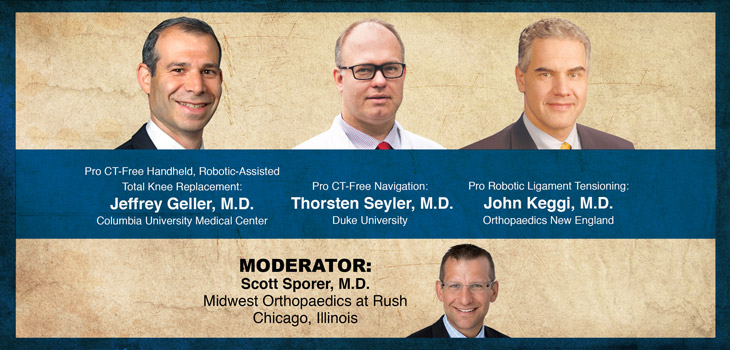
At the last Orthopaedic Summit: Evolving Technologies (OSET), a panel of orthopedic surgeons tackled the case of a 61-year-old stockbroker, now for her first total knee replacement—knows all the investments & technology. In this panel, moderated by Scott Sporer, M.D., seven different surgeons offered their take on the answer. Here are the final three.
Seven Surgeons Tackle a 61-Year-Old Stockbroker’s First Total Knee – Part II
8 min read Premium comments
#totalkneereplacementGreat Debates#evolvingtechnologies#orthopaedicsummit
Handheld, Robotic-Assisted Total Knee Replacement
Dr. Geller: What represents a successful total knee surgery? A customized total knee. Expectations are vastly different between various patient populations. Someone who is more active clearly has higher expectations and you must be mindful of that.
Robotics combine the best of all worlds. Modern robotic technology has improved workflow, reduced OR time, and substantially reduced cost.
As for imaging, I have chosen the route of no CT scan. Why? Because the radiation emitted from a CT scan is up to ten millisieverts.
The basic surgical steps of a reconstruction using this system is imageless. Once your arrays are positioned, you start building the leg from the bottom up. Then you take the leg through a range of motion to establish the center of rotation of your femoral head, which allows you to build your mechanical axis without a CT scan. Once you’ve done that with your probe, you paint the edge of the bone, thus giving you an internal CT scan. This maneuver allows you to obtain the surface anatomy without any other imaging, i.e., no radiation. It is wonderful!
In terms of surgical planning, once you’ve built your knee and you’ve built your anatomy in the system, you can now take the knee through your planning process.
The system will size out your implants and you can adjust it based on the anatomy. Once you have a virtual reconstruction of the knee, you take the knee through a range of motion with both a varus and a valgus stress. This step allows you to build a soft tissue envelope around the knee.
I now am confident of both measured resection and gap balancing. We get better patient satisfaction because I think through doing the procedures both ways. This CT-free handheld robotic assisted total knee replacement is fundamentally just a combination of both great techniques.
We now complete a distal femoral resection, which is validated quickly and efficiently using a plane checker. This then allows me to place my distal femoral five-in-one cutting block. This offers me some degree of control…and if something doesn’t look good, then I can just change it.
I now tweak my implants in order to allow improved gap balancing in the sequence of a measured resection type of technique.
What does all this mean? I can dial-in my implants, customized for this patient, keep my balancing as optimal as possible and reduce the number of necessary soft tissue releases. If I need to do fewer soft tissue releases, the patient benefits: there is less tissue trauma, less variability and ultimately less long-term instability.
Once I have my tibial cutting guide cut, I check my resection for accuracy and then place my tibial trials. Once we’ve got that all put back together, I check the knee for my soft tissue balance. I use a posterior stabilizing; posterior cruciate sustaining type of knee and I cement everything into place.
A summary screen shows me the pre and postoperative plan resection. We conducted a retrospective study where we determined that the time of surgery and the estimated blood loss is much better using this system. We found pain, function, and range of motion significantly improved at one year. In conclusion, I think robotic CT-free handheld is safe—and it’s the way of the future.
Pro CT-Free Navigation
Dr. Seyler: What factors do we need to consider for a great total knee procedure? There are three: alignment, femoral rotation, and balanced gaps.
Neutral mechanical alignment after total knee surgery—the central principle of this procedure—becomes even more important if you use a cementless design. Without cement, you must balance the load across the tibial-bearing surface and promote durability by sharing the load between the medial and lateral compartments.
The optimal range for alignment is between 2.4 and 7.6 degrees of valgus. If you’re outside that range, you have a much higher rate of failure.
If your tibial component is more than three degrees of varus and if your BMI [body mass index] is greater than 33, then you have a whopping 168x higher failure rate. Because alignment is crucial, a navigated total knee offers significant improvement in prosthesis alignment. So, listen up!
Balanced gaps mean they have to be rectangular and equal, which can be achieved either through bony resection or soft tissue releases. There are multiple gadgets to achieve these gaps.
We all have these gap balancers…and the sensors. So why do you need a balanced knee when you stand or sit on a toilet? Everything we do was at zero degrees and ninety degrees. You don’t need a balanced knee when you sit on the toilet.
Computer navigated knees provide a significantly lower rate of revision for aseptic loosening—a straightforward and undeniable benefit.
My basic setup is a computer with a touch screen and an infrared camera. The tracking arrays morph your model and start your navigating. I avoid CT both in order to eliminate radiation exposure, but also because I don’t want to wait for a CT scan to be finished. As for my registration, my femoral trac is typically inside the wound and the tibial trac is outside.
This system allows you to balance the knee across the entire spectrum. You can see leg alignment and predicted stability curves after implantation. Also visible are your flexion and extension gaps.
This software provides you with the flexion gap and extension gap, which has to be rectangular and equal, medially and laterally.
It’s a matter of philosophy. How do you accomplish your goal? You can do soft tissue. You can do bony resections. All systems are going to pick up on one way to adjust versus the other.
By using CT-free navigation you can balance your knee past a 0-90 degree line. You go through a full range of motion, which helps with mid-flexion and stability. And you can combine this with measured resection, a balanced gaps technique, or kinematic alignment. Again, I prefer balance over a full range of motion.
An added benefit of navigation is less blood loss. Prospective randomized studies, multiple studies show that there are fewer emboli with navigation.
The average learning curve for the navigation system ranges between 30 and 50 cases. Even past 100 knees, you’re going to see an improvement in your outcomes. So, remember, navigation is not time neutral. While navigation adds about eight to ten minutes to a case, it is probably offset by the elevation in patient satisfaction.
Navigation is going to lead to improved accuracy and alignment compared to the conventional technique. Registration is easy and leads to a reduced revision rate.
In addition, with live feedback you have a valuable training tool. You can see what a soft tissue release does to the gaps before cutting the bone. And should the need arise, you will have a report uploaded into your system—thus providing documentation for a legal defense.
Navigation reduces blood loss with fewer emboli and fewer cardiac complications. And using image-free navigation streamlines everything: it eliminates the hassle of getting authorization for the CT scan, the extra cost, and the radiation exposure. Bottom line…you need to try my method for your total knees.
Pro Robotic Ligament Tensioning
Dr. Keggi: Everything you just heard misses the mark…so, listen up!
We should discuss pressure measurements, which are very dependent on how you hold the limb. When you measure gaps with a known pressure applied internally, the results are very consistent.
Our imageless, no CT, robotic-assisted, tibial-first surgical technique provides real time data through the entire range of motion. You make the precision cuts and control what you can see—and no, a robot is not doing the cutting.
What we do is a navigated tibial cut, inserting this BalanceBot, which applies a consistent internal pressure that distracts the ligaments and gives you a readout.
You can visualize the ligaments and the dynamic function of the knee after you’ve exposed the knee.
If you’ve morphed the knee or used a CT scan, that changes before you change the joint with a cut in the bone.
Using my approach, you change the joint and obtain a whole range of motion with a known, consistent, internal pressure applied. You get graphs similar to what Thorsten showed you, but my technique is much more valuable.
Next, you move to femoral planning. You can modify your femoral component in real time and adjust your gaps in flexion and extension. You get a predictive curve that gives you a readout of what you can expect in your final result. You then apply this bone-fixed robot—a cutting guide—making the cuts and visualizing them at the same time. You put on your femoral component and you re-measure. Now you are done, plain and simple.
Mid-flexion laxity is real. The Apex knee, which we use in this system, demonstrates the best results in the Australian registry of 2018. In fact, we have achieved within one millimeter of balance between flexion and extension in 90% of cases. That is amazing!
With the BalanceBot, about one-third of patients require some release with a tibia first technique. That compares very favorably to 50% of patients who require release with the femur first technique versus about two-thirds of patients who require release with other systems. Looking at the BalanceBot tibia first, those patients also have a one-point higher UCLA score when you do tibia first technique.
My colleagues would like you to spend money not only on purchasing a robot, but on the maintenance contracts as well. Some of my colleagues want you to radiate yourself and your patients…and most of my colleagues have incomplete data. But wait…there is more. With some of the other devices, you lose sight of the sawblade. Some devices will give you carpal tunnel syndrome. And the best news? Some of them will even make you go deaf.
In summary, this system features no preoperative imaging, consistent internal force, and visualization of the full range of motion for ligament balance. It is fully integrated into your planning and is not a separate system where you have to manually input information. This is virtual planning before you make your femoral cuts—and precision cutting that is under your control and involves fewer releases and better outcomes. So, what are you going to do?
Please visit https://orthosummit.com/ for more information on this year’s upcoming 10th Anniversary Orthopedic Summit 2020 event on December 8-12, 2020 at the Bellagio in Las Vegas, Nevada.
Author
React:
Discussion
This is a fascinating development. In my practice we've seen similar outcomes with the revised protocol. The key differentiator seems to be patient selection criteria. Has anyone else noticed the correlation with BMI thresholds?
Great point. I'd push back slightly on the conclusion, the sample size in the cited study is too small to draw population-level inferences. That said, the directional signal is compelling and worth a larger RCT.
We implemented a similar approach last year. Early results are promising but we're still gathering 12-month follow-up data. Happy to share our protocol if anyone is interested.
Join the conversation
Orthopedic professionals are discussing this. Sign in and upgrade to read every comment and add your voice.