
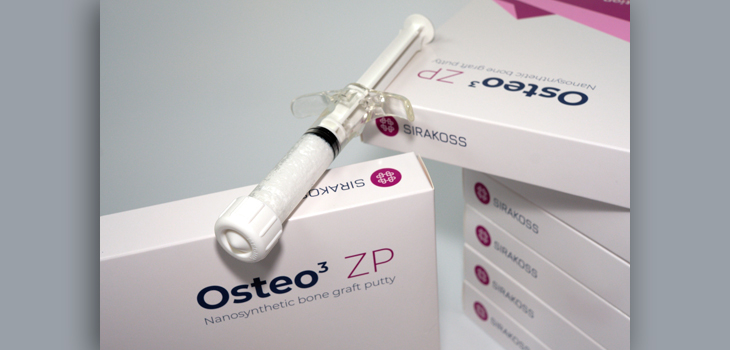
UK-based Sirakoss Ltd, has received FDA 510(k) clearance for its nanosynthetic bone graft substitute, Osteo3 ZP Putty. Synthetic bone grafts are used to fuse bones together during surgery or after a traumatic injury where the bone fails to heal.
Nanosynthetic Bone Graft Cleared for U.S. Market
2 min read Premium comments
#fda510kclearanceSecondary#bonegraft#sirakoss
In a June 17, 2020 announcement, the company said the putty is “an entirely synthetic, nanoporous bone graft substitute composed of novel inorganic granules suspended in a fully-synthetic resorbable carrier.” The putty was designed to “catalyse rapid and complete bone regeneration and can be used immediately, directly from the pack.”
It took the FDA about seven months to determine the putty was substantially equivalent to Apatech Ltd’s putty cleared in 2007.
Spinal Fusion and Trauma Repair
The company’s Co-Founder and Director of R&D Professor Iain Gibson said the putty has demonstrated “excellent pre-clinical performance in models of spinal fusion and trauma repair…. Being able to provide surgeons with the synthetic bone graft in a pre-packed syringe, saves time and is far easier to handle during the procedure in the operating room environment.” Gibson is a Professor of Acellular Regenerative Medicine at Aberdeen University.
Osteo3 ZP Putty
FDA documents state Osteo3 ZP Putty is indicated for filling bone voids or defects of the skeletal system (i.e., the extremities, pelvis, and posterolateral spine) “that are not intrinsic to the stability of the bony structure.” The putty is “resorbed and replaced with bone during the healing process. Osteo3 ZP Putty must be used with morselized autograft bone at a ratio of 1:1 by volume in the posterolateral spine.”
The FDA product description describes the putty as an “osteoconductive, resorbable, porous, 100% nanosynthetic calcium phosphate” bone void filler, containing 5.8 wt% silicon-substituted calcium phosphate granules suspended in a resorbable polymer gel.” The final, finished Osteo3 ZP Putty is “30 wt% granules and 70 wt% polymer gel. The high surface area porous granules have been designed to deliver consistent and rapid bone ingrowth, remodeling and cell-mediated resorption during the bone healing process.
“The aqueous polymer gel phase binds the highly porous granules into a moldable, pliable formulation which enables Osteo3 ZP Putty to be implanted directly from the packaging without any further gelation, mixing or graft setting time.”
The products is provided sterile to the end user in 5 cc and 10 cc sizes and, as stated in the FDA documents, can be used immediately, directly from the pack.
The company’s Director Tom Buckland said the clearance enables the company to implement the commercial strategy for “this game-changing product.”
Sirakoss Ltd
The company was spun out of the University of Aberdeen in 2011 based on the research of Professor Gibson and is supported through financing from Epidarex Capital and Scottish Investment Bank, the investment arm of Scottish Enterprise together with grant funding from Innovate UK.
Author
React:
Discussion
This is a fascinating development. In my practice we've seen similar outcomes with the revised protocol. The key differentiator seems to be patient selection criteria. Has anyone else noticed the correlation with BMI thresholds?
Great point. I'd push back slightly on the conclusion, the sample size in the cited study is too small to draw population-level inferences. That said, the directional signal is compelling and worth a larger RCT.
We implemented a similar approach last year. Early results are promising but we're still gathering 12-month follow-up data. Happy to share our protocol if anyone is interested.
Join the conversation
Orthopedic professionals are discussing this. Sign in and upgrade to read every comment and add your voice.