
Bordeaux, France-based Implanet announced on June 9, 2020 that the company has received extended CE marking from European regulatory authorities for its entire range of Madison knee system for four more years.
Implanet Receives Extended CE Mark for Knee System
2 min read Premium comments
#totalkneereplacementSecondary#implanet#cemark
The company stated the extension will allow the company to obtain clearance “more comfortably” for its product ranges under the new European MDR (Medical Device Regulation) by 2024.
On May 18, 2020, the company announced was in exclusive negotiation with an unnamed entity to sell the Madison platform. In making the CE mark announcement, Implanet CEO, Ludovic Lastennet said the company was still involved in the negotiations to sell the knee system to an unidentified party.
The company received FDA 510(k) clearance for the knee system in October 2019.
Indications
According to the FDA document, the Madison knee system is intended for total knee replacement. The components are for, “use in total knee arthroplasty to relieve pain and restore knee functions for indications such as: painful, disabling joint disease of the knee resulting from degenerative arthritis, rheumatoid arthritis or post-traumatic arthritis, and revision of previous unsuccessful knee replacement or other procedure. These components are indicated for cemented fixation only.”
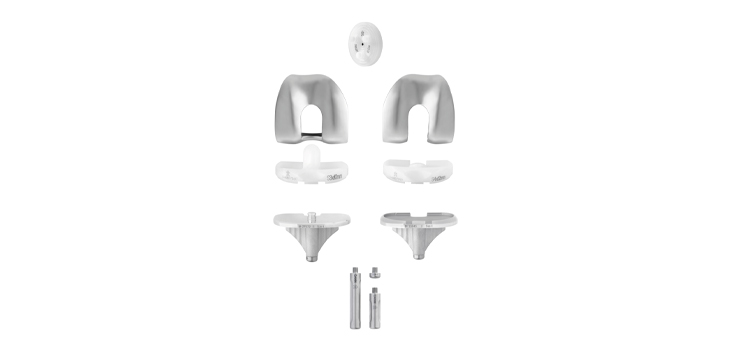
The modular knee system consists of a femoral component, tibial insert, tibial baseplate, tibial stem extensions, and a patella. “The system components are designed to be Cruciate-Retaining and Ultra-Congruent.”
The femoral component and tibial baseplate are manufactured from cobalt chrome and are to be implanted with cement. The tibial stem extensions are manufactured from titanium alloy, and the tibial insert and patella components are manufactured from UHMWPE (ultra-high molecular weight polyethylene). All implant components are provided sterile.
For Sale
While no announcements have been made about the unknown party in negotiations for the knee system, the October 2019 company press release announcing the FDA clearances stated that this is “the first step towards targeted clearance of complete Total Knee Replacement (TKR) range. Robust clinical results, including data collected over 7 years and 17,000 implants, supported the clearance.”
With those 17,000 implants, Lastennet said, “We have demonstrated the clinical value of our products. This clearance is fully in line with the strategic development of our partnership with KICo that aims to target, for Implanet’s knee division, the high-potential markets of Australia and the United States through KICo’s Florida-based subsidiary.”
Lastennet concluded, “Our next objective is to accelerate our growth and devote ourselves 100% to the treatment of spinal disorders to establish our positioning as a powerful player in this sector, both in France and abroad.”
Author
React:
Discussion
This is a fascinating development. In my practice we've seen similar outcomes with the revised protocol. The key differentiator seems to be patient selection criteria. Has anyone else noticed the correlation with BMI thresholds?
Great point. I'd push back slightly on the conclusion, the sample size in the cited study is too small to draw population-level inferences. That said, the directional signal is compelling and worth a larger RCT.
We implemented a similar approach last year. Early results are promising but we're still gathering 12-month follow-up data. Happy to share our protocol if anyone is interested.
Join the conversation
Orthopedic professionals are discussing this. Sign in and upgrade to read every comment and add your voice.