
Disc herniation is a common cause of stenosis and the back and limb pain that it leads to. It occurs when disc nuclear material pushes through a tear in the annulus. Lumbar discectomy is a common procedure used to remove the disc material that is pressing on nerves or the spinal cord. But reherniation is the most common failure mode for these procedures due to the weakened state of the disc annulus.
Evidence Builds for Annular Closure Device, Barricaid
2 min read Premium comments
#barricaid#intrinsictherapeuticsSecondary#discectomy
A study published in April 2020 in the journal Expert Review of Medical Devices (“Expert review with meta-analysis of randomized and nonrandomized controlled studies of Barricaid annular closure in patients at high risk for lumbar disc reherniation”) found that symptomatic reherniation rates after lumbar discectomy with Barricaid were 50% lower than lumbar discectomy without Barricaid.
The market and impact for the device is quite large, with Barricaid’s manufacturer, Intrinsic Therapeutics, estimating 400,000 total lumbar discectomy procedures performed in the U.S. annually, 120,000 of which involve a large defect, which is most likely to herniate and benefit from the use of the Barricaid Annular Closure device.
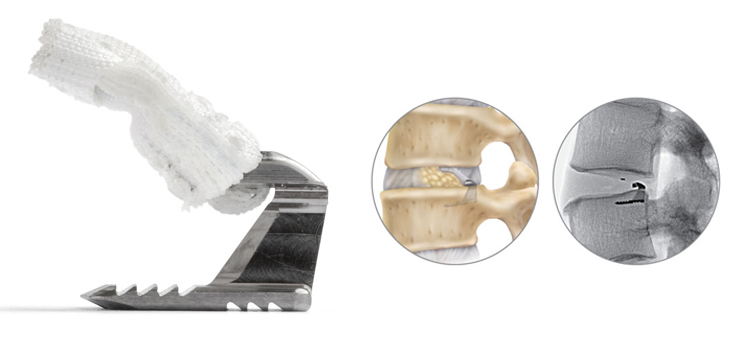
Intrinsic Therapeutics, Inc. of Woburn, Massachusetts, received FDA approval for Barricaid Annular Closure device in 2019. The device consists of a metallic anchor connected to a polyester plug that the company refers to as the occlusion component. The anchor is affixed to the vertebral body closest to the annular defect and the occlusion component is inserted into the defect. The device is designed to withstand up to 330psi, which allows for normal anatomical movement.
More big news for the company came earlier in 2020. The Centers for Medicare and Medicaid Services (CMS) listed a new billing code for annular closure (C9757) for which the Barricaid Annular Closure device is the only one that is FDA-approved. The new code went into effect on January 1, 2020.
Additionally, the International Journal of Spine Surgery issued guidance supporting both coding and coverage of the device. CEO and President of Intrinsic Therapeutics, Cary Hagan said in a recent press release, “We appreciate all the progress that is being made on patient access to Barricaid by leading surgeons and spine specialty societies. With more than 20 insurers now covering Barricaid, together with the support of surgeons and specialty societies, and more than 50 peer reviewed manuscripts, we are confident in our ability to continue delivering needed and cost-effective care for lumbar discectomy patients with large annular defects.”
Author
React:
Discussion
This is a fascinating development. In my practice we've seen similar outcomes with the revised protocol. The key differentiator seems to be patient selection criteria. Has anyone else noticed the correlation with BMI thresholds?
Great point. I'd push back slightly on the conclusion, the sample size in the cited study is too small to draw population-level inferences. That said, the directional signal is compelling and worth a larger RCT.
We implemented a similar approach last year. Early results are promising but we're still gathering 12-month follow-up data. Happy to share our protocol if anyone is interested.
Join the conversation
Orthopedic professionals are discussing this. Sign in and upgrade to read every comment and add your voice.