
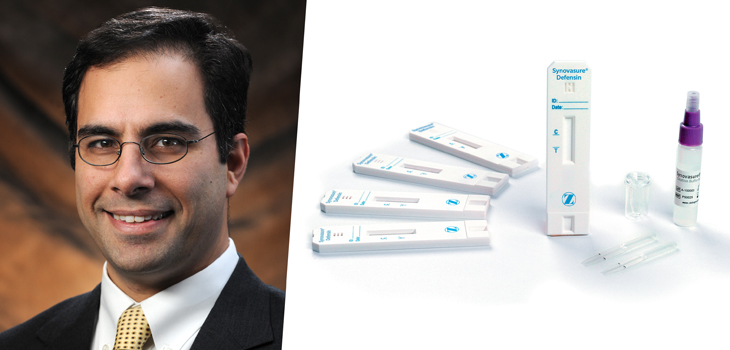
Carl Deirmengian, M.D. is the winner of the 2020 Kappa Delta Elizabeth Winston Lanier Award from the American Academy of Orthopaedic Surgeons (AAOS). Dr. Deirmengian, an orthopedic surgeon and associate professor of orthopedic surgery at Rothman Orthopaedic Institute in Philadelphia, received this honor for his work on synovial fluid biomarkers and the first FDA-Authorized diagnostic test for use in orthopedics.
AAOS Recognizes Carl Deirmengian’s Ground Breaking Research
9 min read Premium comments
#rothmanorthopaedics#periprostheticjointinfectionSecondary#carldeirmengian
After 15 years of synovial fluid research, Dr. Deirmengian created the Alpha-defensin Lateral Flow Test, which aids in the detection of periprosthetic joint infection (PJI) and may help avoid unnecessary joint revision surgeries. As he moved from Harvard Medical School to residency at the University of Pennsylvania then to a fellowship at Rush University, all along Carl Deirmengian was leaping over obstacles or finding ways around them.
And while he never had a chance to sit at the feet of the ancient stoics, Dr. Deirmengian surely took to heart several of their maxims. In the words of Marcus Aurelius, “The impediment to action advances action. What stands in the way becomes the way.”
A Novel Approach to Infection Research
According to published research and AAOS[1], there are approximately 65,000 hip and knee replacement infections, costing the U.S. health care system $1.6 billion annually. And the earlier and more accurately these infections are detected, the better.
Truth be told, what culminated in the revered Kappa Delta Award began with a bit of lowly pus.
Dr. Deirmengian: “While at Harvard in 1999 I was working in a cancer lab during the time that gene arrays came out. This made it possible to take sample tissue and know which exact genes were turned on and to what degree. I was a bit of an enigma because few people in orthopedics at that time made forays into genomics. My unusual approach to research involved collecting pus from a joint—one of the purest things in the body—and putting it on a gene chip.”
And why pus? “It is very pure because it is full of neutrophils and little else. My initial thought was that I would take the fluid and put it on a gene chip, hoping that I would see a difference in patients who get infected and those who do not. At that time, diagnosting infection was an enormous challenge in the field. Even if an infection is present, sometimes the sample doesn’t grow bacteria. I tried to pursue this line of research academically during residency at the University of Pennsylvania, but the lab was not focused on PJI diagnostics at that time.”
Finding a Champion and a Lab
To find an alternative route for research in residency,Dr. Deirmengian made a cold call that set the stage for his PJI work. “I dropped in on Dr. Bob Booth and described my project and in a stroke of luck he was working on infection with polymerase chain reaction (PCR). After 10 minutes of listening to my ideas, Dr. Booth pulled out his check book and handed me $10,000, saying, ‘I don’t want anything in return. Just do your work.’”
But the work would be challenging without a lab.
“Dr. Joe Bernstein at Penn was one of my mentors. When I told him that I had no lab, he contacted a friend at Children’s Hospital of Philadelphia (CHOP) who was interested and adopted me as a lab member. At this point, my second year at Penn, I was able to get IRB [Institutional Review Board] approval for my research. I had two years’ worth of samples from patients with infections. Armed with a pager, I would run to collect samples when any of my surgical peers detected an infection. My first study only had 12 people—7 with infection and 5 with aseptic inflammation.”
Although small, this 2005 study, partially funded by a grant from the Orthopaedic Research and Education Foundation (OREF), was the inception of the idea to find infection biomarkers in synovial fluid. But first, Dr. Deirmengian had to collected enough synovial fluid samples to test the RNA and a lab to measure the genetic data.
“RNA is not stable and degrades rather quickly, so I had to find a way to more efficiently collect fluid samples to be processed at a later date. I was scrambling for a way to preserve RNA and soon came upon RNAlater, a stabilizing solution that you add to the sample to make it last. So if a friend called from the ER at 9pm with a potential sample, I could run over there, collect it, and then run to the CHOP lab to spin it down, add the RNAlater and put it in the freezer, then batch process the samples later.”
“I found a specialty lab that provided chip array processing as a service and used my grant money to pay the gene chip lab to do that part of the research; basically research for contract. But imagine the conundrum when I received all that genetic data and had no idea how to formally interpret the data for publication. So I found a genomic informatics center in Glasgow, England, and used their service to formally analyze the data, again an example of research for contract.”
“We found that neutrophil genetic program is unique when an infection is present. We were the first to determine in humans that neutrophils are tailoring their response to the diagnosis, and had a signature expression response.”
Presenting the Groundbreaking Data
“With support from Dr. Booth, I was invited to talk to The Knee Society and since the topic was so new they allowed me to present in their private meeting. I explained how I was able to know what genes turn on when there is an infection. We ended up winning their 2005 Coventry Award at the meeting that year, and I received kind words from another mentor, Dr. Arlen Hanssen at the Mayo Clinic, who encouraged me to continue the research.”
Eventually, the gene chip was no longer needed but it got Dr. Deirmengian and his team where they needed to be. “It showed us what the neutrophils were doing in an infected joint and how we can use that information to diagnose infection.”
Next Dr. Deirmengian was off to Rush University Medical Center in Chicago for fellowship, where he continued to collect clinical samples, mentored by Drs. Joshua Jacobs and Nadim Hallab. “During that year I was able to conduct a small study with 51 samples. Using more grant funds, my co-authors at Rush and I sent the samples to a Minnesota Laboratory that specialized in multiplex biomarker analysis. These results, published in Clinical Orthopaedics and Related Research, were the first time that synovial fluid biomarkers were advanced as a potential diagnosis for periproisthetic joint infection.”
Pivoting to Commercialization
After completing that first biomarker study Carl Deirmengian tried to turn his professional progeny into a viable commercial entity. “I really struggled with how to turn a research project into a clinical diagnostic test. I accepted a surgical position with Dr. Booth and for several years I made no progress in this area. I had a broad patent to diagnose infection and one day a former Zimmer employee, Michael Behr, contacted me and said that he had been following my work. He came on board as the first CEO and helped me start CD Diagnostics, providing critically-needed early momentum.”
“The Lankenau Institute for Medical Research, an incubator in suburban Philadelphia, offered us lab space. Mike Behr realized that we needed more financing, so we did a seed round of funding where my mentors and friends participated.”
“Mike skillfully realized that a CEO with diagnostics experience was needed, and then reached out to a potential CEO, Rick Birkmeyer, a seasoned entrepreneur with a Ph.D. in biochemistry and immunology. Rick had officially retired and initially declined our offer. Then he read about synovial fluid and our work and changed his mind. He immediately found us a patent attorney, corporate attorneys, and several scientists to staff our lab in the incubator.”
Then Dr. Deirmengian met Keith Kardos, Ph.D.
“Keith is internationally known for the development of the first point-of-care oral HIV test. We met and truly hit it off, to a great extent because we agreed that no matter what, the science must come first…we just wanted to get to the right answer. You could say that science and business do battle as the goal of the latter is to get the product to market quickly, whereas from a scientific perspective we wanted the time to develop the best possible test.”
Their time at Lankenau would last three years.
“We were studying 23 different proteins and could not settle on the best biomarker,” said Dr. Deirmengian. Despite an order from the top to stop learning and pick a biomarker, Keith and I said, ‘Let’s do another run,’ adding a few more biomarkers, including alpha-defensin.’ That run demonstrated alpha defensin as the best biomarker to diagnose PJI.”
Acquiring a Lab
While equipped with talent and data, the young company was still finding its wings when it came to growth. “We were a small company…and we needed substantial progress to reach the market. The solution was to partner with Zimmer Biomet, who funded us on a milestone basis and obtained a position on our board.”
Carl Deirmengian credits his CEO Dr. Birkmeyer with the genius-level next move. “Rick found a CLIA-approved [Clinical Laboratory Improvement Amendments] clinical lab in Maryland and told the two managers—who were near retirement—‘We want to acquire your lab with company equity alone. In two years if you don’t like what you see then you get your lab back, and we get our equity back.’ Pure genius. Now we could make the test available for clinical use, and widely expand our research abilities.”
Building to 1,000 Samples/Week
“We began receiving 50-80 samples a week as people began to understand what we could offer. The next step was not just to perform an alpha defensin test, but to do a complete panel. We optimized our performance of culture, white blood cell counting, crystal analysis, aspirate quality assessment, and also developed tests to identify pathogen antigen in the fluid. Over time we reached the level of processing 1,000 samples a week.”
Initially, Deirmengian’s lateral flow version of the Alpha-defensin test was somewhat controversial.
“Despite our quite comprehensive internal validation that matched the laboratory version, certain smaller European studies indicated that it may not be as sensitive. But these smaller studies did not truly reflect the accuracy of the test.”
Deirmengian and his team designed a prospective, multi-center, blinded clinical trial to evaluate the performance of their Alpha-defensin Lateral Flow Test for PJI which incorporated a disposable cartridge-type device that hospital laboratories can use to get a result in 10 minutes.
The study showed that Deirmengian’s alpha defensin lateral flow test and the laboratory test were identical in sensitivity for infection. FDA authorization of the lateral flow test came shortly thereafter. It was a first in orthopedics.
15-Year Effort Leading to AAOS’ 2020 Kappa Delta Award
“Like most physicians, I thought research was always done in an academic institution. In our case, being under a business umbrella forced us to demand academic rigor with third party oversight…which added even more quality and credibility to what we were doing.”
The great accomplishment of Dr. Deirmengian’s work is that it vastly improved the ease and accuracy of periprosthetic joint infection diagnosis. While various societies, notably the Musculoskeletal Infection Society (MSIS), International Consensus Meeting (ICM), and others, provide criteria-based scoring systems for infection research, they also require a combination of hospital tests that were not intended to diagnose joint infection. Furthermore, they weren’t specifically designed for the orthopedic community. As a result, lab-reported results often do not match the orthopedic recommendations.
Deirmengian’s Alpha-defensin Test gives the orthopedic community its own standardized test and reported in terms of diagnosing PJI.
Seneca said, “No man is more unhappy than he who never faces adversity. For he is not permitted to prove himself.”
Carl Deirmengian has proven himself and, in his own words, “Hopefully there are more tests made for orthopaedics in the future.” No doubt, Dr. Deirmengian will succeed.
[1] Kurtz SM, Lau E, Watson H, Schmier JK, Parvizi J. Economic burden of periprosthetic joint infection in the United States. The Journal of Arthroplasty 2012;27:61-5 e1.
Author
React:
Discussion
This is a fascinating development. In my practice we've seen similar outcomes with the revised protocol. The key differentiator seems to be patient selection criteria. Has anyone else noticed the correlation with BMI thresholds?
Great point. I'd push back slightly on the conclusion, the sample size in the cited study is too small to draw population-level inferences. That said, the directional signal is compelling and worth a larger RCT.
We implemented a similar approach last year. Early results are promising but we're still gathering 12-month follow-up data. Happy to share our protocol if anyone is interested.
Join the conversation
Orthopedic professionals are discussing this. Sign in and upgrade to read every comment and add your voice.